 |
Egypt - Suez Canal transit
August 1, 2007 to August 3, 2007
Saturday morning finds us back aboard DoodleBug and hard at work. We arrived late on Wednesday evening via a Charter flight that was supposed to be from London, Gatwick. The check in procedure was interminable and when we finally arrived at the desk, we were informed that the origin of the flight had been relocated to Stansted
|
airport. We further discovered that the wonderful boarding pass we had just been given, together with it's seat assignment, was actually a bus ticket and would be used for the hour and a half coach ride to Stansted. Needless to say when we finally arrived in Egypt, it was very late, dark and 94 degrees.
  |
We
just got a room at the dive hotel after checking that DoodleBug was floating
where we had left her.
On Thursday we began bringing DoodleBug back to life and ran into the first
problem. I had asked the marina folks to charge the batteries for a half day
every two weeks. It seems likely that they just plugged the battery charger in
and forgot it. The acid had boiled out of the batteries and they were now
swimming in about 4 inches of the stuff in their container. I could not tell if
the batteries still contained any
 |
residual acid but spent two hours carefully
adding liters and liters of distilled water - just in case they were
salvageable. By late afternoon I was able to get enough power to start both the
engine and generator and it was a great feeling to hear them running.
Friday morning I dived the hull to inspect the condition of the sacrificial
anodes ( disks of zinc material that are designed to corrode in stray electrical
currents BEFORE the important things such as propeller and engine corrode). I
was cognizant of the fact that the marina is a closed body of water and that the
half dozen or so dive boats that operate here do not use "holding
tanks" for their sewage. The extra organic material in the water had
created a wonderful garden hanging from the hull and it took several attempts
before I was able to scrape away enough muck to even find the anodes. Today
(Saturday) we will use scuba tanks to clean off the hull and install our last
pair of new anodes. The nearby dive shop has a wonderful shower to clean the
dilute sewage off our bodies when we are through.
On the battery front, they are working at 10 percent capacity and by the time
they had reached the 10 percent "down" level, the refrigerators had
ceased to operate and the milk and beer became warm. Since Friday was the
Sabbath in Egypt, we will find out today if we can purchase replacement
batteries in the town of Hurghada, three hours drive to the north of us.
Annette has inventoried her groceries and set off yesterday morning to a nearby
shopping center in the hotel shuttle. A tour of four ATMs failed to find one
that would dispense cash to her. This had not been a problem when we were here
last January. She returned, hot, sweaty and very disgruntled. Supper in the
hotel restaurant boosted her spirits.
The wind is blowing hard from the north and we do not yet see a weather window
for departure.
August 4, 2007
Yesterday was a major work day. This is not to say we have been idle, in fact the day before was dedicated to
 |
plumbing and bilge pump issues. Today we walked the mile
from the marina over to the Port Captain's office. We are the only vessel at the
marina and this is the second time we have shown up at the marina management
offices unannounced. Each time the offices were darkened and deserted. When we
left however, the desks were occupied and the computers turned on. I wonder if
they use "Rent-a-crowd"? Weird!
The port captain, Captain Sherif was charming and hospitable as usual and
offered us Arabic coffee. I was fairly sure that Annette had never tried this
before. He imports his own blend from Cairo and the resulting coffee was creamy,
fragrant with cardamom, and as rich as chocolate. Could be worth a two mile hike
every morning.
We checked in with the marina office although they are perfectly aware that we
have been back for two days now and made the return pilgrimage to DoodleBug
without incident. The huge marina hotel complex is supposed to
  |
be completed by
the middle of November. They allegedly have a huge financial penalty on the
builder for being late. Right now it does not seem possible that they will
complete the work on time, unless Moses and the Israelites return. Captain
Sherif indicated that they have some 260 townhouses for sale at US$3,000 per
square meter. That would make a 2500 square foot unit right around US$750,000.
We walked through the middle of this huge construction site, ignored the
security and just tried to look like potential buyers.
Back at DoodleBug we hauled out all of our scuba gear. This morning's task was
to clean the hull, clean the propeller and replace the anodes. Once the anodes
were cleaned off, they looked in much better shape than I had originally
thought. The propeller took a lot of work before it was identifiable as a
propeller. As I chipped away at the growth with a chisel, Annette found out what
it feels like to be a sucker fish in a fish tank. She cleaned off most of the
hull herself and removed a veritable forest of growth.
Next task was to replace the main mast flood-lights and the anchor-light bulb. I
had to use a dremel tool to remove the rivets holding the broken flood-light
fitting in place and just when I was finishing up, the marina
security guy showed up. While I am dangling 60 feet up the mast he tells me I
need to call "port control". from my mast-head perch I began yelling,
"Port control, oh, port control!" but that humor apparently doesn't
translate into Egyptian. I was climbing down anyway and called the control folks
on the VHF. They said the security guy had called them to see if I had
authorization to climb my own mast. I said it was a standard safety check and
they said that they had already told the security that I had received
permission. The security man was concerned for my "safety". I said,
"Good! He can catch me if I fall". This elicited a chuckle over the
radio so that attempt at humor was presumably more successful.
More fun scheduled for tomorrow. The battery saga is still in process but so far
marine batteries are unavailable on the Red Sea coast.
August 6, 2007
We are still hangin' at Port Ghalib in the Egyptian heat. We work in the mornings and late evening and siesta inside with the air-conditioning during the hottest part of the day. On Sunday I finished repairing the navigation lighting and spent two and a half hours up the main-mast. This would have been easier with five hands but as it was, at least I remembered to take up a thin line. If I discovered that I needed additional tools, I would lower a
 |
bag and Annette would
add or subtract from my bag. The process was closely supervised by a large
Osprey (type of sea eagle) that landed on the top of the Mizzen mast. He must
have roosted there for over an hour and was not bothered by either my proximity
or the fact that I was above him on the taller Main mast. Annette ran around the
dock taking lots of pictures while trying to "zoom" us both into the
viewfinder. For once, the security man had nothing to say.
Monday we re-rigged the sails, lubricated the tracks, sheaves and blocks and we
are pretty much ready to sail. The remaining item is the battery bank. In the
evening, the Dive shop manger, "Phillipe" told me that they had
located five marine batteries in Hurghada (we use nine batteries). The dealer
said he could have four more in four days time. These of course are Egyptian
days. The last time we were promised "four" days delivery it took
seven weeks. Our current plan calls for us to replace the engine starting
battery and half of the bank with "new" batteries. The other half of
the bank would be made up from the best of the original batteries. We are
looking for a weather window in which to leave and we may have something this
week-end. The wind pattern here has been to have light winds from the west
during the night and early morning. By 1000 hours the winds have swung back to
the north and blow around 20 knots. By late afternoon they begin to die down a
little and also begin to swing back to the west again. It seems that the best
approach for us will be to tack in the middle of the channel during the
strongest winds and make the most of the lighter winds at night to either sail
or motor-sail
on a more direct course.
August 7, 2007
We are now approaching the end of our "Todo" lists. The most critical item was the dinghy which would not stay inflated. We hauled it up onto the dock and using buckets of water, determined that the leak was coming from
 |
the filler
valve. By cleaning this and with the application of silicone grease on the
rubber valve diaphragm, the leak was stopped. Another bullet dodged! We can now
transport customs officials without drowning them.
Late last night a New Zealand flagged catamaran arrived. The vessel had Arabic
markings on the hull but the crew of three consisted of two New Zealanders, Will
and Vivienne, plus fellow American, Douglas. They had just
  |
sailed in from Saudi
Arabia where all three have been / are working. They spent 13 days making the
passage from Jeddah to Port Ghalib and told harrowing tales of Saudi bureaucracy
and getting permission to leave Saudi waters. Will maintained that theirs is the
first private yacht in history to ever sail from Saudi to Egypt. They we
slightly frazzled when they arrived and had a stunned expression on their faces
as they groped for beers in the hotel bar. This was after spending six hours at
the Port Ghalib clearance dock in the crushing heat and without
air-conditioning.
August 8, 2007
This
morning our five "new" batteries arrived on the dock. They had not
been charged, they are within two months of their "expiry" date and
the battery posts were a different size and position versus the old crop. The
Dive shop manager, Philippe indicated that he had a driver heading to the next
town of El Quesir to run errands. Annette was hastily dressed, loaded with
passport, ATM card, shopping bag plus a handful of Egyptian pounds, then sent
off to El Quesir in the company of three Egyptian men who did not speak English.
Philippe assured me that she would return intact.
Meanwhile, Ed had to remove the several liters of spilled acid from inside the
battery compartment; determine which four of the "old" batteries to
keep; remove five dirty, corroded, heavy batteries, still dripping in acid and
schlep them to the dockside. Finally I installed the "new" batteries
in their place. This was amazingly hot work and after showering off most of the
surplus acid and grime, I visited with Philippe, the Dive Manager, as he
performed a visual inspection of the interior of our four scuba tanks. We had
finally used up all of our stored air and I needed to have a couple of filled
bottles in case of anchor emergencies in remote locations.
Annette returned in late afternoon bearing three dozen eggs, groceries,
"nuts and washers" to fit the new batteries, some copper straps to
connect them together and CASH from the El Quesir ATM. Three different trips to
any of the local ATMs had failed to produce anything but Annette was able to
extract some 5,000 Egyptian pounds in 500 increments from the El Quesir ATM.
This totaled about 900 US dollars and enabled us to actually pay for the five
new batteries. It was a long, hot and stressful day for both of us and we were
grateful to see the new batteries charge up successfully. All we need now is a
weather window for departure.
August
9, 2007
Yesterday I charged up the four new
batteries that make up half of our 24 volt "house" bank. (The fifth
battery is separate and just used for engine and generator starting). To do this
I disconnected the other four of the existing house bank batteries. This morning
I tentatively joined all eight together and waited for the flash and bang.
Fortunately this did not happen and we now have an uneasy but working alliance
of the old and new.
After checking the weather, we made the long pilgrimage across the construction
site to visit the Port Captain's office on the opposite side of the marina
complex. He was as gracious and charming as ever and served us with his
excellent Arabic coffee. We have arranged to pick up fuel tomorrow, pay our
final bill, collect our documents and leave in the mid-afternoon.
Our scuba tanks have been refilled and our salt and sand encrusted lines reset
for easy cast off on the morrow. We are ready to go!
August 10, 2007
Our
original plan was to leave our mooring at 1230 hours, move to the refueling dock
by 1300 hours to buy diesel, pay our marina bill and receive our clearance
documents. All morning the wind howled from the north and I was beginning to
regret having "singled up" our mooring lines. We radioed to the fuel
dock to say we would be late and finally requested a marina dinghy to help us
control the bow. In the event, we did not need this assistance but it was
nevertheless comforting to know we had some emergency backup.
We eased into the fuel dock without problem and were immediately told they had
no electrical power. We would have to wait for, "maybe, one hour"
until we could get fuel.
I hauled the extra diesel jugs out of the stern locker and set them ready for
the eventual fueling, leaving Annette guarding DoodleBug, while I walked over to
the Marina offices. The marina officials were charming as
 |
ever and explained that the power was off. I already knew this and within a few minutes, the power came back on and presumably the same was true for the fueling dock. I asked the Port Captain why the fuel dock could not take credit cards for payment. He was incensed and insisted he was going to straighten this out. He grabbed his cell phone but it was not working. It was then that I noticed that none of the offices had "land-lines". Everyone relied upon cell-phones. For perhaps twenty minutes he struggled with his cell phone while I looked out of his windows and watched Annette struggling with the diesel fuel hoses over on DoodleBug in the shimmering heat.
Eventually
we determined that the credit card machine at the fuel dock was broken and was
in Cairo for repair. I finally got my marina bill and went to pay it at the
accountants office. Their credit card machine would not work. We tried multiple
cards with the accountant standing outside of his office to try to get better
reception for his "wireless" credit card machine. Nada. I trudged back
to DoodleBug to get cash. Back at DoodleBug, Annette had "fired" the
Egyptian fueling crew because of the amount they were spilling over the clean
deck and down the side of the boat and had completed the job herself. I paid for
the diesel; back to the marina offices; paid for the marina fees and we finally
left the dock at 1600 hours, motoring into 10 knot headwinds.
Annette had fixed an early supper of tuna salad and while we were enjoying this
first meal at sea, she discovered that she had broken a tooth. Fortunately she
has no pain from the tooth but it will be a major discomfort until we get
someplace with dentists other than "Painless Ahmed - Dentistry and Camel
Castrating". The broken portion of tooth is meanwhile stored safely in her
jewelry box to await arrival of the tooth fairy.
At 2000 hours we were under full sail, close hauled on the port tack and straying
just a few degrees off our desired course.
August 11, 2007
We left Port Ghalib yesterday afternoon at 1600 hours. Current position N 27 09.3' E 034 35.5' at 0353 hours UTM on 8/11/2007. Annette broke a tooth, otherwise - all well on board.
later that day.....
0100
hours. We are still on the port tack, close hauled but now with 20 to 25 knots
of wind and lots of shipping. Most vessels did not respond to VHF hails and so I
would send out a "Securite! Securite!" warning message, stating that
we were a sailing vessel under full sail and giving our position and course. I
also turned on the forward deck flood light as the tankers came within five
miles or so and the big flood light illuminates the whole Genoa. Nobody hit us
and a few vessels even called to confirm our position following our "Securite"
warning.
At 0430 hours, an orange nail clipping of the waning moon appeared in the east.
The night sky has been crystal clear and glistening with stars.
1000 hours we had drawn north of Hurghada and had reached the "top" of
the Red Sea but were too far to the East. We went to the starboard tack and
headed back west. At around noon, the wind dropped and we began to motor
directly for Endeavour harbor on Tawila Island. As we moved to the northwest, we
passed close by the west coast of Shaker Island. There is a good anchorage there
but the Island is occupied by the Egyptian military and the guide book states
that it is heavily mined. They don't like visitors.
  |
We were told at Port Ghalib that Hurghada has around 7,000 dive boats. We believe this, as the radar screen began to be filled with their echoes. We turned into Endeavour Harbor at 1600 hours with Annette taking back bearings with a hand compass on a distant navigation beacon. This was to keep us in the unmarked entrance channel and she did a magnificent job with the now 20 knot crosswind. We dropped anchor at 1630 hours at N 27 33.8 E 033 47.0 The straight line distance from Port Ghalib is 130 nautical miles.
August 12, 2007
Last night the wind howled through the rigging, gusting to 30 knots and then dropping back to 25 knots. This would have made "fun" night-time sailing in the Strait of Gubal, that guards the entrance to the Gulf of Suez. The Strait is known as a "wind acceleration zone". The wind generally blows down the axis of the Gulf, so for northbound vessels like us, it is a headwind. Then too, the current runs at 2 knots during a flood tide. The flood tide against the wind, produces sharp breaking waves in the six and a half mile wide channel. We hung at our beautiful and barren anchorage performing boat chores. Finally at 1000 hours we had run out of excuses and the wind had dropped to around 13 knots. We raised anchor and set off for Marsa Zeitya, an anchorage some 20 miles further upwind in the direction of Suez. The route we chose passed between reefs and a significant portion of the route was in "sheltered" waters.
  |
The wind rose back to the 25 to 30 knot range just after we cleared the reefs guarding our anchorage and we struggled to motor at high RPM, tucked in as close as we dared to the east edge of Gubal Island. The latter has sea cliffs dropping steeply into the sea, with "close to" depths of 100 to 200 feet. We were perhaps two boat lengths off these cliffs as we struggled northwards. As we rounded Bluff Point, we were exposed to the full effects of both wind and waves. The waves were in the 10 foot range and seemed about a boat length apart. The bow was still burying as the next wave arrived, with lots of water over the bows. Our speed dropped away to nothing, until we were able to change course and rig a tightly sheeted and reefed mainsail. Now we could make progress and it was amazing what a difference a scrap of sail can make, if you can just get an angle on the wind. We made progress up the Zeit channel by hugging the west side of Shab Ashrafi and staying in 30 feet of water, while we kept a close watch for coral patches. When we had a feasible sail angle, we sailed close hauled across open water for the anchorage at Marsa Zeitya. We dropped anchor at 1435 hours and are now anchored at N 27 49.7 E 033 34.9, just off the beach. Just a mile north of us is a small oil loading facility with a tanker being loaded at anchor. The land looks just as bleak, barren and blasted as much of this coast. There is no fresh water and the rocks are twisted and tortured volcanics, ashes and the like, overlaid with a smattering of sand. For the first time we see oil platforms and production facilities on the horizon. The oil workboats look familiar and are moored nearby. Past sailors have complained about the smell here but the wind must be blowing too strongly as we do not smell the scent of money.
August 13, 2007
Last
night the winds just kept on rising and the waves were rocking DoodleBug from
side to side. When you consider that we are just a couple of hundred yards off
the beach and pointing towards same, it does not seem possible that water can
generate waves in such a short "fetch". Well they did and were near
two foot in height when they reached DB, pushed on by the gale force winds of 35
knots. At 0200 hours this morning we decided that it would be prudent to put out
more chain on the sea-bed. The bow was rocking from side to side but there were
no witnesses to our antics in our underwear. We needed to run the engine and
motor slowly forwards in order to take the strain off the anchor chain. This
enabled us to remove the "snubber" that we had rigged. A snubber is a
length of nylon line that is attached to a cleat and acts as a shock absorber,
so that the anchor windlass does not receive the damaging effects of a jerked
chain. This device is very useful but not easily removed in strong wind
conditions. Fortunately it came free easily and we swiftly increased our anchor
chain deployed on the sea-bed from 42 meters (138 feet) to 62 meters (203 feet).
We had originally dropped the anchor in 8 meters (26 feet) of water so that is a
"scope" of nearly 8 to 1. Now we had a chance of going back to sleep!
We received a report of forecast winds of 50 knots at nearby El Gouna. Very
believable last night.
Daylight showed a sea of whitecaps to the horizon with large waves visible even
miles away. The wind continued to blow at just below gale force all day long in
our anchorage. We have read books, written e-mails and pondered the navigation
and weather forecasts to see how we break out of here. The guide book warns that
vessels are often trapped for days where are currently anchored.
The most exciting marine occurrence of the day was a supposed turtle sighting
just off our beam. Closer examination showed it to be a large black plastic
trash bag, floating just below the surface. We have seen surprisingly little
marine life. On the leg from Port Ghalib up the Red Sea we saw a couple of
dolphins and a smattering of small flying fish. Yesterday we did see a
"real" turtle about three foot across but that has been about it. Just
a few fishing boats. Lots of dive boats.
Annette has been scouring the floor lockers for canned provisions and came up
with duck gizzards that were purchased in Djibouti following a mis-translation.
She translated "canard" correctly as "duck" and quit trying
at that point. They were remarkably edible as long as you did not think too
much. They were also helped down by beverages following the discovery of an
overlooked case of Djibouti Heineken beer in the forward floor lockers.
August 14, 2007
2100
hours local time. Position N 28 35.7' E 033 11.6'
Just arrived after a looong day. Details to follow. All well on board.
later that day.....
   |
Last
night the winds blew at gale force throughout most of night. DoodleBug rocked
and bounced around until 0500 hours, when the wind subsided a little. We had
already prepared for departure and at 0715 hours the wind speed dropped to 17
knots. We hoped this was the beginning of a calm, soon had the anchor raised and
were heading across the Strait of Gubal towards the port of El Tur on the Sinai
coast. The wind rose immediately to around 30 knots as we cleared the shelter of
the land but this phenomenon had been observed by other cruisers, so we
persisted in the hope that the wind would drop to something more comfortable as
we left the coast. Naturally this did not happen and we struggled onwards in 35
knot winds, close hauled, with heavily reefed Genoa and mainsail and with waves
in the 10 to 12 feet range. The 12 footers would come in like a truck and when
they were about half a boat's length away, you could see translucent green water
at their crest. This meant you were about to get the crap slapped out of you and
there was lots of water crashing over the foredeck, rushing down the length of
the boat and finding its way through the seams in the window of the hard-dodger.
When we around the mid-point of the passage, I realized that the mainsail had
split along it leech and a strip of sail was now tearing it's way upwards. We
quickly furled the remains of this sail and rigged the mizzen in it's place,
heavily reefed. Thus we continued the 25 mile crossing, dodging freighters,
heeled at up to 30 degrees and with a scrap of Genoa plus the reefed mizzen.
When we were within 6 miles of El Tur and near the Sinai coast, the winds
finally dropped to the 25 knot range.
We anchored in the harbor at El Tur at 1140 hours, after motoring slowly through
a swarm of sailboarders. A
 |
guy on a sailboard approached us and asked us to
re-anchor another 50 meters nearer the beach. By the way he handled his
sailboard, I could tell he was not a guest. We did try to re-anchor but the
anchor would not hold and we slipped back to our original point. Our sailboarder
friend re-approached and we chatted. He asked how long we would be there and we
said it depended upon the wind conditions. He indicated that the local forecast
called for the winds to drop by around 1400 hours to the 15 knot range and stay
that way until evening.
At 1400 hours, the wind had dropped as promised and we attempted to raise anchor
and set off for Ras Sheratib, an anchorage approximately 30 miles further up the
coast. When we raised the anchor, it was fouled with old fishing nets and
centuries of garbage. Annette hung over the bow and hacked away at the mess with
a dive knife, while I attempted to miss the sailboarders. It was soon obvious
that we also had a quantity of netting around the propeller. What fun!
I rigged the dive ladder, dragged out snorkel gear and made ready to go over the
side to try and cut the mess free. DoodleBug was rolling in the swell and
drifting closer to the many reefs. I again hit the throttle to move further away
from the reefs, when the problem cleared itself. Thank goodness!
For the remainder of the afternoon we motored perhaps a hundred yards off the
beach, into a direct headwind in the range of 13 to 25 knots. The hour it had
taken us to clear the anchor and prop now meant that we would arrive at our next
possible shelter about an hour after sunset. If conditions deteriorated, we
would have little option other than to sail back to El Tur.
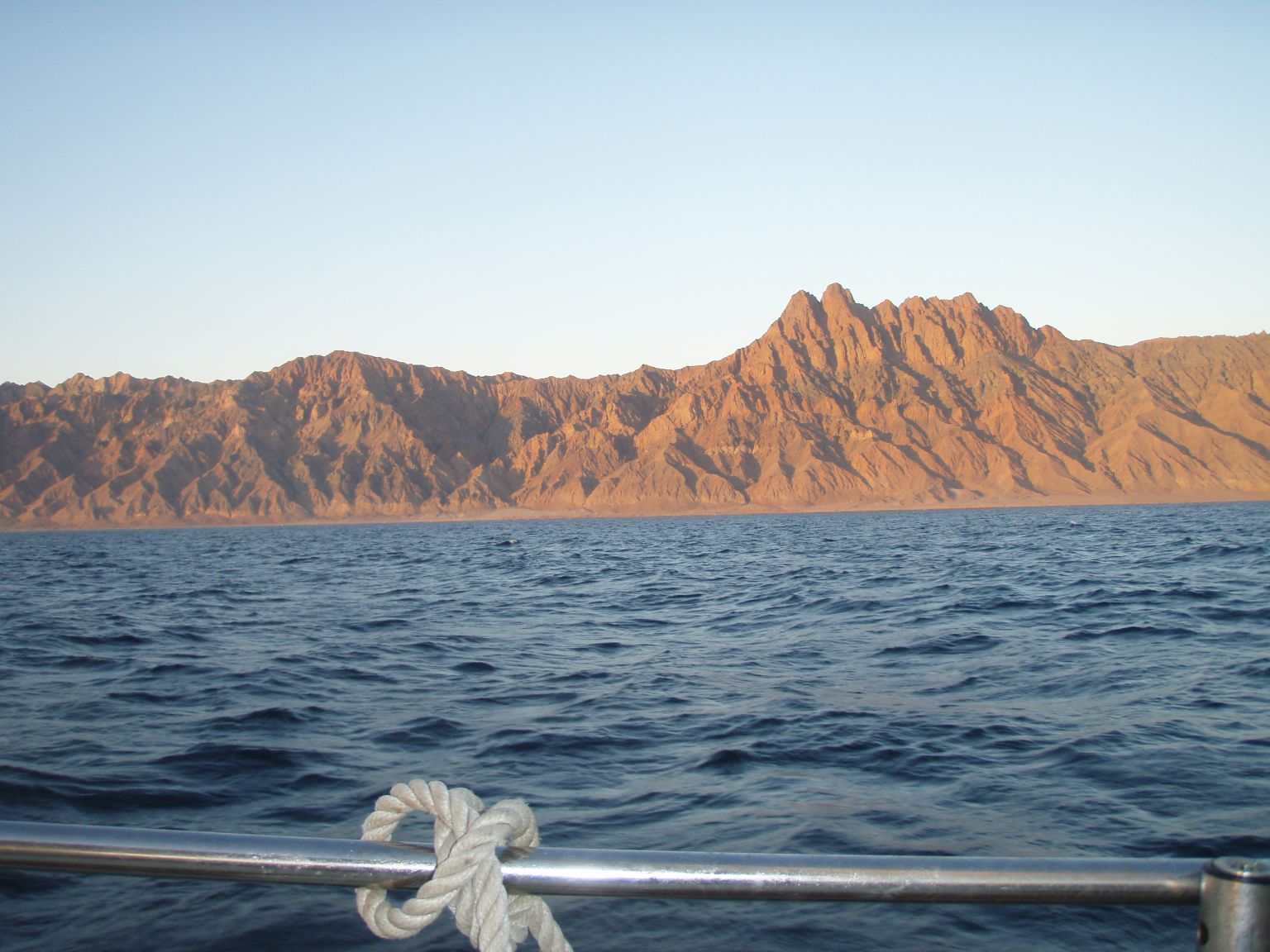
As it was, the conditions held and we began to enjoy some of the most
spectacular and stunning scenery that we have seen in quite a while. The shore
of the Gulf of Suez on the Sinai side is edged with steep mountains that drop
right to the waters edge. There was almost no sign of life, just a few straggly
bushes near the strand in one or two places. There were a few abandoned
buildings, which bore the air of military construction but no signs of human
occupation. The mountains themselves were tilted and striped in shades of pink,
gray, ochre, orange and brown. Craggy and with sand slopes tucked into the
ravines - just as you would find snow-fields in the Alps. The colors deepened
and became richer as the sun sank lower in the western horizon. I had always
imagined Sinai to be kind of flat. I had wondered why it had taken Moses so long
to get sorted there.
  |
The sun finally set and the first lights of oil facilities appeared in the distance. We made our way very carefully between oil platforms and edged behind a reef to anchor for the night. Navigation was more based upon the depth sounder, in order to find the correct channel in proximity to the hidden reef. At 2030 hours we anchored at N 28 35.7' E 033 11.6' at Ras Sheratib, some 90 miles south of Suez.
August 15, 2007
The
forecast for today was for lighter winds than yesterday and also for these to
lighten early in the day. We were up, checked, ready and set to go at 0700
hours. The wind was blowing strongly, "dead on the nose", and
DoodleBug was rocking and plunging with the swell. Maybe another hour. We
settled down with our paperback books. Each hour we looked at each other, looked
at the waves across the reef in the main channel and settled back again.
Finally, at 1100 hours we said, "Let's go!".
The wind was still blowing strongly but we needed to feel like we were making
some progress towards Suez. The wind did indeed drop but the seas stayed much
rougher than yesterday and our progress was correspondingly slower. At sunset,
the seas finally dropped away and the miles began to accumulate.
The scenery up this part of the coast has become less and less spectacular and
both the sea and coastline are full of oil production facilities, well heads and
storage tanks. This is just the Sinai coast we see. The Egyptian coast is only
10 miles away to the west but almost completely hidden in the haze.
We were now making over six knots against the headwind and decided to just keep
on going into the port of Suez. The last 10 miles was made skirting the edge of
a hundred plus large vessels, such as liquid carriers and container ships, plus
all of their associated pilot boats and tugs. The channel had many shallows and
reefs and we had to be precise in our navigation.
The horizon was now filled with a plethora of multi-hued lights. Some of these
would be flashing markers, some working floodlights, some the navigation lights
of moving vessels. In the midst of this sensory input was an almost non-stop
jabber of voices on the VHF radio. Some were holding long conversations in
Arabic on the hailing channel. Others were yelling at the latter to get off the
main frequency onto a side frequency. We heard the port controller chewing out a
Captain who had taken his vessel across the main traffic way without asking
permission. The guide book also warned us of approaching the inner harbor
without similarly receiving permission, so we began to hail the Port Controller.
We asked permission to anchor and he refused immediately. He demanded to know
our tonnage and I repeated again that we were a 16 meter sailing vessel. This
time we got a curt and disgusted sounding "OK" and he no longer
responded to our subsequent hails. We dodged between the behemoths, and found
the inner harbor anchorage in the glare of the port floodlights. We dropped
anchor at 0220 hours on 8/16/2007 at N 29 56.3' E 032 32.9'. Doodlebug is at the
Suez Canal!
August 16, 2007
0220 hours local time; Dropped anchor in Port Ibrahim just down from the Suez Yacht Club. We arrived!!
Position N 29 56.3' E 032 32.9' All well on board.
later that day.....
After a refreshing sleep of a full three hours, we telephoned our Suez Canal transit agent. He suggested that we move immediately to the Suez Canal Authority's "Yacht Club" to complete formalities and for us to call on the VHF as soon as we had raised anchor. This involved a move of just two miles and we soon underway. We called on the
 |
VHF and he then warned us to have two 20 meter lines ready. What?! 20 meters? This is double the length of our longest dock line. Now we struggled with dragging extra rodes out of lockers and then struggled with the tangles, to get at least 20 meters of line ready. Of course he had conveniently mentioned this after we had raised anchor, so that DoodleBug was drifting slowly onto the nearby seawall.
  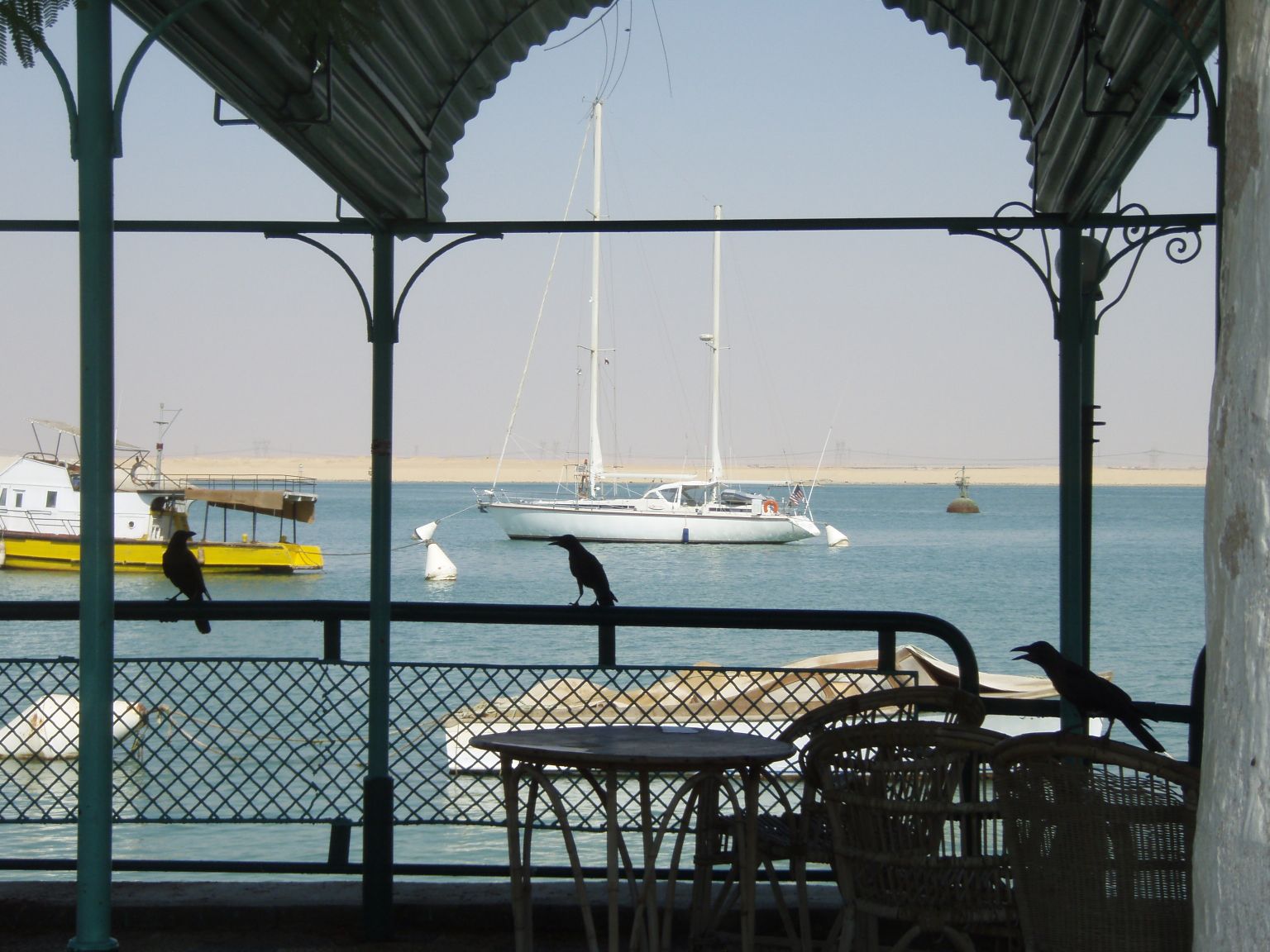 |
We moved to the "Yacht Club" and discovered that our regular dock lines were more than adequate and the early morning panic had been for nothing. We cleaned up the boat while we waited the agent and I took the opportunity to "snorkel" the propeller. This was to see what was causing the random vibrations and loss of power. I found a
 |
mass of nylon netting wrapped around the
prop and had fun cutting it all free with a dive knife. We must have acquired
this as we were leaving El Tur and now that mystery solved! Next task was to
refuel the main tank from our Jerry Jug supply. Diesel in Egypt is about half
the cost of the Mediterranean countries and we wanted to leave with a full tank.
The "Yacht Club" is a run down, decaying affair, with an unloved look.
Someone obviously put some effort into creating the facilities a decade or so
ago but nothing has been done since then. We had visions of lots of cruisers
waiting for canal-transit, internet facilities, maybe Wifi, a restaurant and
perhaps a dockside bar? Reality was a little different. DoodleBug was the only
cruising vessel. No restaurant. No bar. No internet. There was a shower but
little else. The marina staff were very pleasant and helpful and whisked away
our empty diesel jugs to refill them. The gas cans were returned at perhaps 90
percent of the quoted volume. This scam always pisses me off. I would have no
problem with an up-front request to pay a 10 percent fee for the refueling labor
and transportation if I could just get the proper volume of diesel I need.
Around noon our agent "Magdi" arrived. He explained the procedure for
the transit and suggested that the process would be smoother if we followed the
custom of providing Baksheesh (cash gifts) to the officials involved. He
suggested perhaps US$30 to the admeasurer who would examine DoodleBug to
determine the vessel size for transit fee calculation purposes. He further
suggested US$20 each for the two pilots we would use (one for each day of
transit). He indicated that Friday was not possible as the Canal Authority's
offices would be closed; thus we would leave on Saturday - unless there was a
warship in the canal. Yachts are not allowed in the canal then for security
concerns.
The admeasurer, Mr. Said arrived perhaps thirty minutes later. He was very
pleasant and we chatted about children and grandchildren, while we completed the
paperwork. Finally he requested that Annette show him through
 |
the boat as I
filled out one of the forms. In the back cabin and out of line of sight, he then
tried to kiss Annette. I was unaware of the incident until after he had left.
Back in the main cabin he began to ask me for any spare lap-top computers or
cell-phones I would like to give him and we were subjected to a non-stop hustle
until he finally got off the boat..
We filed a written complaint about the groping and kissing incident with the
Harbor Master. This has been a common problem according to other cruiser's
reports but we expected this behavior from the pilots - not the supposedly more
educated and mature admeasurer.
Finally everyone left and we headed to town to find a restaurant. Annette has
been lusting for roast chicken (not admeasurers) for days now and we were on a
quest. The road outside the "Yacht Club" was deserted and we were told
that there was a restaurant perhaps two kilometers away. We set off in the
crushing mid-day heat, telling ourselves that we needed the exercise and we just
had to beware of "mad dogs". After perhaps a kilometer, we found the
main drag into town and could see buildings in the distant haze. Two kilometers
my foot! We flagged
  |
down a taxi and rode the several miles into the downtown
area. As we browsed the various restaurants, we discerned that fish was the main
culinary constituent. This was surprising to us, since we have seen virtually no
fishermen. We were directed to a Shish-Kebab restaurant and although we were the
only customers, the owner insisted that we could have chicken and beef kebabs.
The meal was very pleasant except there was no sign of chicken on our plates.
For our entertainment they had the TV blaring a monotonous and droning male
voice wailing Koranic verses. It reminded me a little of being in church as a
child and listening to a Catholic priest "singing" as part of a Latin
mass. The singers were equally comprehensible of course but at least the latter
was over in about ten minutes. The Koranic singer was good for hours.
Sated on our non-chicken, we did a little shopping for bread and fruit and
bought "dust" cookies at the bakery. These turned out to be dates and
tasted a whole lot better than dust would have.
Our return taxi driver was a part-time taxi driver part time sea-man. He had
been to the USA many times but said that since the 9/11 attack, he is no longer
allowed to land in the USA and must stay aboard while in port.
Back aboard DoodleBug, the wind died down and the heat became even more
oppressive with a noticeable increase in humidity. There was a wedding at the
facility next to the Yacht Club and some sort of entertainment on the opposite
side. The music was a mixture of American "rap" and Arab
"MTV" and continued until the wee hours, when the mosquitoes found us
trying to sleep in the cockpit and drove us below.
August 17, 2007
This morning we moved DB from our mooring to the floating dock. We could now reach the water hose and took the opportunity to wash some of the grime and salt off the boat. Our agent arrived around lunchtime. He drove us into town and at the fifth bank we tried, the ATM grudgingly provided us with a little Egyptian currency, albeit without a receipt. Next stop was a shop that sold rotisserie chickens! Magdi presented Annette with a gift of two roasted chickens and she was almost salivating as we headed back to DB.
August 18, 2007
Left
at 1120 a.m. this morning along with our pilot "Mohammed" bound for
Port Ismailia, the mid-way point on the Suez Canal, a distance of around 45
miles.
The day did not begin well, as in the wee hours of the morning, Ed came down
with the symptoms of "Gippy tummy" and began swigging
"Imodium" syrup by the jug-full. At least it is not far to the toilet
aboard DB!
We have read the canal transit described as "really boring". We did
not find this so. There was very little bird life but we did see a small black
and white kingfisher on a couple of occasions. There were lots of military
installations and lone sentries every couple of hundred yards on both sides of
the canal. The sentries would wave
    |
and yell, "Hello, Welcome!" as we
passed. We saw sections of "Bailey bridges", pre-assembled on
launching ramps and held by chains. (These are military use temporary floating
bridges) We saw pill boxes and bunkers protected by barbed wire entanglements.
The newer equipment is presumably to prevent a terrorist attack on canal
shipping and the older, a relic of the Egypt / Israeli wars, where Israel
occupied the Sinai bank of the canal. We saw a single large dredger we supposed
to be working to widen the canal.
Our pilot was selected as a non-smoker and had been briefed by Magdi that he was
to receive a US$20 "tip" at the end of our trip. Within minutes of
leaving the dock, he began asking if he could smoke. Then he asked for
cigarettes. This went on for most of the seven hour trip. He wanted cigarettes,
beer, marijuana, tee-shirts, baseball caps and the like. He explained that he
needed to pay a 400 Egyptian Pound (about $US72) taxi ride back to Port Suez
when he got off the boat. 400 Egyptian Pounds would probably have taken him to
Aswan and back. Finally he announced that he had received no sleep the previous
night. He slept for an hour in the cockpit and he finally shut up. Meanwhile I
(Ed) conned the boat with the perfectly usable autopilot. After his one hour
nap, he came back to life and insisted on manually steering for the remainder of
the trip. This task is suitable
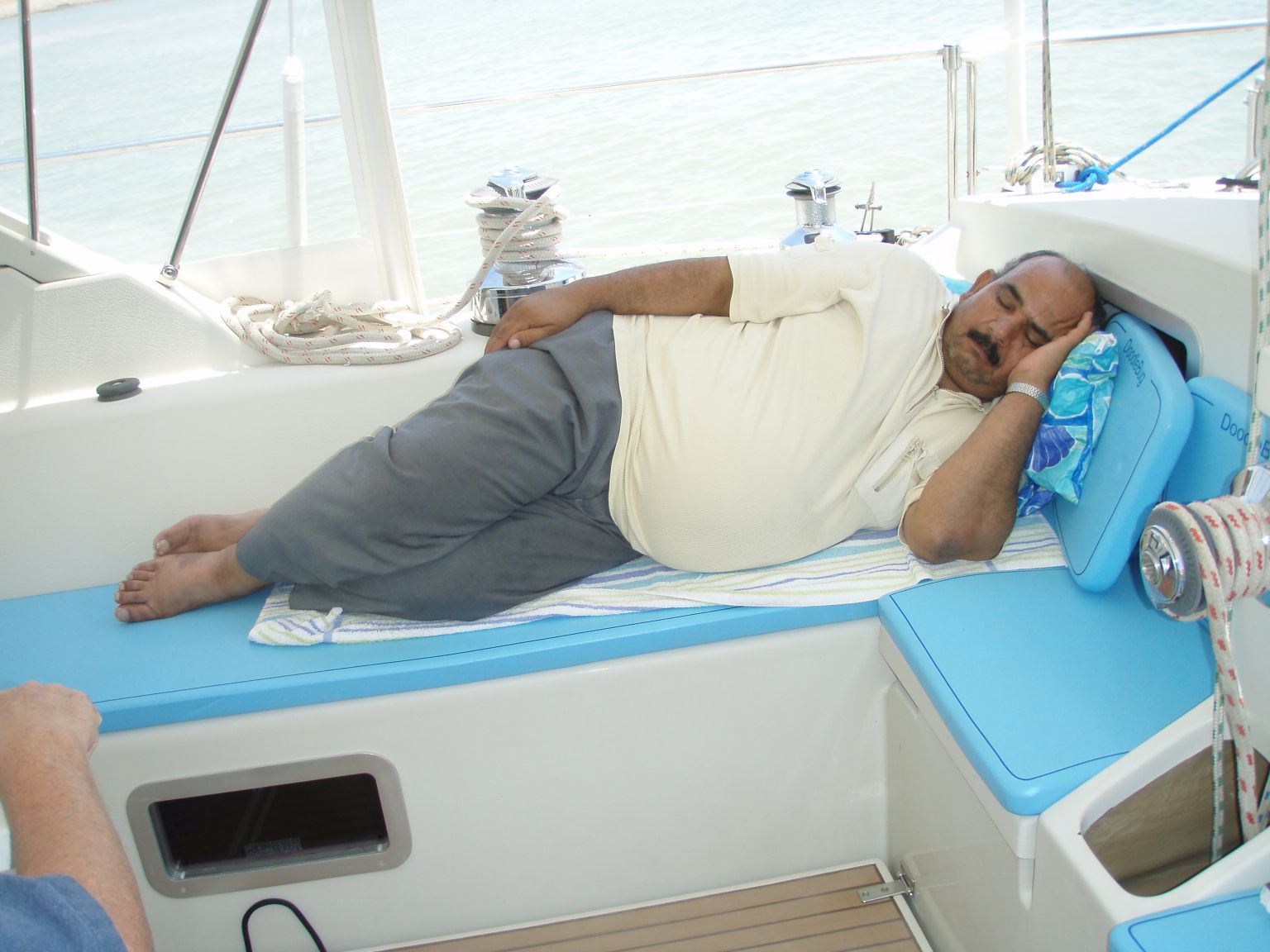  |
for most small children to accomplish. I mention
this, as he seemed to need frequent assurance from me that he was doing a very
good job - like you could somehow get lost in an arrow straight ditch. I must
admit that he made it more exciting when he would begin to drop off to sleep,
slumped over the wheel, while DB drifted closer to the shallows along the shore.
When this happened, he shrugged off offers from me to "drive" while he
rested. We kept him plied with coffee, tea, soft drinks and food. He looked a
little like a 70 year old "Wimpy" ("I will gladly pay you
tomorrow for a hamburger today" - or something like that) although he
professed to be 50 years old.
When we crossed the "Great Bitter Lake" there were lots of local
fishermen. Some were laying down immense
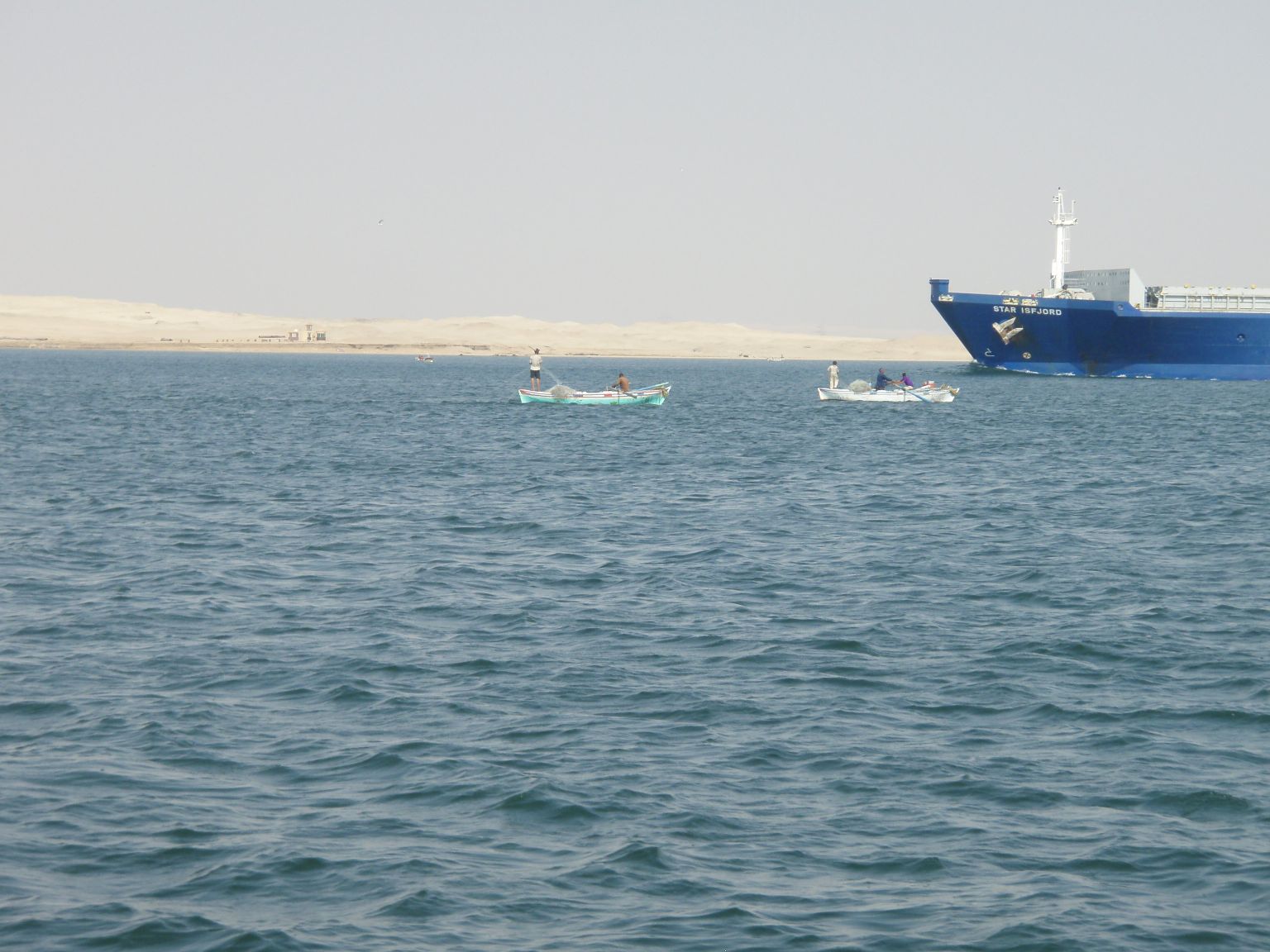 |
drift nets amongst the mammoth vessels
maneuvering or anchoring there. I would be astonished if there really are decent
fish left here.
As we neared Ismailia, the hustle from the pilot reached a crescendo and I
offered to call Magdi, the agent in order to clarify things. He did not feel
that was necessary but asked if he could borrow my satellite phone to place a
call to Turkey.
We gratefully arrived at the Ismailia Yacht club dock and had been assured by
the agent that he had called ahead and that they were expecting us etc.
There were pairs of mooring buoys in front of the dock and a single yacht, stern
to the dock with a line through the buoy at the bow. I asked the pilot how we
picked up a bow line and he assured us there was a line in the water we could
pick up with a boat-hook. Anticipating this, Annette already had both boat-hook
and gloves ready. We backed into the dock and a man approached and stood ready
while Annette threw him a line. The rope hit him in the face and he looked
simultaneously astonished and angry that a strange American woman would treat
him thusly. Annette told him to pick the line up (sort of forcefully) and he
stood there holding it as DB drifted away from the dock. Finally he got the
message to wrap it around a bollard and as Annette move to the opposite line on
the other side of the stern, the pilot helpfully removed the line that Annette
had just cleated and repeated the Egyptian arrival ceremony of limply holding
the line - as though you were going to be able to control an 18 ton vessel in a
15 knot wind that way. By now, I had looked over the side of DB and realized
that the promised bow pick up lines were non-existent. The pilot asked Annette
to reach over the bow pulpit and thread a line through the eye in the buoy that
was 9 feet below and perhaps 15 feet off to the side. I insisted that we let go
of all lines and we motored clear to regroup. One possibility was to go side-to
but it looked like the dock had concrete blocks protruding and I did not want to
mess around with rigging fender boards in an area where the depth was unknown
anyway. We made a second approach and this time, we dropped our anchor between
the buoys and backed to the dock to moor Mediterranean style. At 1900 hours we
were in!
I gave the pilot his envelope with his US$20 and of course he was insulted and
the like with his "gift", just like every other hustler. He finally
got off the boat and a policeman arrived, examined our passports and documents
and then asked if we had a complaint to file against the pilot. I told him,
"No" - after all he did not either smoke on board or grope my wife -
so that was pretty good. The policeman then asked for baksheesh for himself. I
was not feeling well, I also had a headache and I was pretty sure that I had
been vastly overcharged for the canal fees anyway and so I might have been a
little less than completely diplomatic. The policemen hastily retired and we did
not see him again.
An hour later, the marina manager showed up, assured us that he was the only one
who knew how to tie a dock-line, pointed out that we could hook-up to power and
gave us a run down on the facilities such as showers and food vendors. We could
have used him perhaps an hour and a half earlier but he was very pleasant.
We were just adjusting our line when a young Moslem lady approached us and began
to chat. Her family was sitting nearby and they insisted that we stop by and
visit after our shower. Actually, they didn't insist on the shower part, we did.
We sat with the extended family and they were delightful. They insisted on
buying us Coca-colas and then bought us pizzas without asking us. The family
consisted of the grandparents (our age), two
  |
adult sons with their wives and
children. They had two grandchildren, a boy about three and a little girl at six
months. The little boy even looked like our grandson Maddox and he insisted on
explaining to Annette, in great detail and with lots of facial expression and
hand gestures for emphasis, something important about the crocodiles in the
lake. (There aren't any). He jabbered away non-stop and never once realized that
Annette could not understand a word of his Arabic. This was a truly great
experience and the aggravation of the previous days began to melt away. Here
were normal people doing ordinary things with their children and it was
wonderful.
August 19, 2007
Last
night we were informed by the Ismailia marina manager that there were multiple
warships transiting the canal today and we would not be allowed to travel. Today
was therefore a "rest" day and since we have already legally
"checked out" of Egypt, we were not allowed to leave the marina
grounds. We changed the second Racor fuel filter since we left Port Ghalib and
hoped that by now the effects of 7 months idleness has been filtered from our
diesel fuel. The crew of a southbound British flagged boat returned that evening
and we went aboard SV Sanna2 to visit. I asked Dave on Sanna2 what his transit
fees had been, since Sanna2 is just slightly bigger than DoodleBug. Dave
confirmed what I already suspected, i.e. we had been raped by the Felix Maritime
agent for fees. Dave's Suez transit fee was $256 out of a total fee of $534,
versus the $602 out of a total fee of $877 that we had been charged. I have sent
an e-mail to the Felix Agency asking for an explanation and am awaiting a reply
with bated breath.
Captain Dave has been hounded almost daily by the head of the marina security
police detail for baksheesh. At around 2130 hours the marina manager informed us
that we will transit tomorrow. About a half hour later the marina policeman
asked to talk to me. I felt that this was going to be a shakedown so we
discussed when I first came to Egypt, whether he had been born then and how many
times I have been back to Egypt since then. He never came to the point and I bid
him goodnight. Dave came across to DoodleBug shortly afterwards to say that the
guy had been back to him, told him that there would be a warship transiting
tomorrow, thus Dave could not leave. He the policeman, could fix this with a
phone call in exchange for some baksheesh. The call would go something like
this:
"White House? This is Ali at the Port Ismailia marina, is George in? Hey
George. I have a live one for maybe 40 dollars worth of baksheesh. I'll split it
with you if you would turn the Enterprise around and stall it for a day,
OK?"
August 20, 2007
Dave
said that three marina policemen boarded his boat at 0100 hours and woke them,
demanding baksheesh. This action was repeated at 0700 hours.
We prepared DoodleBug for departure and awaited the 0800 hours arrival of our
pilot. At 0900 hours I called the agent and asked him what was going on. Ten
minutes later he said that there was a warship transiting and we would have to
wait. I said that was yesterday's crap, what is the real story? He insisted that
the warship would pass Ismailia in one hour and we could leave then. We were
stunned when the pilot showed up an hour later. We cast off and were underway
for Port Said at 1015 hours.
The second, northern half of the canal passage was much more populated than what
we had seen. There were resorts, small villages and ferry crossings, as well as
plenty of military presence. The soldiers were friendly, waved and yelled,
"Welcome!" to us as we passed. The pilot was very quiet. No smoking,
no requests for baksheesh and he hand steered the entire trip. As we approached
his drop off location, we gave him his "gift" plus a carton of
Marlboro's that have probably been on the boat since Panama. Since I don't
smoke, I don't know
 |
if they are any good and I really don't care either. We
dropped the pilot off and the burly deckhand type character on the pilot boat
began to yell at Annette, "Lady! You give present for pilot!". The
pilot boat also swerved at us as if to ram. I had just given our pilot a whole
carton of ciggies and assumed this would cover it. Apparently not! As they
swerved dangerously close to DoodleBug, Annette stood at the rail and yelled,
"La! Bara!" (means - "No! Go away!") at them while taking
photographs. I think the camera did the trick as they did not care for
photographic evidence. Finally they gave up and we motored on, entering into the
calm, blue Mediterranean waters at 1615 hours.
Once clear of the harbor entrance, we went to a close reach under Genoa and
Mizzen and were back under sail for the first time in days. We had received
notification while we were in transit that there was no marina space available
at Larnaca, Cyprus and had decided to change course to Ashkelon, Israel where we
could get our mainsail repaired.
The remainder of the afternoon was a very pleasant sail. We passed through
hordes of fishing boats and calculated from the radar display that they were at
the density of one fishing vessel per three square miles of sea. The sun set and
we continued to pass through the fishing fleet on a course that would take us
just northwest of Ashkelon. At around 2200 hours I noticed a flashing amber
light amongst the fishing vessels in the distance. I changed course to give it a
wide berth since it was an unknown to us. Usually flashing amber lights in the
middle of the sea are things to avoid and by now we were 35 miles from Port Said
and fifteen miles from the Sinai coast. As we got closer to the mystery light,
it resolved itself as a beat up looking trawler, with a police type light-bar
across the cabin roof. It began emitting a police type siren noise and swerved
as though to ram us. I was under full sail at the time and had to turn sharply
and start the engine. The trawler made circles around us with some bozo on the
back yelling something at us in Arabic from about fifty yards off, as they were
heading away from us. What did they want? They did not respond to hails on the
VHF and they made no attempt to draw alongside us to talk, just kept making the
threatening ramming actions. I had already sounded an emergency warning with an
air-horn (really woke up Annette who was off watch and sleeping!) and now loaded
my flare gun with a white warning flare. By this time we had changed course so
that we were heading away from our original route by about thirty degrees and
were now going more directly out to sea. As I prepared to fire my flare, they
pulled back and hung off our stern. A second larger trawler approached, just as
old and beat up and also bearing a flashing amber light. WTF? I had assumed that
the first vessel was just part of an Egyptian shake down racket for
"baksheesh". These guys were not fishing. Was this a patrol? They were
obviously not military, did not respond to the VHF and did not attempt to come
parallel to us and talk as a real security patrol would. What was the deal?
By now the wind had dropped away so we would have been motoring anyway. The
orange flashing light vessels gradually dropped astern and when they were two
miles off, we came back to our original course. An hour or so later, a third
vessel approached us. A large trawler again but no flashing lights. He put a
spot lamp on us and I in turn, turned on all of my deck lights. He could now see
that we were an American flagged sailing vessel and we ignored him and did not
change course. Like the others, he followed for a while, like a bad dog chasing
a car, until he finally lost interest and fell away.
The remainder of the night was uneventful. We contacted the Israeli Navy to tell
them we were on our way, although radio reception was very difficult. As we
passed down the Sinai and Gaza coasts, the International hailing channel #16 was
being jammed almost continuously. Many third world countries chatter non-stop on
this channel but this was a continuous transmission of either noise or pop-music
without let-up.
