Maldives
November 17, 2006
0050 hours UTM. Position: 03 11.6 S 72 4.4 E
Yesterday morning we waited until 0920 hours, when the radar indicated a gap in the rain clouds, and then raised anchor and weaved our way through the bombies
using our inbound GPS track as a guide. It was heavily overcast and occasionally showering so the bombies them selves remained invisible. At 1030 hours we were in the open ocean under full sail
and beam reaching for the Maldives in 14 knots of wind. This was a little more wind than forecast but welcome all the same. Three weather forecasts had agreed on light but very useable winds
towards the equator. An 80 foot yacht Serenite had departed some 20 hours ahead of us and reported zero wind at 02 degrees South.
Our first hours sailing was very pleasant but then the wind began to build. By 1400 hours it was blowing at 30 knots with corresponding 15 to 20 foot seas
just West of the shallows of "Speakers Bank" - that lies 30 miles north of Salomon Island. We were now close hauled into this mess with sheets of water crashing over
the bow and it was no longer fun. We heaved to for the next three hours to allow the mini-gale to blow itself out. The wind blew at 35 to 40 knots but finally
 began to subside to the 25 knot range. By now the wind was dying but the waves were still huge, so we began sailing again so we could at least try to dodge the big ones.
The wind continued to drop throughout the dark and starless night and as I write this, we are close hauled with 8 to 12 knots of wind and some 182 miles north of our Salomon anchorage.
began to subside to the 25 knot range. By now the wind was dying but the waves were still huge, so we began sailing again so we could at least try to dodge the big ones.
The wind continued to drop throughout the dark and starless night and as I write this, we are close hauled with 8 to 12 knots of wind and some 182 miles north of our Salomon anchorage.
November 17, 2006...later
Dawn was a wonderful sight after the hammering we received yesterday. We had left on all of these assurances of fine sailing weather and then suffered through
a gale, followed by hours close hauled, reefed down in rough seas. Despite having been "heaved to" for three hours in the worst of the storm, we discovered we had
managed to run 151 miles in the previous 24 hours. Annette does not like the wind ahead of the beam and these sea conditions are not her favorite. We had stowed DoodleBug for "heavy" weather as
we always do but there were still several surprises. Just as we were leaving Salomon atoll, we had found a quantity of water in the engine compartment. I tasted it and it was "fresh", albeit a
little oily. I could not identify it's origin and pondered the options of heat exchanger leaks, overpressure blowout from the hot water heater and the like. Not critical since we were under sail
but worrisome, since the forecast indicated some serious motoring.
 Our forecast light trade winds from the southeast did not materialize and instead we were tacking in winds of 12 to 14 knots and a choppy sea. The wind was blowing from NNE or just about
exactly where we were heading. By noon they died away to 6 knots and we began to motor to our destination. We had decided to put into Addu atoll in the Southern Maldives, to check on the motor
and the "mystery" engine room water. The day was heavily overcast, with large rain cells that dumped prodigious quantities of water on DoodleBug, reminding
us of the Australian "wet season". I had decided that the 12 V alternator on the engine probably has a shorted out voltage regulator and always provides full
charge. I was fairly sure that the starter battery was damaged and planned on replacing this soon. To prevent further damage, I disconnected the "field" coil voltage from the alternator -
essentially turning this "off". After some hours of motoring, I tested the voltage on this battery and measured it as 6.8 volts. Problem! We were not going to be
able to restart the engine. I reconnected the field coil and eventually the battery charged back up. It's replacement will sooner rather than later. The next alarm was that the engine began to
lose RPM. I stopped the engine, it restarted on the "shot" battery but using the backup Racor fuel filter. It died. I bled the fuel lines for air and restarted it.
Success but still no (high) RPM! Sort this out in Addu. Later that night there was a loud bang next to the engine, that woke me with a start, as I had begun to doze. What now? A flashlight search
found a large flying fish that had struck near my head and was lying comatose and slimy on the engine cover. As it began to rain even heavier, the sound of squeaking from the rigging grew to a
crescendo. I grabbed a flashlight and braved the pouring rain to try and locate the source of this torture. The noise was coming from both the main and mizzen rigging. When I put on the deck floods, I
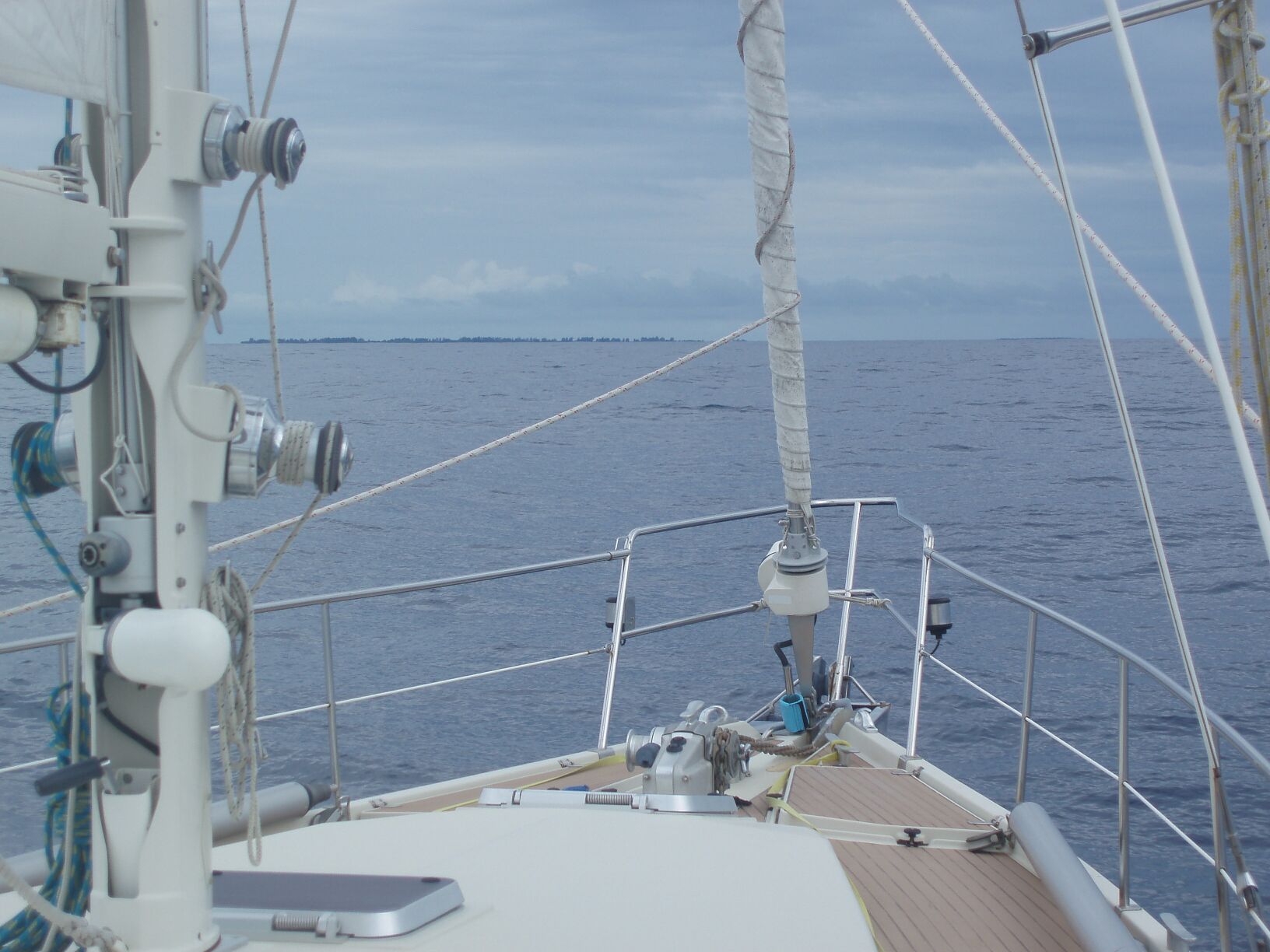
then saw that we had a flock of seabirds, circling tightly around a rolling, pitching DoodleBug in the darkness and the rain. Another biological panic over! Dawn showed a line of trees of Addu atoll on
the horizon, plus a gamboling pack of 200 plus dolphins. What a welcome! The
Our forecast light trade winds from the southeast did not materialize and instead we were tacking in winds of 12 to 14 knots and a choppy sea. The wind was blowing from NNE or just about
exactly where we were heading. By noon they died away to 6 knots and we began to motor to our destination. We had decided to put into Addu atoll in the Southern Maldives, to check on the motor
and the "mystery" engine room water. The day was heavily overcast, with large rain cells that dumped prodigious quantities of water on DoodleBug, reminding
us of the Australian "wet season". I had decided that the 12 V alternator on the engine probably has a shorted out voltage regulator and always provides full
charge. I was fairly sure that the starter battery was damaged and planned on replacing this soon. To prevent further damage, I disconnected the "field" coil voltage from the alternator -
essentially turning this "off". After some hours of motoring, I tested the voltage on this battery and measured it as 6.8 volts. Problem! We were not going to be
able to restart the engine. I reconnected the field coil and eventually the battery charged back up. It's replacement will sooner rather than later. The next alarm was that the engine began to
lose RPM. I stopped the engine, it restarted on the "shot" battery but using the backup Racor fuel filter. It died. I bled the fuel lines for air and restarted it.
Success but still no (high) RPM! Sort this out in Addu. Later that night there was a loud bang next to the engine, that woke me with a start, as I had begun to doze. What now? A flashlight search
found a large flying fish that had struck near my head and was lying comatose and slimy on the engine cover. As it began to rain even heavier, the sound of squeaking from the rigging grew to a
crescendo. I grabbed a flashlight and braved the pouring rain to try and locate the source of this torture. The noise was coming from both the main and mizzen rigging. When I put on the deck floods, I
then saw that we had a flock of seabirds, circling tightly around a rolling, pitching DoodleBug in the darkness and the rain. Another biological panic over! Dawn showed a line of trees of Addu atoll on
the horizon, plus a gamboling pack of 200 plus dolphins. What a welcome! The

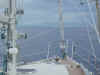 atoll entrance is a little intimidating, as it faces to the south and is a gap between two extensive reef systems. The Indian Ocean swell was crashing on the reef, with awe inspiring
breakers to both sides of us. We passed safely between the breakers and anchored at 00 41.0 S 073 08.6 E behind the islet of Gan. We are 41 miles south of the equator.
atoll entrance is a little intimidating, as it faces to the south and is a gap between two extensive reef systems. The Indian Ocean swell was crashing on the reef, with awe inspiring
breakers to both sides of us. We passed safely between the breakers and anchored at 00 41.0 S 073 08.6 E behind the islet of Gan. We are 41 miles south of the equator.
November 18, 2006
0100 hours UTM. Position: 01 08 S 072 57 E
We are just 30 miles off the reef entrance to Addu atoll in the Southern Maldives. We intend to stop here for a few days. Details to follow. All well on board.
November 18, 2006 through November 21, 2006
Just as we were anchoring inside the atoll at Addu, we noticed Jens of SV Carita nearby in his dinghy. (Jens is the Danish single-hander we had first met at Christmas
Island.) He advised us that we should stay aboard and in about 2 to 3 hours, we could expect to be boarded by 5 Maldivian officials. The boat was already tidy, so in the interim, I began to do some
boat chores. Twenty minutes later, just as I was in the middle of checking the fluid level in the batteries, Jens radioed to say that the Maldivian officials were already waiting on the dock. Their
boat motor would not start, could we pick them up in our dinghy?


It took two trips to transport the five officials, all smart in their pressed uniforms and representing Health, Security, Customs and Immigration. While I had been deep
into the battery bank, Annette had been busy making jam from what were described as a "tropical crab apples" and which she had collected in quantity in Chagos. The customs men were
deeply interested in the jam making and quizzed her on what she was doing. Twenty minutes of filling out forms and they were through. They asked me to take down the quarantine flag we were
flying and watched carefully and gravely as I removed it. Then they were hauled back to the dock and we were legally here!
We are anchored off the islet of Gan, one of seven inhabited islets joined by a causeway. Addu was occupied by British forces in WW II and after Sri Lanka became
independent in 1956, the RAF (Royal Air Force) developed an airbase here on the islet of Gan. Over the years they have had between 600 and 3,000 personnel here, depending upon the state of
the World problems and they built the causeways joining the islets. In 1976, the British departed and left behind a nice airstrip, lots of buildings and a local population that could speak
English. It is therefore no surprise that Gan was chosen as the location of the "International Airport" plus a tourist resort. It is strange to walk around the local streets, as the barriers,
guard posts, painted curbs of an airbase remain. There are gift shops and stores but it is still very obvious that this was a military base. The tourist resort called "The Equator
Village" (www.equatorvillage.com) is established in the former NCO's club.
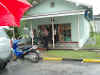
On Sunday we walked through Gan and found the Post Office, fuel station, customs office and the like and stopped for lunch at the Equator Village. We selected this
establishment because it is the only location on Addu with a bar. The beer was Balinese Bintang and we imbibed several along with our Equator Village Club sandwich.
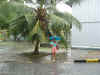
It had been raining on and off all day but now the heavens opened and we were thoroughly soaked by the time we reboarded DoodleBug. We called it a "movie day", invited
Jens over and force fed him popcorn, while we fried his brain watching "The Matrix".


We have been performing chores and I have serviced the engine and transmission and resolved the low RPM problem by changing out the "on engine" fuel filter. This had
been changed less than 100 hours of engine time ago, during our passage to Ashmore Reef. There is a pre-filter (Racor) and although it was not due to be changed, I swapped it out for a finer mesh
filter in the hopes that my "on engine" filters will last longer. Some cause for concern, as I only have two spares left of the latter.
We have also walked from Gan islet to the others via the causeway and visited the villages along the way. The homes were uniformly neat and clean and the streets in the
villages were laid out in a rectangular pattern. In an internet cafe there were two smiling girls behind the desk. One was wearing a headscarf and the other was not. Annette asked the
latter if she was Moslem and if so, why she did not also wear the head covering? The girl replied that she is indeed Moslem and she does not wear the covering because she "does not like it". OK
then, a "moderate" society.
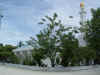


Yesterday we walked to the opposite end of islet to the airport. The terminal building is big, modern and has a large illuminated sign on it's walls proclaiming "Gan
International Airport". We chatted to the security guards and they said that the airport normally handles three flights a day, perhaps five during the school holidays. The flights are strictly
domestic. The walk to and from the terminal was highlighted by huge fruit bats that flapped clumsily around us. Annette even managed to creep up on a bat in a tree and snap
several pictures before it flapped away in disgust.
Today we topped up our diesel at a fuel station about 400 yards from Doodlebug. At high tide we were able to land our dinghy on a strip of sand, perhaps 30 yards from the
pump. We leave in the morning to sail to Male, the capital of the Maldives, which lies on the north side of the equator some 300 miles from here. Our final chore was to obtain a
transit permit from the Customs office granting us permission to sail to Male. The customs man was surprised and pleased when Annette presented him with a gift of a small jar of her homemade
jam.
November 23, 2006
Our second day at sea since we left Addu. We have received no rain on board but have seen localized rain showers in the distance. The clouds at this latitude seem low altitude
and with the shifting weather patterns of the equator, produce colorful and dramatic vistas. The light headwinds continued and moved resolutely onto the "nose".
I had been using a tightly sheeted mainsail to provide some anti-roll damping against the swell and as long as the wind is within 10 to 30 degrees of the bow, we were able to
get an extra half knot or so. The wind picked up around 1000 hours and I began to furl the mainsail to stop it from flogging. Then I discovered that the furler was no longer working. The pin that
connects the mainsail furling foil to the drive motor at it's base, was missing. A brief search did not find the missing pin and I had to manually furl the mainsail. What a bummer! Now I realize
just how spoiled we have become, as it now takes both of us to perform this task - Annette in the cockpit operating the electric drive for the main outhaul, with me at the mast furling the sail in.
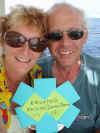


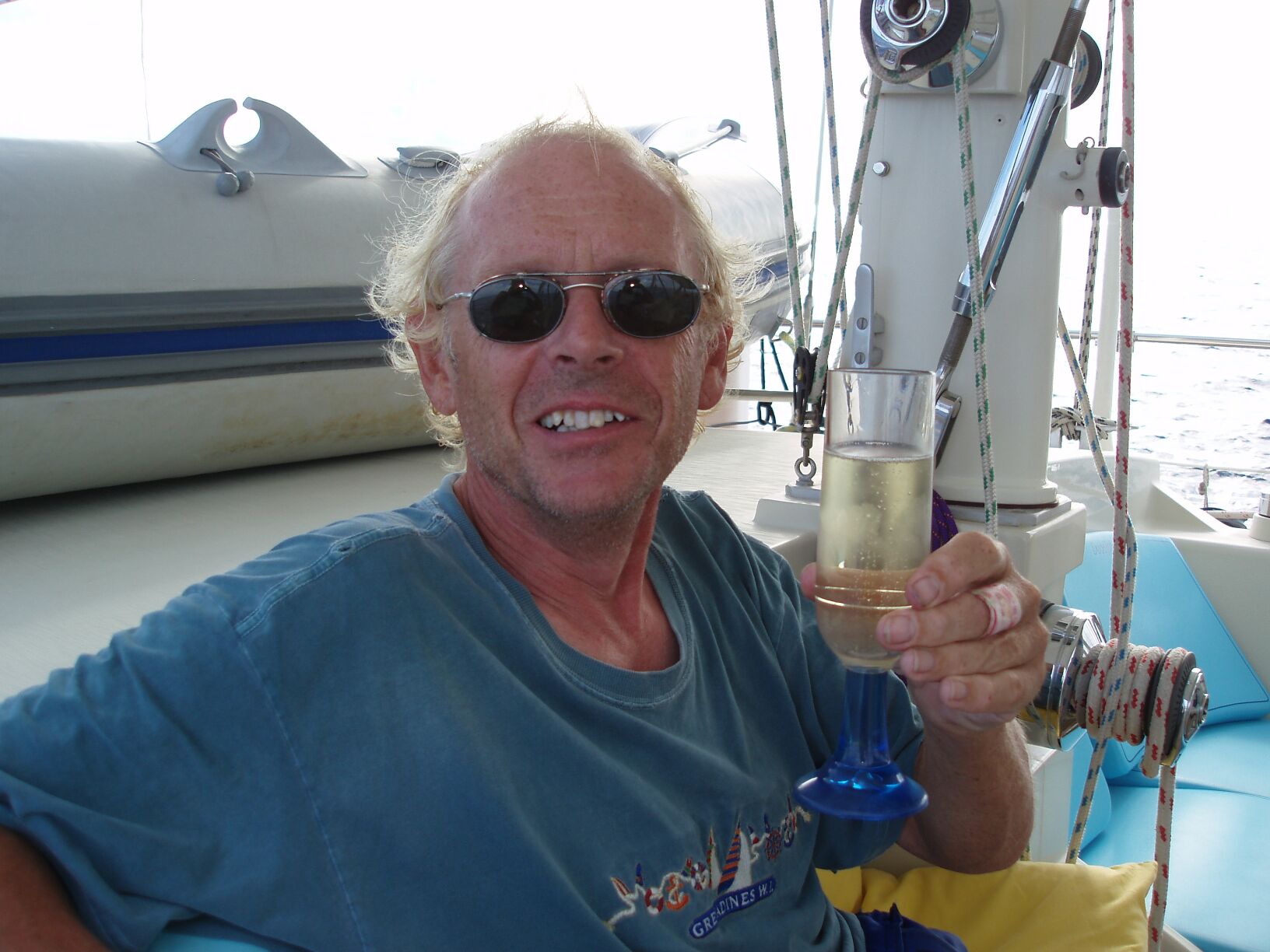
We celebrated Thanksgiving with the traditional corned-beef hash and a bottle of Champagne. I whined about being turkey and cranberry deprived but
Annette assured me, nobody was going to feel sorry for us. The day was partially salvaged when I located and retrieved the missing mainsail furling pin, with the aid of a
small mirror. It was jammed behind the winch handle holder at the base of the mainmast.
At midnight we passed the lights of SV Carita as she tacked against the building headwind while we motored by. We had been talking to Jens (Danish single-hander)
by radio and he maintained that his engine was not powerful enough to make way against the headwind. The main tank on Carita (length 10 meters) holds 20 liters of diesel.
By contrast, 16 meter Doodlebug's main tank holds 600 liters and the 24 meter SV Serenite, we had been meeting along the way, carries 4,000 liters. Jens can sail in 5 knots
of wind and reefs down at 15 knots. We usually need at least 10 knots of wind and the Captain on Serenite told me they need at least 15 knots.
November 23, 2006
01 32.4 N 073 40.5 E at 0045 hours local time.
Yesterday morning at 0810 hours local time, we raised anchor and bidding the hordes of flies and mosquitoes farewell, we set sail for Male. The winds
remained light, in the 1 to 5 knot range, all day long and consistently from the north. We have been motor sailing up the east side of the chain of atolls that make up the
Maldives and at around 1500 hours, we crossed the equator for the second time in three years. DoodleBug is now back in the northern hemisphere.
November 24, 2006
Arrived safely at Male' at 0900 hours local time. Anchored 04 12.5 N 073 32.0 E. All well on board.
Turkey deprived. At dawn we saw the strange skyline of Male' on the horizon. Almost all of the atolls we have either passed or visited, we see as a
ragged line of coconut palms on the horizon. The islet Male' has a population of around 100,000 and contains perhaps one third of the population of the Maldives Islands, within
its bounds of around half mile by one mile.


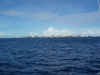
The building height is supposedly
restricted to 12 stories and the skyline we were approaching was seen as a continuous juxtaposition of brightly hued skyscrapers. The airport lies on the adjacent island and
there was a continuous stream of high speed ferries running between the two. We dropped anchor in a lagoon at the north end of the airport, just off the end of the runway
at 0830 hours. We soon perceived that our chosen spot was close to the track of the ferries and also that they have no concept of slowing down in a crowded anchorage. When
we tried to raise the anchor and move deeper in the lagoon, we

 found a heavy rope twisted around the anchor. We launched our dinghy and Annette cut the rope with a dive knife, we keep in the cockpit for just such an occasion, and reanchored
closer to the runway at N 04 deg 12.5' E 073 deg 32.0'. There was a 26 foot yacht nearby, flying the Finnish flag and I dinghied over to introduce myself to "Paul".
He knows Jens and also Paulo from SV Saltimbanque (met at Chagos). While dinghying over, I managed to get a huge line wrapped around the dinghy outboard and struggled to get
it off. Paul told me that the locals do not typically use chain to anchor with. They put out multiple anchors with "floating" rode and so the lagoon is a
spider web of floating lines. That is what dive knives are for!
found a heavy rope twisted around the anchor. We launched our dinghy and Annette cut the rope with a dive knife, we keep in the cockpit for just such an occasion, and reanchored
closer to the runway at N 04 deg 12.5' E 073 deg 32.0'. There was a 26 foot yacht nearby, flying the Finnish flag and I dinghied over to introduce myself to "Paul".
He knows Jens and also Paulo from SV Saltimbanque (met at Chagos). While dinghying over, I managed to get a huge line wrapped around the dinghy outboard and struggled to get
it off. Paul told me that the locals do not typically use chain to anchor with. They put out multiple anchors with "floating" rode and so the lagoon is a
spider web of floating lines. That is what dive knives are for!
While I was replacing the itinerant mainsail furling pin with a dab of epoxy glue, Annette attempted to install our "Shadetree" sun awnings.
A gust of wind tore the flapping awning out of her hands and one of the fiberglass wands that holds the shape, plopped neatly overboard. Gosh, Darn! I snorkeled to get it
back but soon gave up with the poor water visibility. The next attempt was using a scuba tank and I sank slowly to the seabed at a depth of just over 30 feet. The visibility
was less than three feet and the seabed was soft ooze. No joy! That puppy is history! Meanwhile, out at sea, Jens tacks away and occasionally we check his progress by radio.
It is near sunset and he believes he will have to heave to for another night at sea. We offer to guide him through the lagoon entrance where we are anchored, by the time
honored method of "flashlight in dinghy". He presses on and we can soon see him with our binoculars, as he rounds the island of Male'. I give him a bearing to steer
and we turned on our lights. Jens dropped anchor in the last of the fading light and we fed him Huevos Rancheros and vodka and bitter lemon - a sailor's favorite combination
- necessary since Annette and I had long since sunk the champagne.
November 25, 2006
This morning we finished up our boat chores and dinghied over to the nearby ferry terminal to await the ferry to Male'. We are
anchored at the north end of the main runway on the islet of Hulhule' Male'.
 The lagoon is also used as a seaplane base and, in calm conditions, the seaplanes takeoff from the lagoon - otherwise they use the hard runway intermixed with the international
jet traffic. There has been a continuous stream of aircraft taking off and landing but the most fun are the seaplanes taking off from the water. When this happens, they are at a much lower
altitude as they flyover DoodleBug and we feel like we should perhaps turn on our mast light.
The lagoon is also used as a seaplane base and, in calm conditions, the seaplanes takeoff from the lagoon - otherwise they use the hard runway intermixed with the international
jet traffic. There has been a continuous stream of aircraft taking off and landing but the most fun are the seaplanes taking off from the water. When this happens, they are at a much lower
altitude as they flyover DoodleBug and we feel like we should perhaps turn on our mast light.
The ferry ride is 5 Rufiyah (about 40 cents) and takes around 10 minutes to arrive at the congested terminal at the main island of Male'. Our destination was the
Customs office to turn in our transit permits and apply for permits for the next leg to the north. The walk from the ferry terminal to the Customs office is perhaps the main tourist
attraction. The sidewalks are very narrow - if they exist - and usually on only one side of the roadway. Every inch of space is crammed with parked motorcycles to the point where in order to cross
the road, you may have to walk 20 yards to find a gap wide enough to walk between the machines. The street traffic is bumper to bumper trucks, cars, motorcycles, and bicycles with the pedestrians
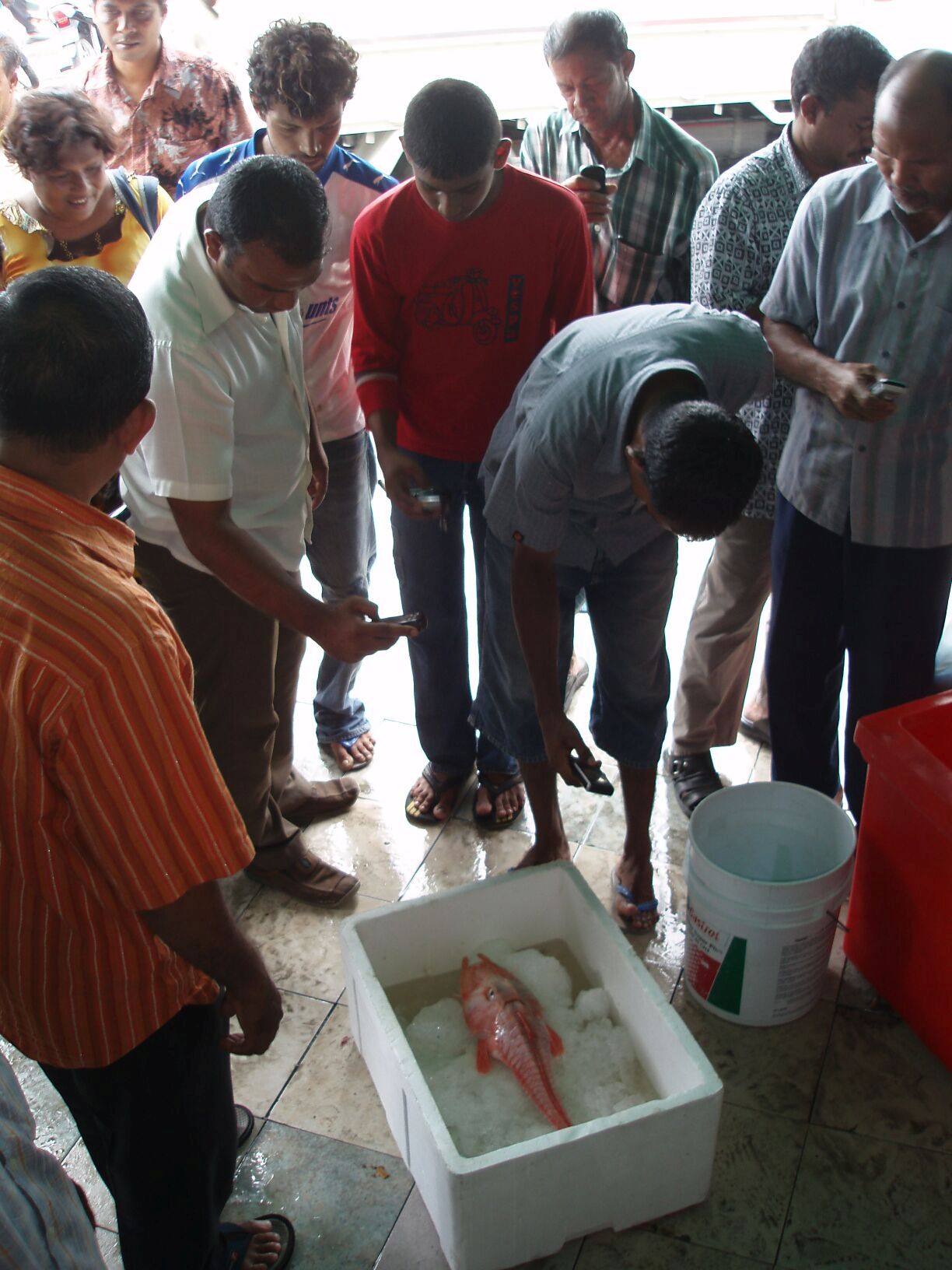
wandering aimlessly through the middle of this. We passed the main fish market and the huge fat tuna were stacked across the sidewalk. One stall had a large crowd with folks taking pictures. The
attraction was a strange fish that was unidentified (possibly a Pink Frogmouth - a deep water fish). It was somewhat like a large pink catfish but was definitely odd looking.


The next market was the fruit market with stalls piled high with bananas, papayas, limes, coconuts, pumpkins - a mouthwatering smorgasbord of goodies for sailors
who have been living off canned goods for weeks. The narrow streets, crowded sidewalks, with all sorts of exotic merchandise and strange smells, reminded me of the Arab markets of Cairo,
Tripoli, and Algiers. One marked difference is that there was no trash, no beggars, and even the market stalls were neat and tidy.
We visited the Customs, resisted the suggestion we hire an agent (a hundred bucks for what?) and obtained our exit permit for Uligamu. They do like their stamps
here. We have used our boat stamp more since we have been in The Maldives than our entire boat stamping experience since leaving Houston three years ago. Unfortunately, we had forgotten to
bring our stamp. No problem! The Customs officer produced an ink pad and we provided a thumbprint.
Next stop was the (huge) Yanmar dealer to see if we could buy some more fuel filters. They were singularly surly and unhelpful in this dealership and just said
"No". No offers to order parts or anything. The mystery of their attitude was partially explained as they were installing a "Closed" sign on the door as we were
leaving. We were encroaching on lunch hour!
We also headed off for lunch and stopped at a nearby sandwich shop that had been recommended to us. I ordered the "American Burger". Big
mistake! It was so loaded with garlic - to which I am allergic - I was sick for the remainder of the day plus most of the next day. We cut short our Male' visit and
Annette salvaged her afternoon by discovering that the beach between the container terminal and the new runway under construction, had never been "shelled". She got so
excited trying to pick up new shells, she forgot that her hands were still full of the shells she had already grabbed.
November 26, 2006
Still raining this morning but we braved the water to head back to catch the 1000 hours ferry to Male'. Today's goal was to visit the tourist sights, beginning with
the National Museum. The museum is located in a small three story building that is all that remains of the original Sultan's palace. There were photographs, furniture,
military uniforms, and artifacts from the line of Sultans that have ruled The Maldives. In fact, most of the museum's artifacts had been derived from the various Sultans.
There were also a collection of pre-Islamic carvings but little is known as to the age and origins of these pieces. When we arrived at the museum, we were the only tourists and after we had
purchased our ticket, the ticket lady motioned us to wait and called to someone. A petite, aged, withered and shrouded woman shuffled up. She preceded us through the different rooms
cackling "look, look", which was the entire extent of her English. She would grab a plastic sign that was sitting on an exhibit, such as a throne and shove it under our
noses so that we could read it easier. Must have been one of the retired concubines, I suppose.
The next destination was the art gallery. We finally located the building and were informed that it had closed some two years before and was now a restaurant. We had
lunch. Lunch was made more pleasant by Annette's reversion to our collective youths as a newly married couple in Libya. She was carrying a recycled peanut butter jar concealed in her bag that
contained vodka and was a perfect complement to the Schweppes's Bitter Lemon that we were served.
While Annette shopped the supermarket, I searched for an internet café without success. We passed a large hotel on the return trip to the ferry terminal and
stopped in to ask for directions to the Post Office. The girls at the reception sold us stamps and Annette sat in the air-conditioned lobby, writing post cards, while I used the hotel
Internet. By now the skies had opened and it was bucketing rain. We waited for a break and scurried across the road to the ferry terminal followed by a bouncy ride back to Hulhule' Male' and a very
wet dinghy ride back to Doodlebug. That night the rain and shifting winds continued and we noted that several of the local boats were having difficulties with their anchoring systems and we watched
carefully as they swung towards us.
November 27, 2006
The high winds, rain, and choppy water in the lagoon where we are anchored, continued for the morning and we canceled our
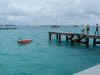 plans to return to Male' for a second round of shopping/sight seeing. By noon, conditions had improved a little and we braved the tricky transfer from dinghy to dock with
the still choppy water. We had decided to shop the stores on Hulhule' Male' and found them a short walk from the ferry terminal. Annette was shopping for fruit and found
various items that were acceptable and had also identified an item she had seen at the Male' fruit market. The mystery item turned out to be Betel nuts and there were bags of them just hanging
next to the bananas. (Annette had previously thought them to be nutmeg).
plans to return to Male' for a second round of shopping/sight seeing. By noon, conditions had improved a little and we braved the tricky transfer from dinghy to dock with
the still choppy water. We had decided to shop the stores on Hulhule' Male' and found them a short walk from the ferry terminal. Annette was shopping for fruit and found
various items that were acceptable and had also identified an item she had seen at the Male' fruit market. The mystery item turned out to be Betel nuts and there were bags of them just hanging
next to the bananas. (Annette had previously thought them to be nutmeg).
 Keith on SV Lady Guinevere (met at Chagos) had given high recommendations regarding a ba called the "Captain's Pub" at a nearby resort and we decided to hire a taxi to head there for
lunch. I explained to the taxi driver that we needed the resort with the red roof and that it on the inner lagoon at the airport. He nodded his head and answered "yes" to
everything I said. I knew this meant "No, I don't speak a word of English". We climbed into the taxi and pointed in the direction we wanted to go. After a while of
lefting and righting, I spotted the roofs of the resort in the distance. "There", I said and pointed. He looked confused. As we got closer, we could see that the
resort lies on the next islet and the causeway between the two islets is still under construction. We couldn't talk him into driving down the airport runway, so we gave up and returned
to the ferry terminal having completed our ten minute taxi tour of Hulhule' Male'.
Keith on SV Lady Guinevere (met at Chagos) had given high recommendations regarding a ba called the "Captain's Pub" at a nearby resort and we decided to hire a taxi to head there for
lunch. I explained to the taxi driver that we needed the resort with the red roof and that it on the inner lagoon at the airport. He nodded his head and answered "yes" to
everything I said. I knew this meant "No, I don't speak a word of English". We climbed into the taxi and pointed in the direction we wanted to go. After a while of
lefting and righting, I spotted the roofs of the resort in the distance. "There", I said and pointed. He looked confused. As we got closer, we could see that the
resort lies on the next islet and the causeway between the two islets is still under construction. We couldn't talk him into driving down the airport runway, so we gave up and returned
to the ferry terminal having completed our ten minute taxi tour of Hulhule' Male'.
By 2300 hours we had prepared DoodleBug for an early morning departure and had already turned in for the night. The wind had swung, it was still raining and
there was lightning flashes around us but something else had woken me. When I looked around from the cockpit, I was horrified to see 40 or 50 tons of dive boat, with a second vessel rafted alongside,
bearing down on us. It was broadside to the wind and was obviously dragging it's anchor(s). As I mentioned previously, the locals attempt to anchor the largest vessels with a kind of
grappling hook on the end of floating line and with no chain to hold the rode parallel to the sea-bed. The grappling hook would work in coral (we are anchored over mud) but then the coral would
cut through anything but chain in a matter of minutes. There was a lot of shouting aboard the darkened boats and bodies moving in the gloom. There seemed to be smaller motor boats in the water
but the mess was still becoming much closer to us. I started our engine, turned on the bow thruster and hurried forwards in the pouring rain to remove our snubber, that is attached to our
anchor chain (a snubber is a sort of shock absorber made from a length of stretchy nylon line, to prevent the anchor chain from jerking hard on the windlass when there are waves). To get the
snubber off, we normally motor forwards to take the strain off the chain and then take up enough of the anchor rode to be able to detach the metal hook of the snubber from our chain. To do
this, I needed Annette's help but she was still asleep and I did not have time to wake her. I only had seconds before we were hit, so I hauled the boat forwards using the
windlass (bad thing to do!) that moved us closer to the impending crash but by hanging over the side I could reach our snubber hook and get it off. Success! I scurried
back to the cockpit and simultaneously threw the engine in reverse, while I dropped another 50 feet of chain. The dive boats missed us by perhaps three feet and seemed to stabilize their
position, still broadside to the wind and now occupying our former anchoring location. The yelling and activity continued for perhaps another forty five minutes until two divers appeared at their stern
and climbed aboard. They had also had line wrapped around their propeller! They motored away and calm descended again aboard Doodlebug as we moved back towards our original anchoring position
and tried to return to sleep. We leave in the morning for the northern Maldives.
November 28, 2006
We raised anchor this morning at 0615 hours local time after a very disturbed night and set sail for Uligamu in the northern part of the Maldives some 190 miles away.
We cleared the pass on the west side of the Male' lagoon at 0745 hours and found ourselves heading north into a headwind instead of the forecast easterlies. We could have left yesterday but delayed so
that we would get the benefit of the non-existent easterlies. There were still sprinkles of rain but also a hint that there might be sun above the clouds. At 1300 hours there was a wind shift and
we were under sail, close hauled in a choppy sea. The wind built to 19 knots and we were double reefed on the Genoa but still sailing close hauled and tacking between
the reefs as night fell. There were lots of lightning flashes to the west but fortunately nothing heading our way.
November 29, 2006
We raised anchor yesterday morning at 0615 hours local time and set sail for Uligamu in the northern part of the Maldives.
 All well on board. We arrived at the village of Uligamu at 1500 hours today and anchored at 07 04.7 N 072 55.2 E. We will hit the Customs, Port authority, Health
department, and Immigration tomorrow morning and apply for exit documents. We sail for Salalah, Oman on Friday morning (as long as the weather holds of course). We expect an 8 or 9 day
crossing.
All well on board. We arrived at the village of Uligamu at 1500 hours today and anchored at 07 04.7 N 072 55.2 E. We will hit the Customs, Port authority, Health
department, and Immigration tomorrow morning and apply for exit documents. We sail for Salalah, Oman on Friday morning (as long as the weather holds of course). We expect an 8 or 9 day
crossing.
Hurricane season officially ends tomorrow but of course the hurricanes don't know that. We will be watching the forecasts closely, as we again are crossing
a known hurricane track - this time in the Arabian Gulf. In the early hours of the morning the winds dropped to the 12 to 14 knot range and also shifted, so we were able to close reach under
full sail of Genoa, main and mizzen. The sky has also cleared and tonight was the first time that we have been able to see the Southern Cross to the south and the Dipper and Polaris to the
north. The sail north, skirting the east coasts of the various atolls, was very pleasant, with blue skies and sunshine and a welcome change from the rain and rough seas of the past weeks. We
were less than 10 miles from the northern reef pass entrance to Uligamu when the wind shifted back to the north. We motor-sailed into the lagoon and anchored at 1540
hours at 07 04.7 N 072 55.3 E.
November 30, 2006
We arrived yesterday afternoon in Uligamu and took a quick look around the village. It was mostly deserted and the Customs and Immigration Offices were tightly
closed. I asked a passerby what time the store opened and they said, "It depends....the people at the store live in the same building, so if you want to buy something, just go and knock on
their door".
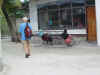


This morning I was updating the log, when Jens of SV Carita sailed in and anchored. He had been sitting all night outside the reef pass, "heaved to" on a sea anchor.
We all went ashore to find the various offices and begin the check-out dance. We started at the "island office", where we filled out the inevitable forms, which
were then rubber stamped to extinction. They had rubber stamps for everything. When the wrong date had been set on the rubber-stamp, there was another stamp to indicate this, which then
had to be initialed. We paid a fee of US$4 for the 12 days we have been in the Maldives but they probably spent more than that on stamp ink. Next stop was immigration. The office swarmed
with mosquitoes and I received several bites. Annette has been carrying a can of repellant for several weeks and it was now found to be empty. When I mentioned my blood loss to the immigration
official, he assured me there was no malaria. He was not so forthcoming on the subject of Dengue. Next was a trek to the island medical center. While I completed even more forms and had
lots of crew lists stamped, Annette got a tour of the medical center and introduced herself to all of the patients (one). Last stop was Customs and after another dozen rubber trees were
extinguished, we had our clearance in hand.
We asked where we could buy bread and were told "January". After much further discussion, we discovered the island does not have a bakery. Even more
discussion and we determined that they eat chapattis (tortillas) not "bread". Ok, we need chapattis. The store owner introduced himself as Ahmed Nasir. He said he was a
judge in the Maldives taking a break from judging, and showed us photographs of himself plus the president. He also showed us a traditional fishing boat he is building. It was perhaps 100 feet
length and 30 feet beam. Jens is a carpenter/joiner in Copenhagen and assured us that the quality of construction is very high.
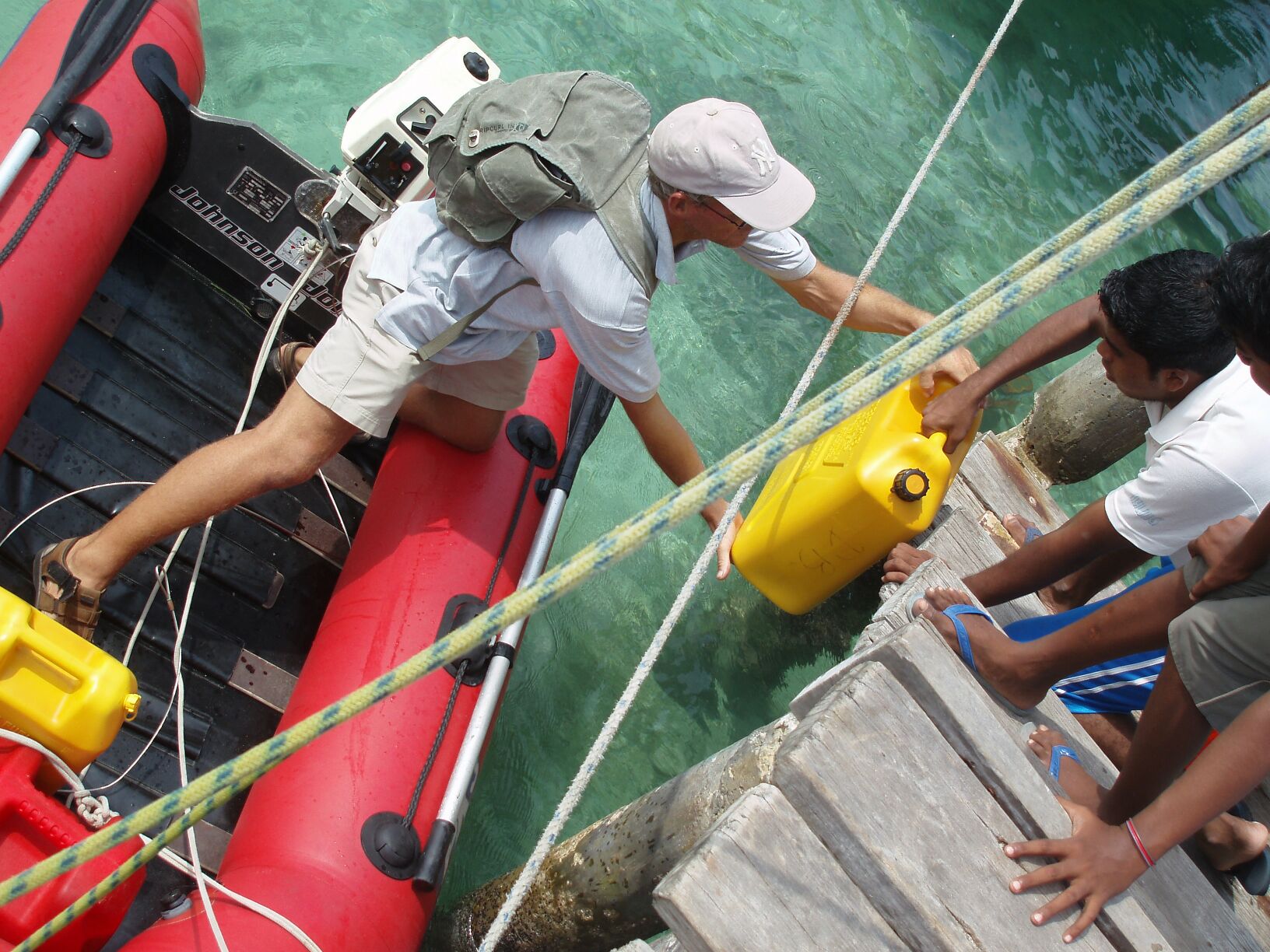
Our final stop was to purchase fuel. This was the most expensive fuel we have purchased to date but was worth the entertainment of watching it transferred to our
jerry jugs.


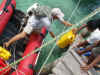
It was meticulously hand pumped into a five liter galvanizedmeasuring jug and then poured into our jug, using a funnel made from a plastic coke
bottle with the base cut out. We bought 40 liters(10 gallons) of diesel, as did Jens, and we also bought 10 liters of gasoline. The process took the best part of an
hour and we sat on plastic chairs in the shade of a tree while being entertained by a youngster strumming a guitar from within the dark smelly recesses of the fuel
store and also by Elton John being played from a cell phone. Back to DoodleBug to prepare for the major passage in the morning.

 began to subside to the 25 knot range. By now the wind was dying but the waves were still huge, so we began sailing again so we could at least try to dodge the big ones.
The wind continued to drop throughout the dark and starless night and as I write this, we are close hauled with 8 to 12 knots of wind and some 182 miles north of our Salomon anchorage.
began to subside to the 25 knot range. By now the wind was dying but the waves were still huge, so we began sailing again so we could at least try to dodge the big ones.
The wind continued to drop throughout the dark and starless night and as I write this, we are close hauled with 8 to 12 knots of wind and some 182 miles north of our Salomon anchorage.