Chagos - Salomon Island
October 22, 2006
Just an update on our position as of 0000 UTM: Position: 11 30.6 S 94 18.7 E
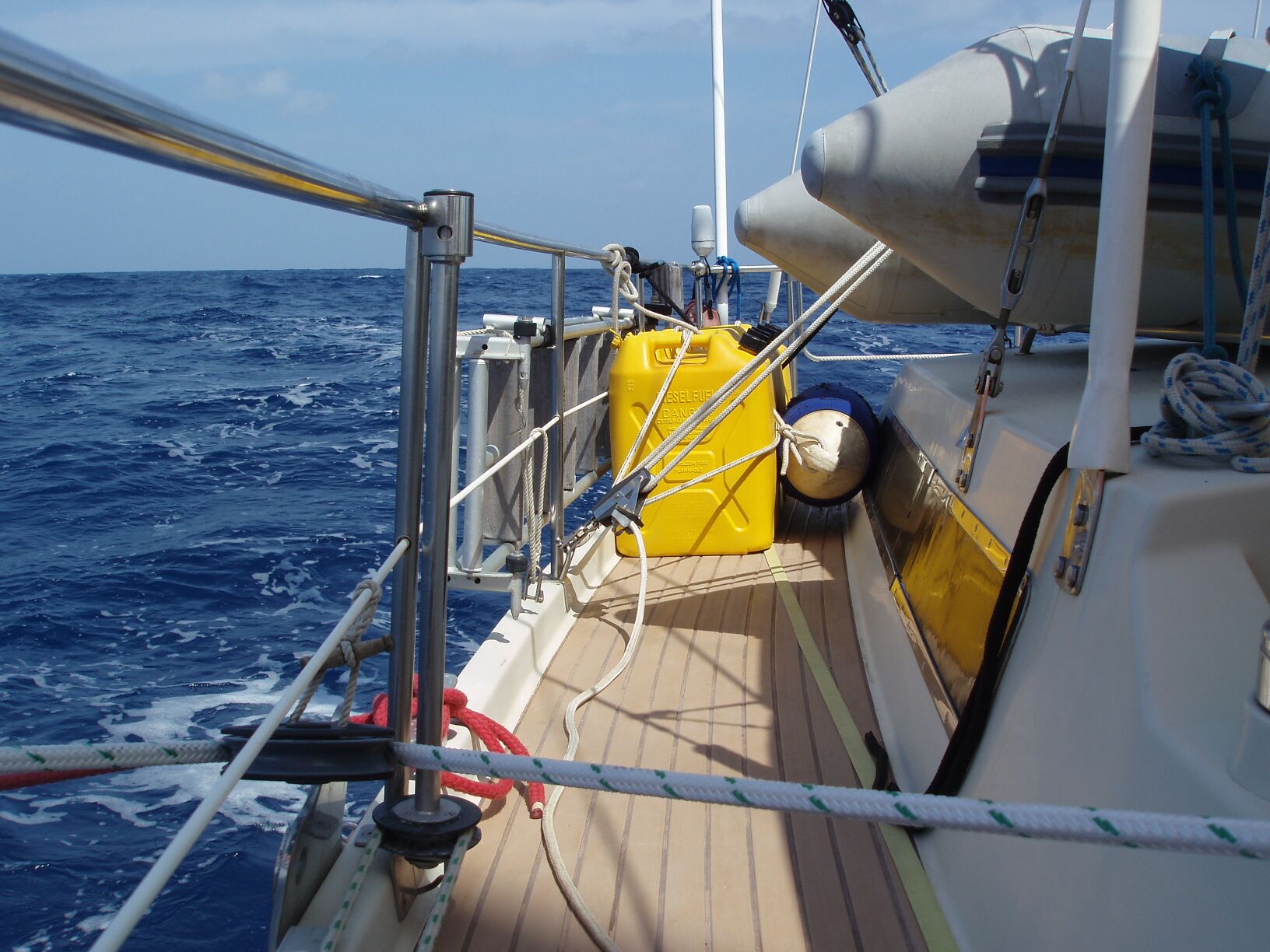
When we left Cocos Keeling yesterday, we had three large dolphins escort us out to the open sea. We have sailed between a broad reach and a dead run all day with poled genoa and occasionally winged main plus mizzen. The was not a lot of wind and the sea has been lumpy with 6 to 8 foot waves from the stern. Blue skies and sunshine. Our 24 hour run will be 161 miles.
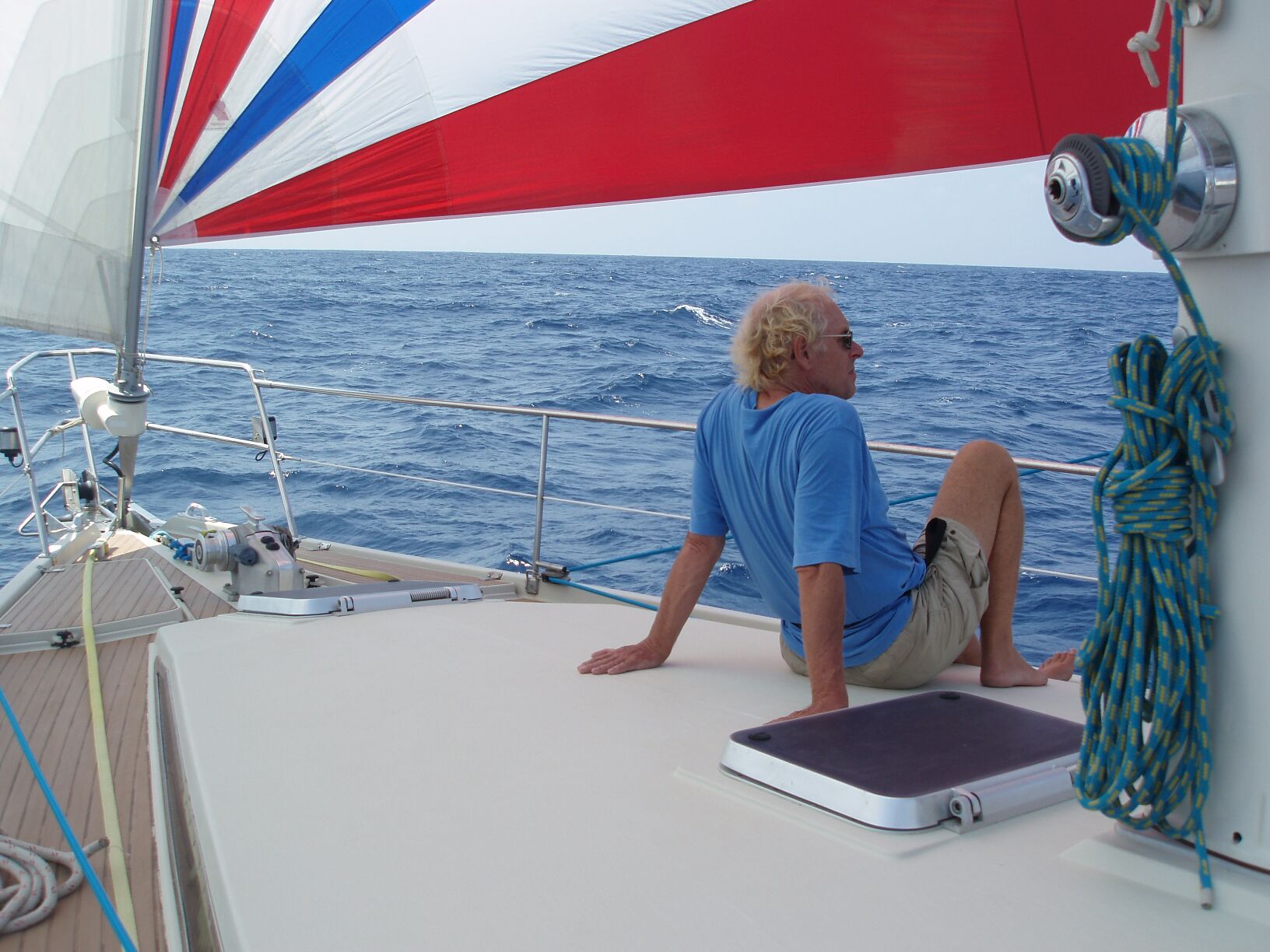
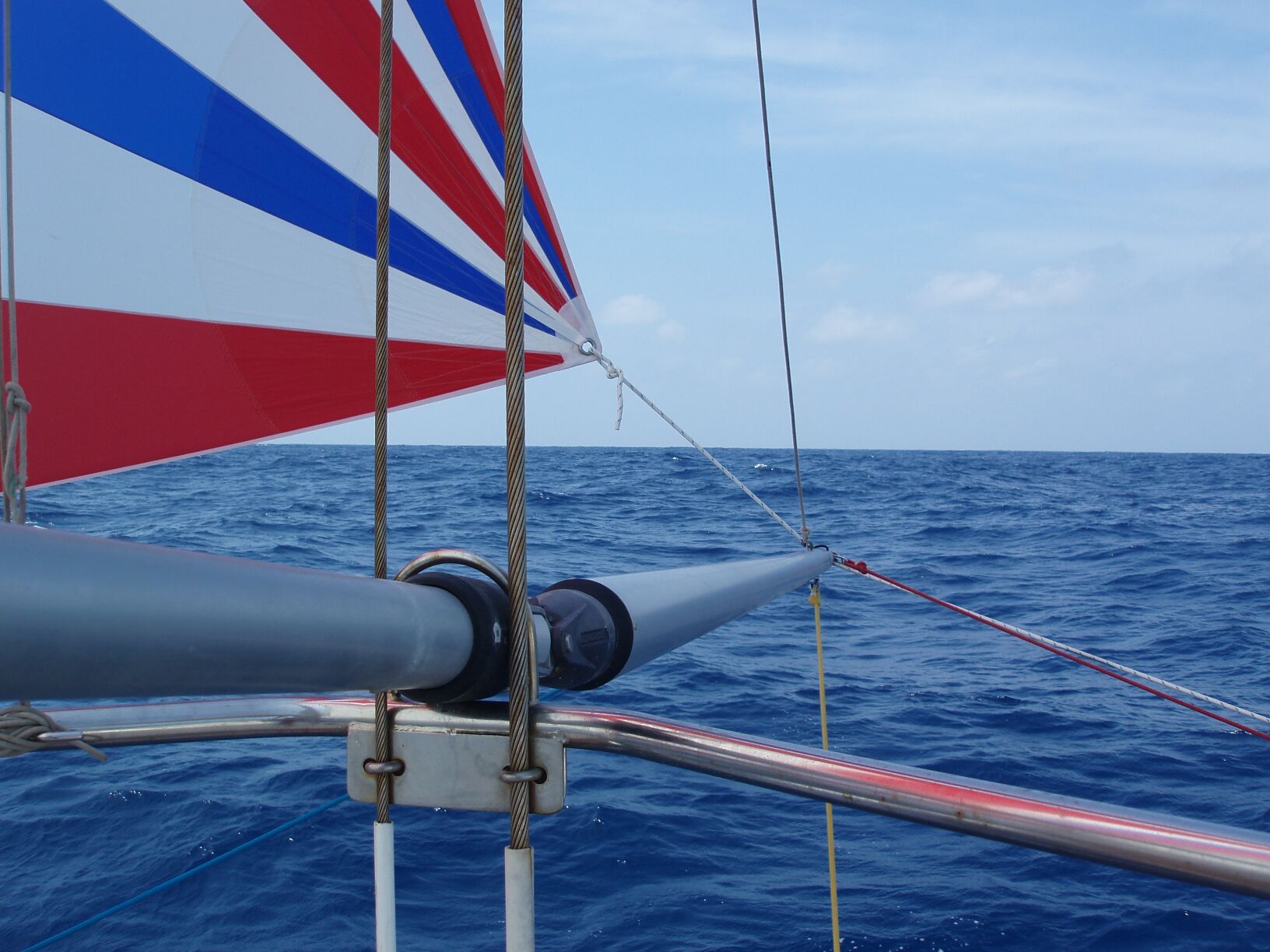
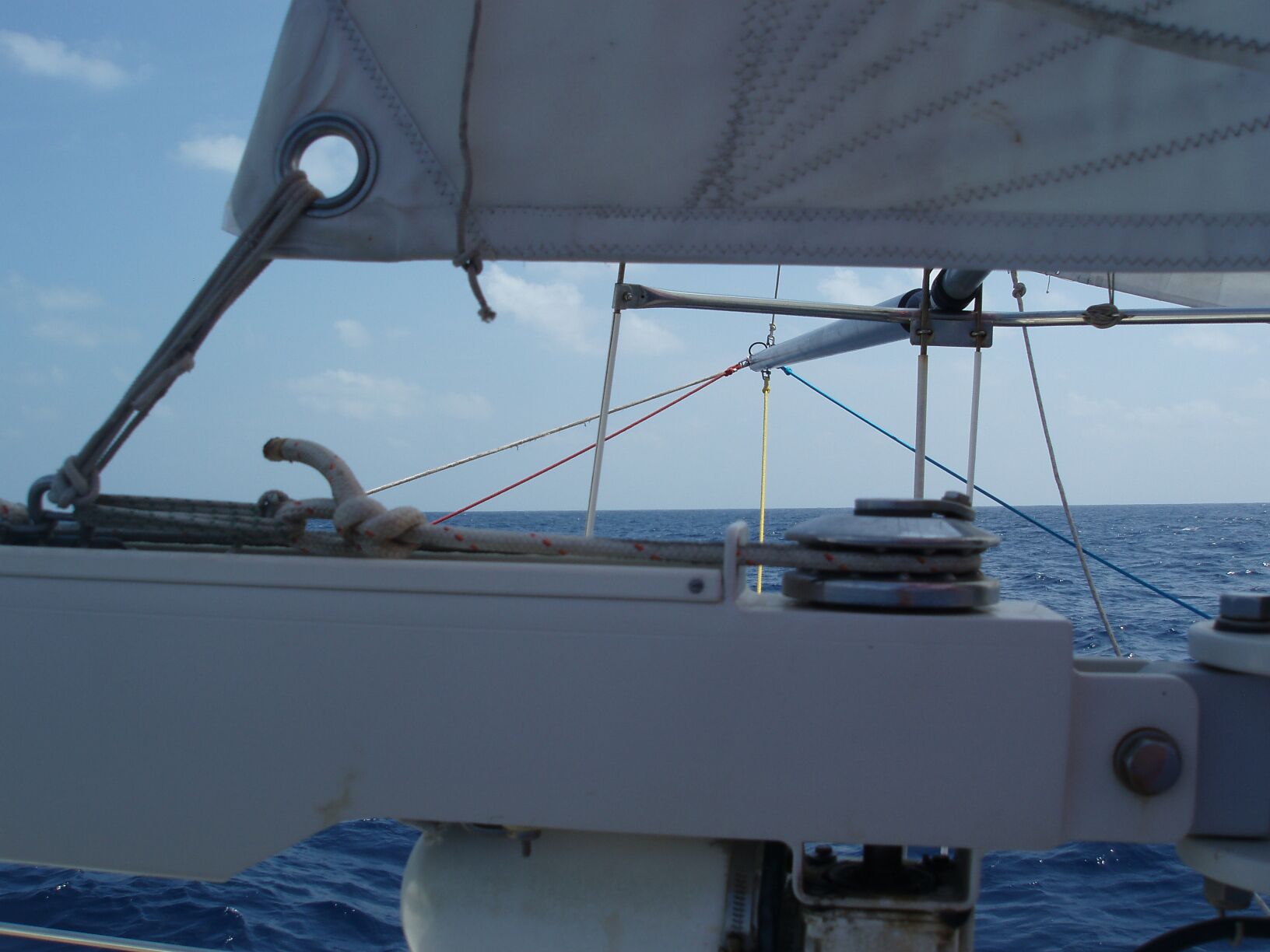
Yesterday we had sailed pretty much downwind all day, with the Genoa poled to starboard and "goose winging" the mainsail. That is, the mainsail was out on the port side, with a preventer to stop it from accidentally "jibing" - or switching to the starboard side in an uncontrolled swing and breaking everything. We were also using the mizzen sail with a preventer. There was an awkward motion to the boat all day and night, as a short and steep roller would pass the stern. This motion causes the two booms to occasionally slam against the preventers and you then feel like the boat is coming apart. The advantage of this rig is that you can get these sails down easily if necessary. The forecast had the possibility of squalls and during the night we had seen the first of these on the radar display. The pods of rain did not contain any strong winds and so this morning, we rigged the "Genoa" to port and the "Ballooner" to starboard. These two sails are both on the head stay and provide nearly 1,500 square feet of sail in a balanced configuration. No more crashing and banging from the preventers! The change was very pleasant, although the same short, sharp, swells have persisted. It looked like the bow was buried at one end of DoodleBug, while the seas were washing over the step at the stern. It looked so strange, I even checked compartments to make sure we were not taking on water and sinking.
During our first 24 hour run from leaving Cocos Keeling, we had covered 161 miles but today are moving noticeably faster. Lunch was the seaman's traditional favorite - tacos. We have been surprised to find "El Paso" brand taco shells at supermarkets all across the world.
This evening we watched DVD movies on our individual night watches, using a portable player in the cockpit. We have found this produces less eye strain than trying to read by LED flashlight and makes a 3 hour watch pass quickly. Our run for the second day under "Genoa and Ballooner" was 195 miles. This is our second highest mileage in a 24 hour period and the first time we have flown this particular sail combination at night.
October 23, 2006
Our position as of 0000 UTM: Position: 10 49.5 S 91 05.0 E All well onboard.
Last night we had spotted the loom of a fishing boat's working floodlights on the horizon and had glimpsed the vessel at the edge of our 12 mile radar setting. Dawn brought showers of flying fish, exploding from the surface in a ripple of silver and reminding us of chaff, scattering in the wind. There were hundreds of fish in each eruption and, together with the fishing boat, reminded us that we are approaching the "90 Degree Ridge" in the Indian Ocean. This is an immense mountain range that bisects the Indian Ocean and has peaks that approach with a thousand feet or so of the surface. The natural feature attracts fish, fishing boats and rogue waves. To avoid the latter, we had plotted a waypoint in the saddle between two shallow submarine peaks and hoped to thereby obtain a smooth passage.
We had checked the weather forecast this morning and the only bad weather forming is in the Somali Basin, heading west and away from us. We are crossing the main cyclone route of the Southern Indian Ocean and are keeping a look-out for an early season storm. Tonight is the new moon signaling the end of Ramadan. We did not see it but our 1500 square feet of sail does an effective job of blocking the western sky. The nights have been very dark and the stars shine even brighter. The Milky Way in the southern hemisphere is just painted across the sky. The temptation to just sit and look for shooting stars is irresistible.
October 24, 2006
Position: 10 08.7 S 087 59.0 E
I believe this to be the second longest passage we have ever attempted. We have passed the "one third" point and have another 1,000 miles to go. All well on board.
Exciting Day! The day began with an e-mail announcement that our daughter-in-law, Kari, is pregnant! Annette began to wear her "Grandma To Be" tee-shirt and insisted I wear my "Grandpa To Be" baseball cap. The mileage covered during the previous 24 hours was 190 miles. Another excellent run. The sailing has been very pretty with blue skies and sunshine all day. The catch is that there are deep swells coming from the south, that show up clearly on the radar display. The wind has been blowing from astern in the 12 to 15 knot range and has generated 6 to 10 foot waves, according to it's mood, that are right angles to the swells - since we are heading just west of northwest. With our sail configuration of essentially a symmetrical pair of headsails (Genoa plus Ballooner) there is no wind pressure to stiffen the boat against rolling from side to side and it has been performing this particular activity in a wicked and unpredictable manner. You get used to the motion during the day but it does make it very difficult for the off-watch person to get any decent sleep. The motion is just too irregular and you can't relax while simultaneously bracing yourself.
After sunset, we can now see a fingernail crescent of the new moon. We passed a fishing boat at about 7 miles. This is the first vessel where we have been close enough to see the vessel's lights, rather than just a radar image or the loom of working floodlights over the horizon.
October 25, 2006
Position: 09 16 S 084 59 E
All well on board. In the previous 24 hours we ran 183 miles and just before noon we passed the half way point between Cocos Keeling and Chagos. We keep track of these events like "quarte way", "third way", so that we can feel we are making some progress in the immensity of the ocean with the serried rows of the trade wind generated chop stretching to the horizon. We have been using the same sail set up for three days now without any adjustment. According to Amel, we can use the Ballooner, which is made of a light spinnaker type material, for wind speeds of up to 20 knots and within 20 degrees of a dead run. Most of the time we have held to these parameters but occasionally the wind has swung away from a dead run and we have switched to "wind-vane mode" on our auto-pilot. Instead of following a satellite directed course over the ocean, the computer instead simulates a device found on smaller yachts that is a wind operated vane that holds the vessels course to a fixed angle to the prevailing wind. We have used this to hold our course as close as possible to where we want to go but also keeping the sail configuration within it's parameters of wind angle. This procedure has worked well and, after an hour or so, the wind has settled back to it's original direction and the satellites take over again. What we are doing is in fact quite difficult for a real wind vane, as they don't work well on a near dead run or in light winds, whereas our computer driven system doesn't care. The winds have indeed lightened today as we move nearer to the equator and the doldrums.
October 26, 2006
Position: 08 26 S 082 23 E.
630 miles to go. All well on board.
In the previous 24 hours we ran 156 miles as the lighter winds have taken effect. We expect reasonable winds today and tomorrow and then expect the winds to die away as we approach the Archipelago. At 0330 hours this morning we passed within 4 miles of some kind of petrochemical carrier. The previous freighter was passed on the leg between Ashmore Reef and Bali 6 weeks ago. This is a vast and empty ocean!
October 27, 2006
Our position as of 0000 UTM: 07 44 S 080 04 E. 490 miles to go! All well on board.
Annette has been trying to make breakfast biscuits, every morning for the past three days. She is out of the self-raising flour that she usually uses and the flour she bought at some island store, she describes as, "not spoiled but old". Her various experiments at trying to get the dough to rise have produced some interesting creations but not her desired biscuit shape. This morning she gave up and we ate cereal.
A large container ship passed within two miles of us on a reciprocal course just after dawn. We have become accustomed to having the whole ocean to ourselves and are surprised at it's appearance. Some yachts do not keep watch on deep ocean passage like ours. They simply go to bed for the night and assume everyone will miss them. We have been keeping a twenty minute timer going, as a reminder to visually check the horizon, although we also have a "guard zone" set on the radar. This feature sounds an alarm if a" radar reflecting object" enters the zone. This could be a vessel, rainsquall or of course - land. We would hope never to be surprised by the latter.
This morning we measured a previous 24 hours run of 148 miles. We have experienced light winds in the 10 to 11 knot range and have been using the same sail configuration of poled Genoa and poled Ballooner (essentially twin head sails) for the past five days. It has not been necessary to touch the sail trim as we have been on a dead run, with the wind from the stern since we left Cocos Keeling. The forecast is for two more days of light winds before the winds are forecast to die away to a light breeze. Hopefully we will then be close enough to the Salomon Island to effect a reef passage with good light by mid-morning Monday.
Today was HOT. The temperature peaked at 90 degrees but with the wind from astern, the apparent breeze is almost non-existent. Annette opened her Cocos Keeling coconuts. These are unique in that she gathered them from the jungle floor, husked them with a metal spike driven into a log on Cocos and has now opened the nuts and extracted the meat. Xena, warrior coconut Princess!
On the Houston front, we have learned that grandson Maddox has had his six month check-up and flu shot. He did not care for the shot and has since contracted the Coxsackie Virus (Hand, Foot, Mouth Disease) as some form of retaliation.
October 28, 2006
Just an update on our position as of 10045 UTM: Position: 06 58 S 077 34 E. All well on board.
Four large ships passed by this morning. One came very close and we hailed the "MV Commodore". She is on passage from Durban to Singapore and must have altered course to pass us close by. We must have looked strange in the dawn with the two large headsails coming directly at them. Our route is obviously intersecting a major shipping lane, as we are now just below the equator and passing the sub-continent of India.
Yesterdays mileage run was 150 miles. We are hoping the wind will hold for two more days to see us to Chagos. Our freezer now has space for fish and for the first time since Bali, we have deployed our trolling lines.
October 29, 2006
Just an update on our position as of 0000 UTM: Position: 06 10 S 075 01 E. 173 miles to go!
This morning I sat in the cockpit and thought, "What IS that smell?". A rank fishy odor swept up from the stern and I thought that perhaps somewhere on deck
there were several - now rotting - flying fishes. I checked the side decks and was puzzled to see a quantity of feathers rather than fish scales. The mystery was solved when I reached the stern.
Sometime last night we had acquired a hitchhiker. The bird had perched on the rail next to the satellite antenna and
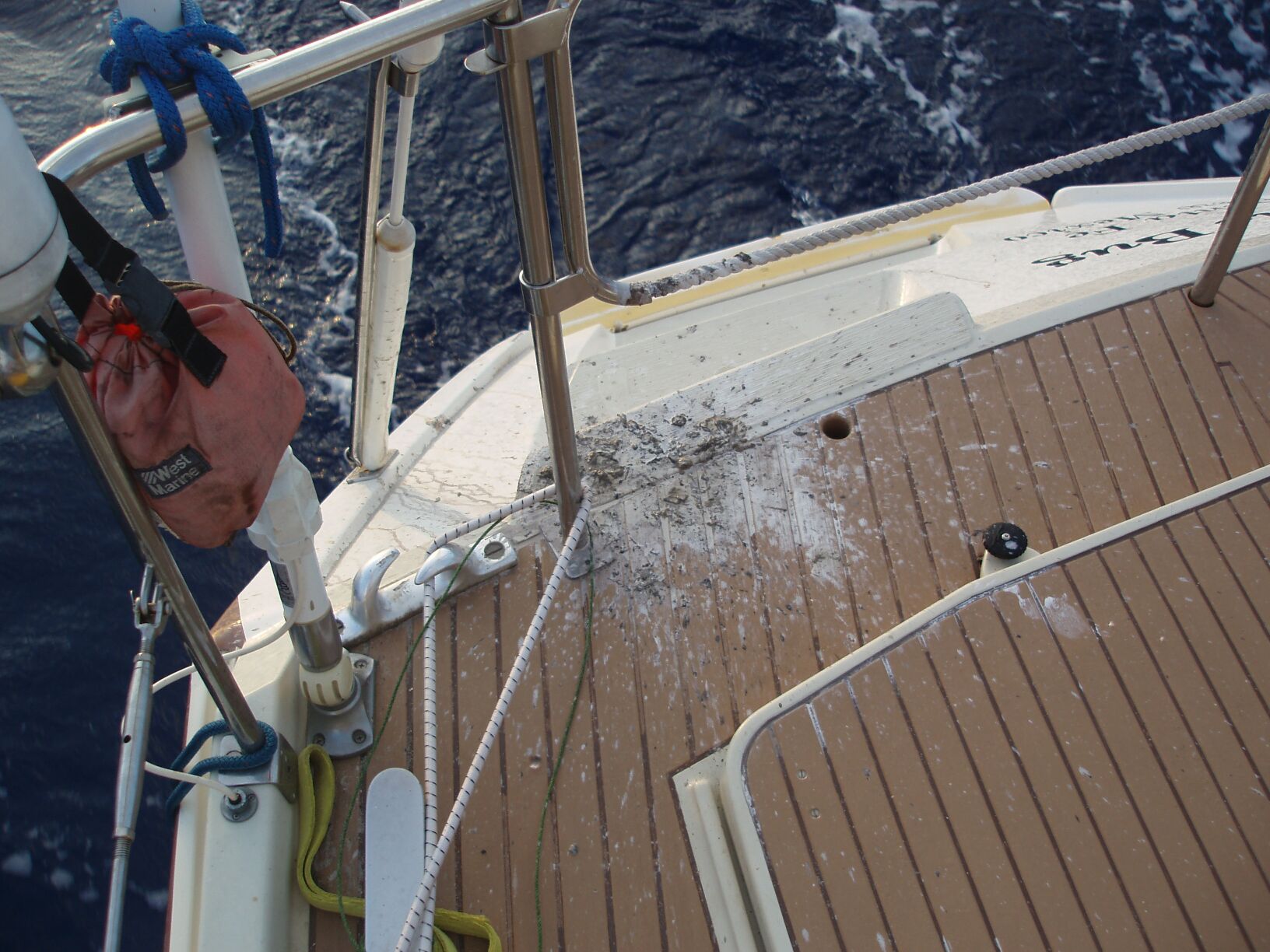 produced an enormous pile of bird shit, that defied even determined efforts with a brush and sea-water to remove. This is the first time on our cruise that this has happened and I told Annette that
we can add one more item to our watch schedule, that is we will check the roosting area with a flashlight at regular intervals throughout the night.
produced an enormous pile of bird shit, that defied even determined efforts with a brush and sea-water to remove. This is the first time on our cruise that this has happened and I told Annette that
we can add one more item to our watch schedule, that is we will check the roosting area with a flashlight at regular intervals throughout the night.
All good things must come to an end and after completing a 24 hour run of 165 miles, a line of rain cells passed us by. There was just a little wind associated with the mini-"front" but the wind shifted 30 degrees from the dead run we have held for 8 straight days. We went to a broad reach with Genoa, main and mizzen but left the ballooner rigged and laid flush across the Genoa. After an hour, there had been no change in wind direction and we struck the ballooner, de-rigged it's pole and packed everything away. Right on cue, the wind switched back to a dead run and our speed dropped. We re-rigged the Ballooner, only this time the head of the Ballooner would not" lock" into it's fitting at the top of the forestay. We lowered it, checked everything, tried again. At the third attempt, the process worked and the Ballooner luff was in place. Unfortunately the sail had now blown behind the Genoa and the sheet (sailor word for rope) was completely under the hull and running to the pole on the opposite side of the boat. Annette is meanwhile buried under a pile of Ballooner and trying to hold it out of the water. I ran a second line to the Ballooner clew and lashed it to the boat, untied the sheet and let it go. It zipped out of my hands, as we were still under full sail and was soon trailing in the water on the starboard side, well out of reach. I swung the pole back in to the vessel, grabbed the soaking line, re-rigged the pole, reattached the sheet to the Ballooner and rescued Annette, who was completely hidden but grimly hanging on. What a fun way to pass a morning!
This pattern of light shifting winds continued all day and we chased the wind until at 1500 hours we gave up, dropped the Ballooner and sailed all-night on a broad reach with poled Genoa, main, mizzen and mizzen staysail.
October 30, 2006
0930 hours local time. Anchored off Ile Fouquet, Salomon Island, Chagos Archipelago at 05 20.2 S 072 15.9 E after passage of 9 days from Cocos Keeling. All well on board.
Annette woke me in the dark of the night to tell me it was my shift and that there was also "good news" and "bad news". The
good news was that our birdy friend had not returned to his perch of the previous night. The bad news was that he had now selected the top of the mizzen mast. We yelled, we used bright
lights, we shook the rigging, all to no avail. As the boat rolled, the mizzen staysail and the mizzen would snap full of wind and the mizzen mast would whip. Our passenger was unruffled. He would
flap his wings and look down at us as if to say, "This must be one of those "E" ticket rides. Cool!".
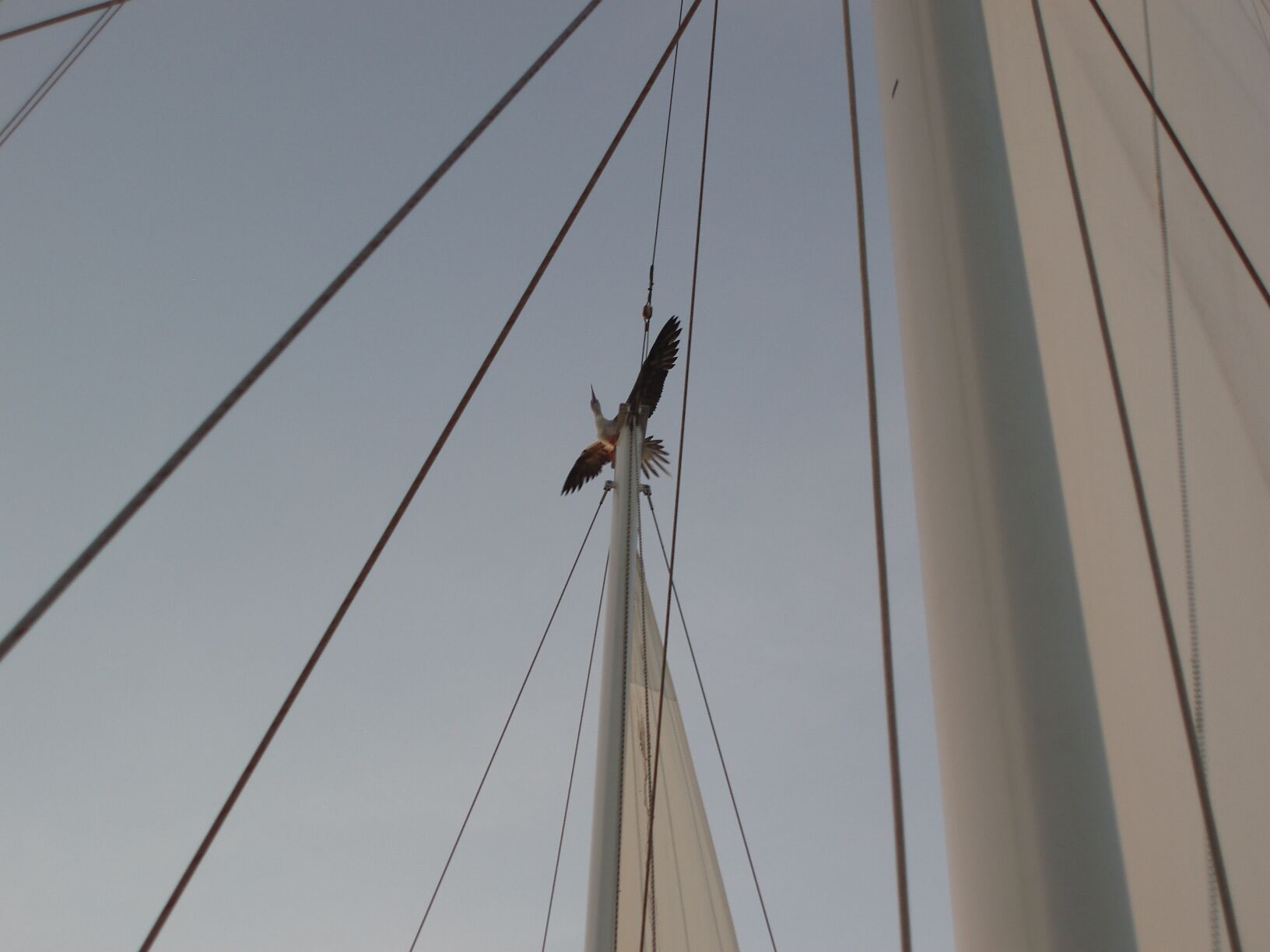 This bird was a real pro. All-night long a steady stream of shit fell from the heavens. I was amazed that a living organism could maintain it's living functions while excreting that
amount of it's body weight. Everything within a radius of 20 feet of the mizzen mast received it's due. The mizzen sail, port sheet winch and port deck received a liberal coating. All night long
the quiet of the night was punctuated by the sound of processed fish hitting the bimini.
This bird was a real pro. All-night long a steady stream of shit fell from the heavens. I was amazed that a living organism could maintain it's living functions while excreting that
amount of it's body weight. Everything within a radius of 20 feet of the mizzen mast received it's due. The mizzen sail, port sheet winch and port deck received a liberal coating. All night long
the quiet of the night was punctuated by the sound of processed fish hitting the bimini.
At 0330 hours the wind died away to a whisper and we motor-sailed for the first time. We could not see our destination until we were perhaps 10 miles away, although
the radar display confirmed it's existence.
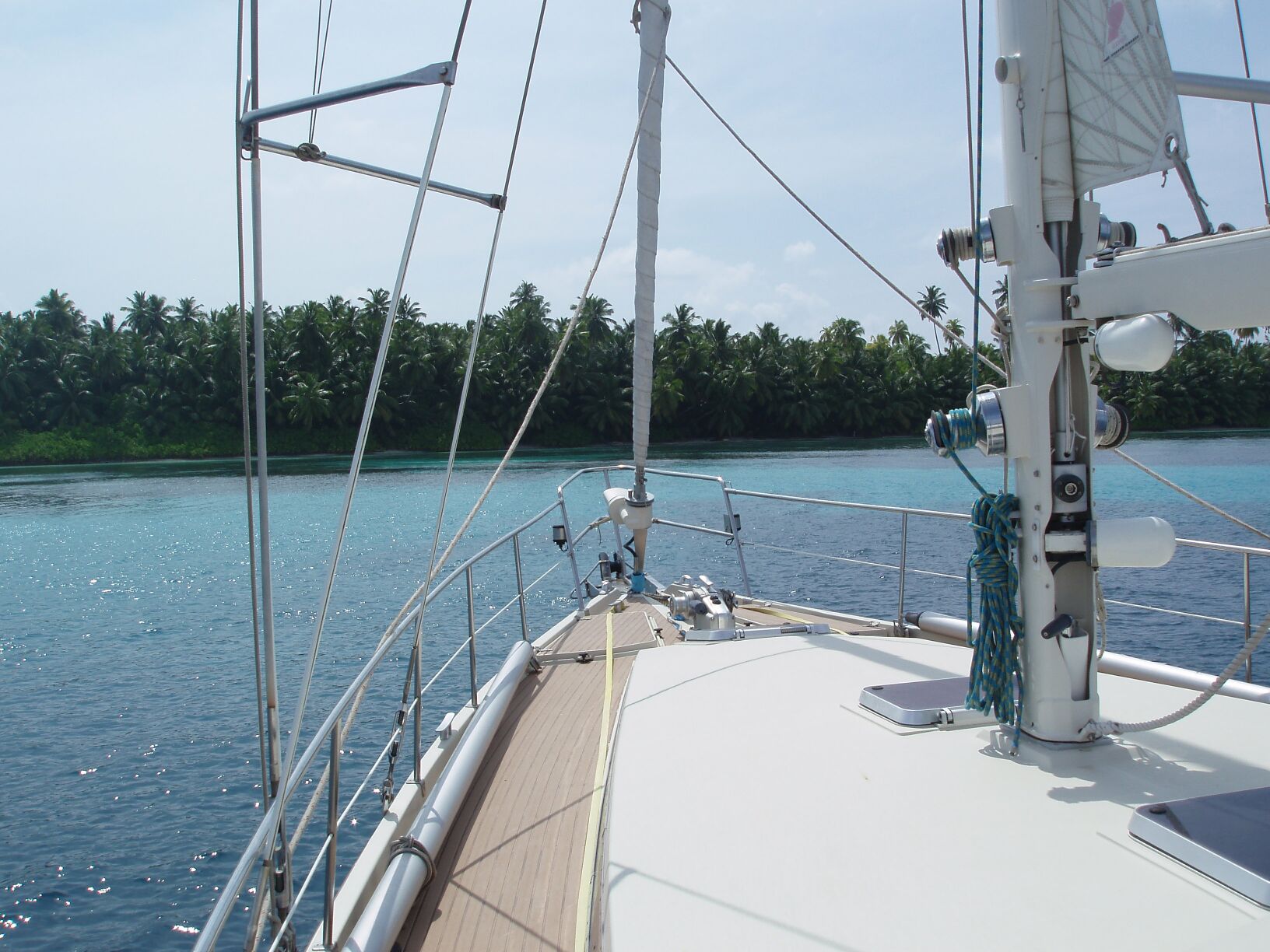 We sailed through the lagoon pass at 0900 hours and carefully transited the lagoon, with Annette standing some 10 foot off the deck on the main shrouds, scanning ahead for obstacles.
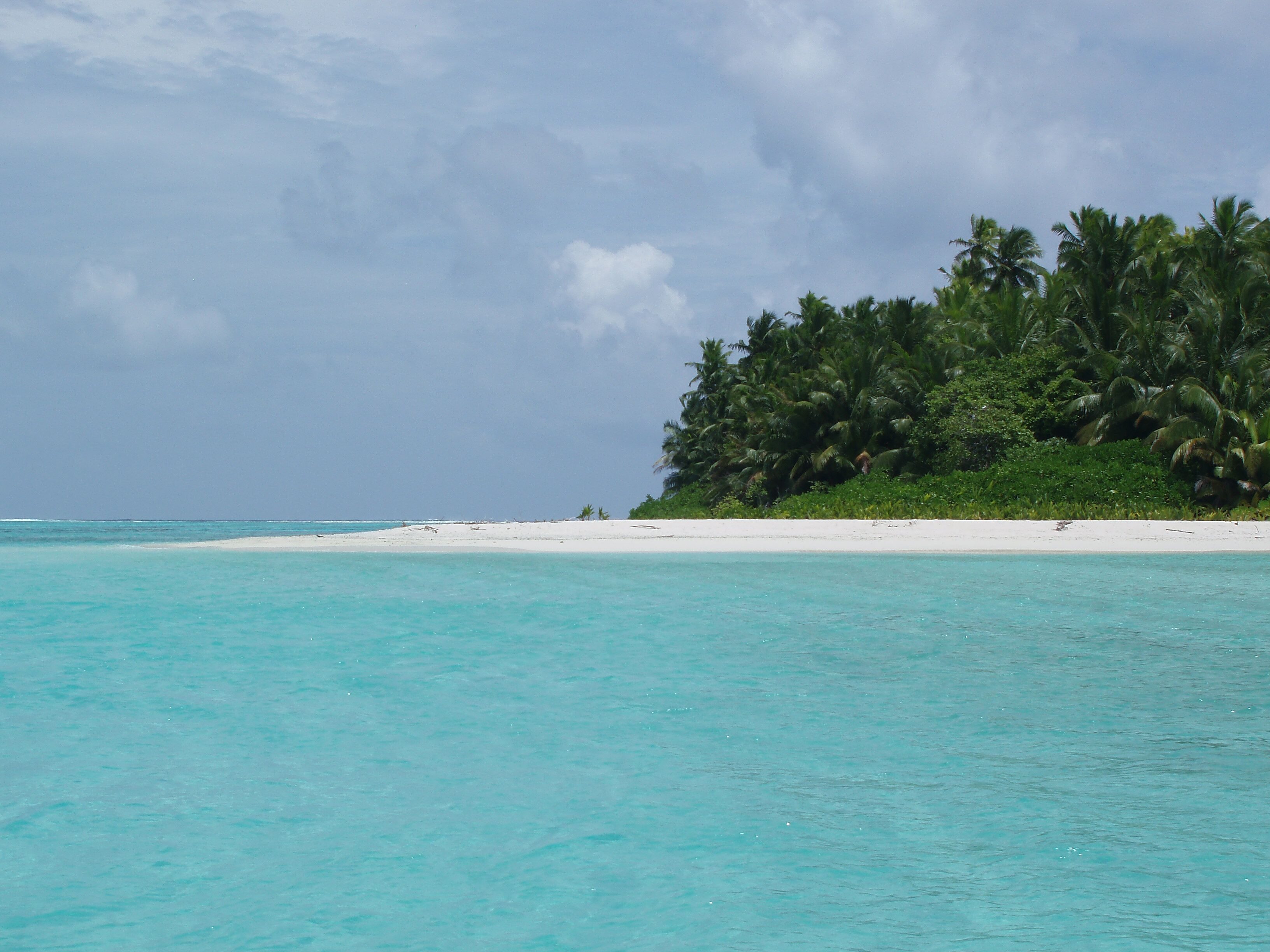
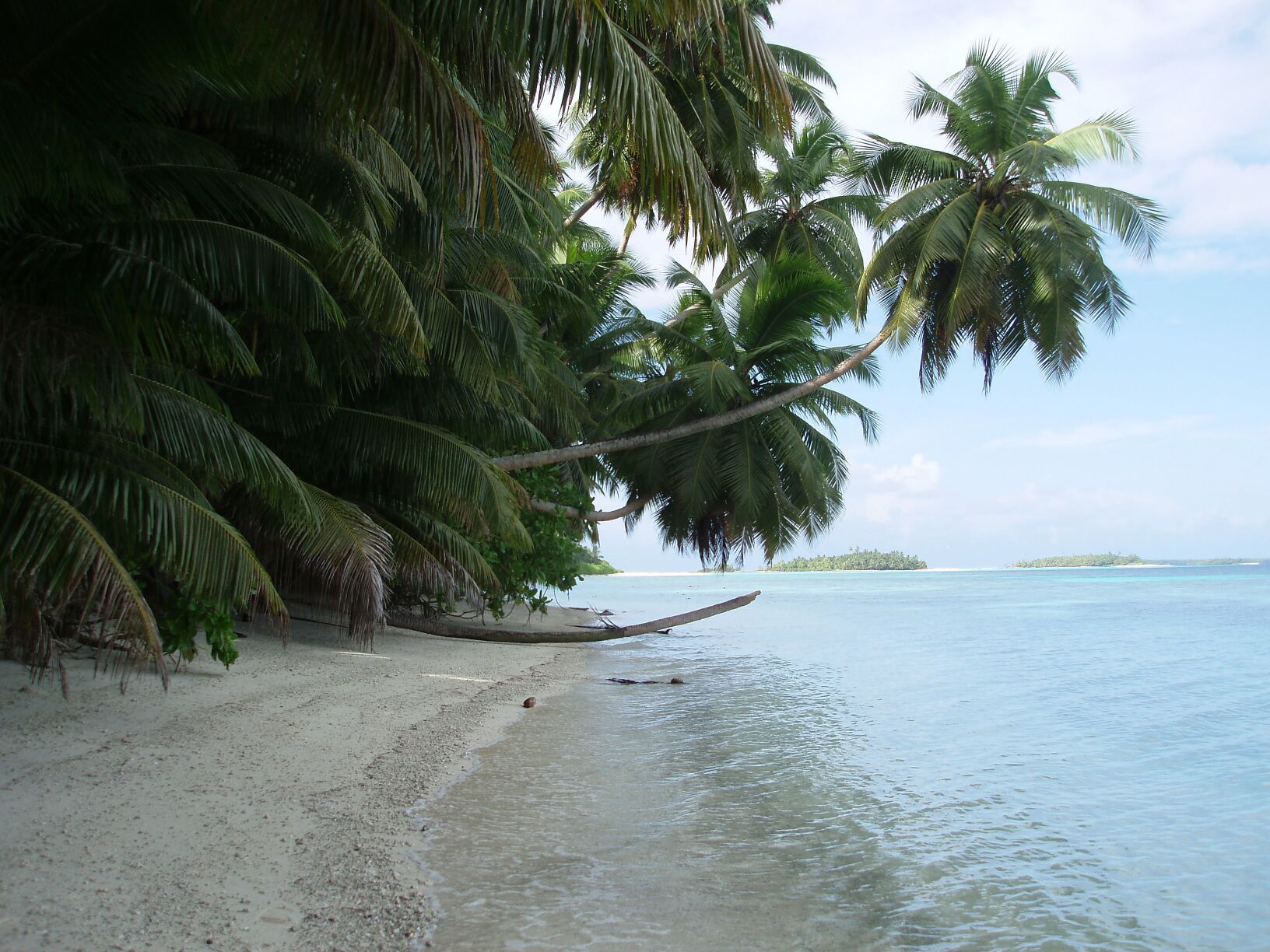
We anchored at 05 20.2 S 072 15.9 E behind a small islet called "Fouquet". There are two other yachts anchored within a mile or so. The sand is white, the islet covered in the green
of coconut palms, the lagoon is azure. We are here.
We sailed through the lagoon pass at 0900 hours and carefully transited the lagoon, with Annette standing some 10 foot off the deck on the main shrouds, scanning ahead for obstacles.
We anchored at 05 20.2 S 072 15.9 E behind a small islet called "Fouquet". There are two other yachts anchored within a mile or so. The sand is white, the islet covered in the green
of coconut palms, the lagoon is azure. We are here.
October 31, 2006
Background: I have not found much background history for Chagos but what seems to have happened was that all of these islands belonged to Britain, either by discovery or conquest. In 1965, Britain granted independence to the Seychelles and the surrounding islands were handed back to the newly formed government. However, Britain retained ownership of the Chagos Archipelago and purchased it from Mauritius. (At this time Chagos became a British Ocean Territory). In 1970, Diego Garcia was leased to the USA as a communications, naval, and air base, although the base almost certainly existed and was already established. The Vietnam war was well under way and Diego Garcia made a wonderful, unsinkable aircraft carrier right in the strategic center of the Indian Ocean. At the time of the lease, around 1,200 indigent islanders were evicted from the islands. There were International protests and Britain promised to help Mauritius resettle the evictees. I believe that I read somewhere recently the descendants of the Islanders now want to return. They also want compensation based upon the Universal Principle that their forebears have already spent the first pay off. I think they also want Uncle Sam (in this case the tenant) to ante up, again based upon the lawyer's principle of who has the deepest pockets. From what we have seen of Salomon, the infrastructure of fresh water, industry, dockage and the like, to support a modern community, seem to be lacking.
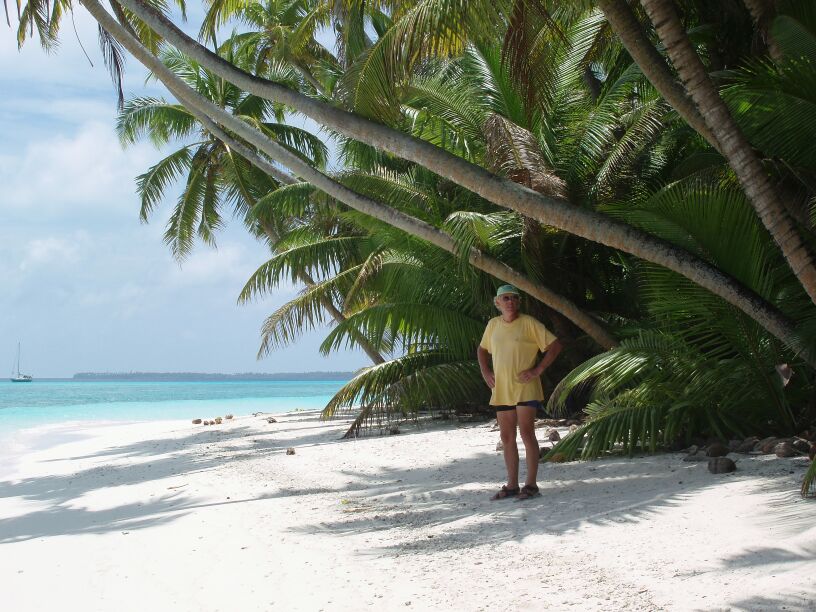
Yesterday we were visited by Jens Henning, a Danish single-hander aboard SV Carita. We had met Jens briefly at Christmas Island but he had Australian visa problems and decided to skip Cocos Keeling. His passage, like ours, was fast but he described it as "like spending several weeks in a washing machine at 30 C" ( ~ 90 degrees F). We spent yesterday and today just beach combing, exploring the jungle beyond the fringe of coconut palms and snorkeling the reefs.
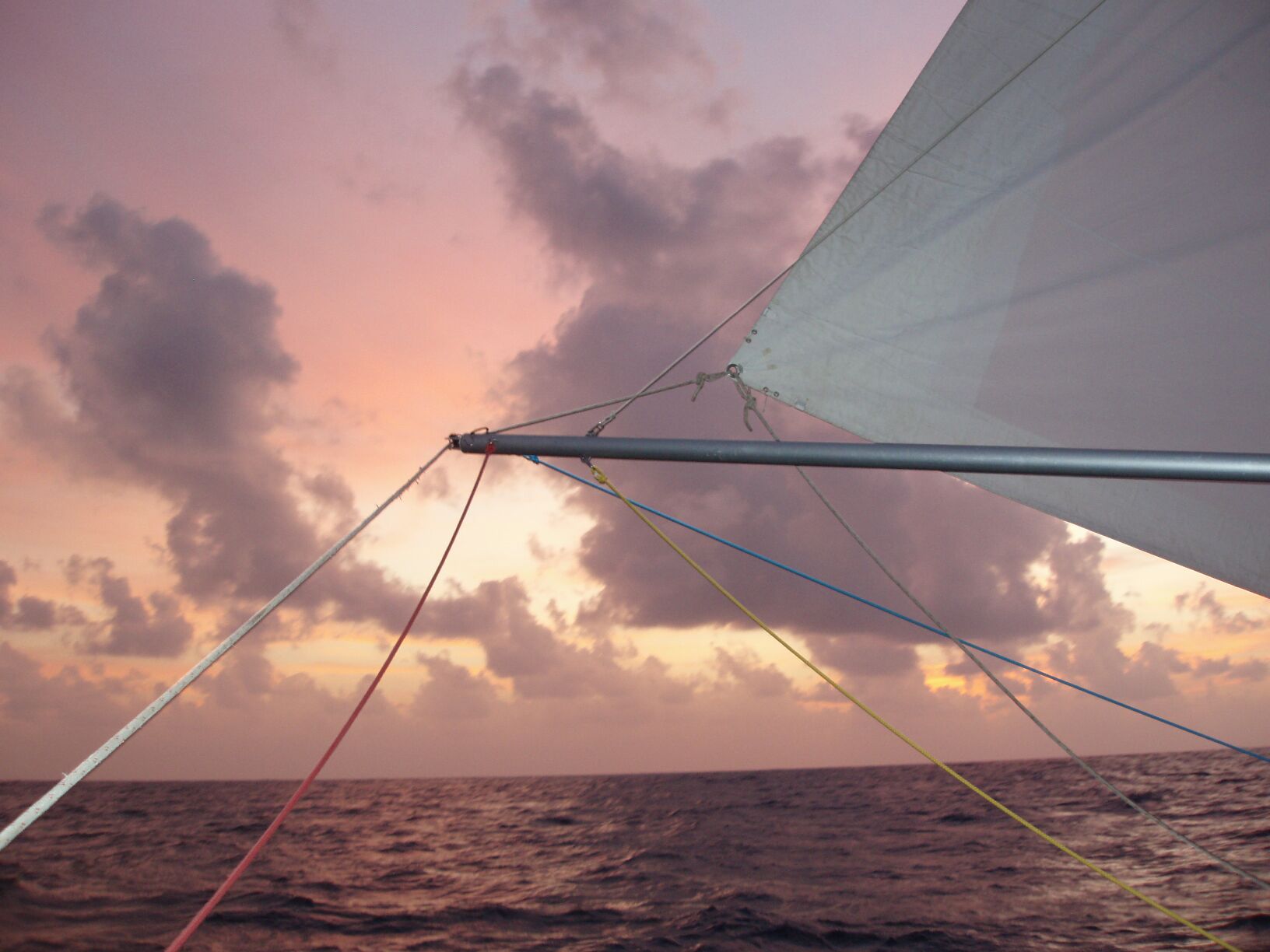
The sunsets have been colorful and moody, as we are now close to the equator and the ITCZ. The latter is the Inter-tropical Convergence Zone and is caused by high altitude, dry, cold air from the poles sinking at the earth's equator and meeting the moist tropical air from the northern and southern trade winds. The result is a belt of light winds with frequent clouds, rain cells, and thunderstorms as the two types of air masses meet. The belt of light shifting winds is called the "doldrums". One advantage of being here is that cyclones are very rare this close to the equator and we intend to sit out the beginning of cyclone season in the southern hemisphere and the end of cyclone season in the northern hemisphere in this relative haven before continuing our passage north.
Jen joined us on board DoodleBug for "sun-downers" and we watched a large pod of dolphins gamboling about the lagoon followed by a turtle and then a very large manta ray. The ray swam over the nearby reef, approaching within feet of DoodleBug. Its "wing tips" must have been nearly 12 feet apart. When it swam towards us near the surface of the calm water, we saw a broad "V" bow wave - just like in the "Jaws" movie. Occasionally the tail would appear in the middle of the disturbed water looking a little like a shark's fin but the give-away were the two smaller "fins" that were it's wing tips. Very exciting!
November 1, 2006
Jens left this morning to explore the "other" end of the lagoon leaving us all alone here. We explored Ile Takamaka by dinghy and, after penetrating the thick,
beach-edge jungle, found a cleared trail running most of the length of the islet. On this trail were several clearings and evidence of previous yachtie "camps". The
jungle trails were overhung with palm fronds and we could hear the sound of feral roosters calling. One of the clearings
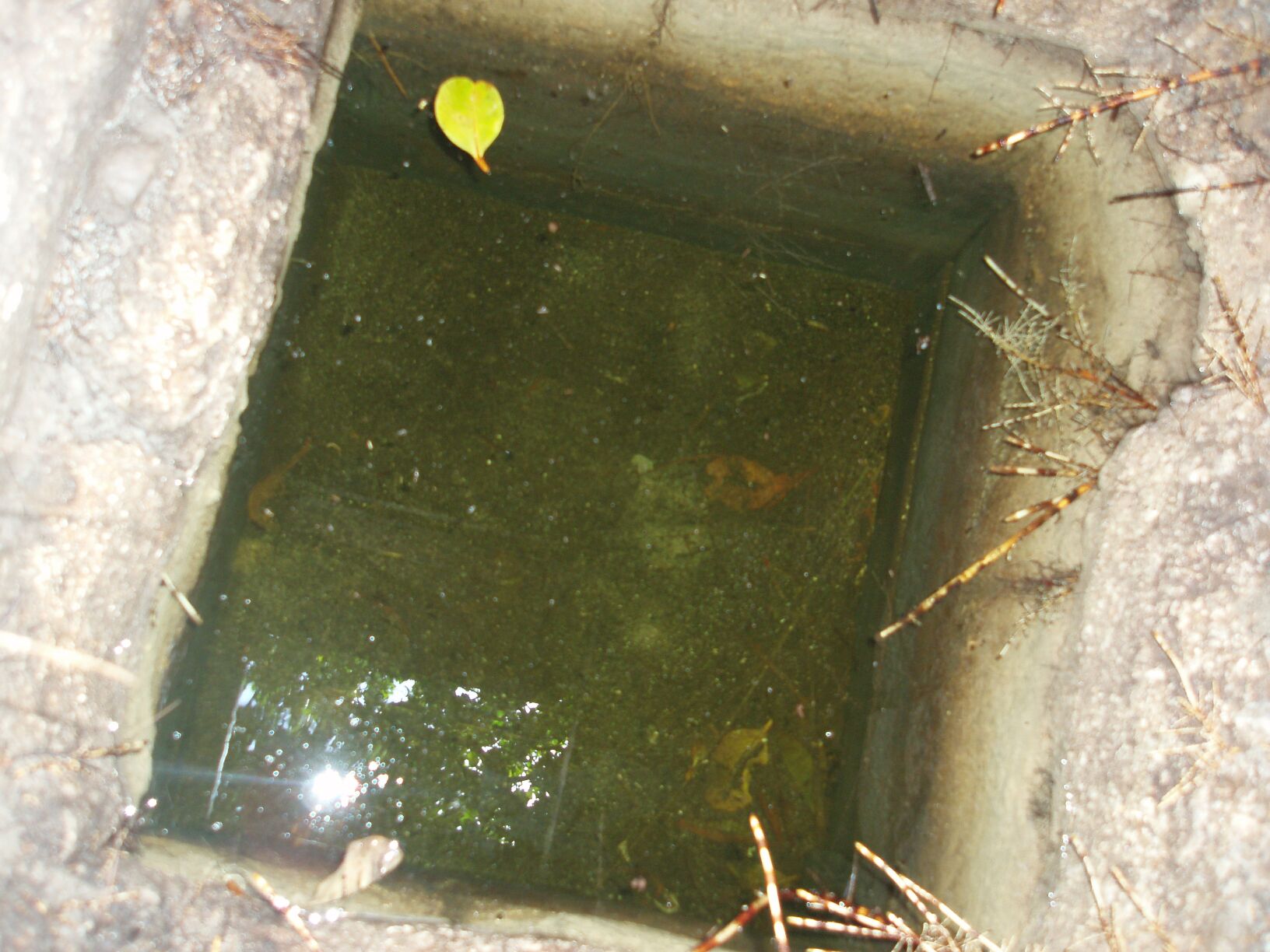 had the ruins of an old well. The water was salty, brackish, and uninviting and the mosquitoes were ferocious and determined. Another clearing had the remains of an ancient
oven. It shows signs of having been repaired and maintained by voyagers such as ourselves but the hygiene did not look so great. Annette assured me that the temperature needed to bake bread
kills off any and all bugs. Oh yummy.....
had the ruins of an old well. The water was salty, brackish, and uninviting and the mosquitoes were ferocious and determined. Another clearing had the remains of an ancient
oven. It shows signs of having been repaired and maintained by voyagers such as ourselves but the hygiene did not look so great. Annette assured me that the temperature needed to bake bread
kills off any and all bugs. Oh yummy.....
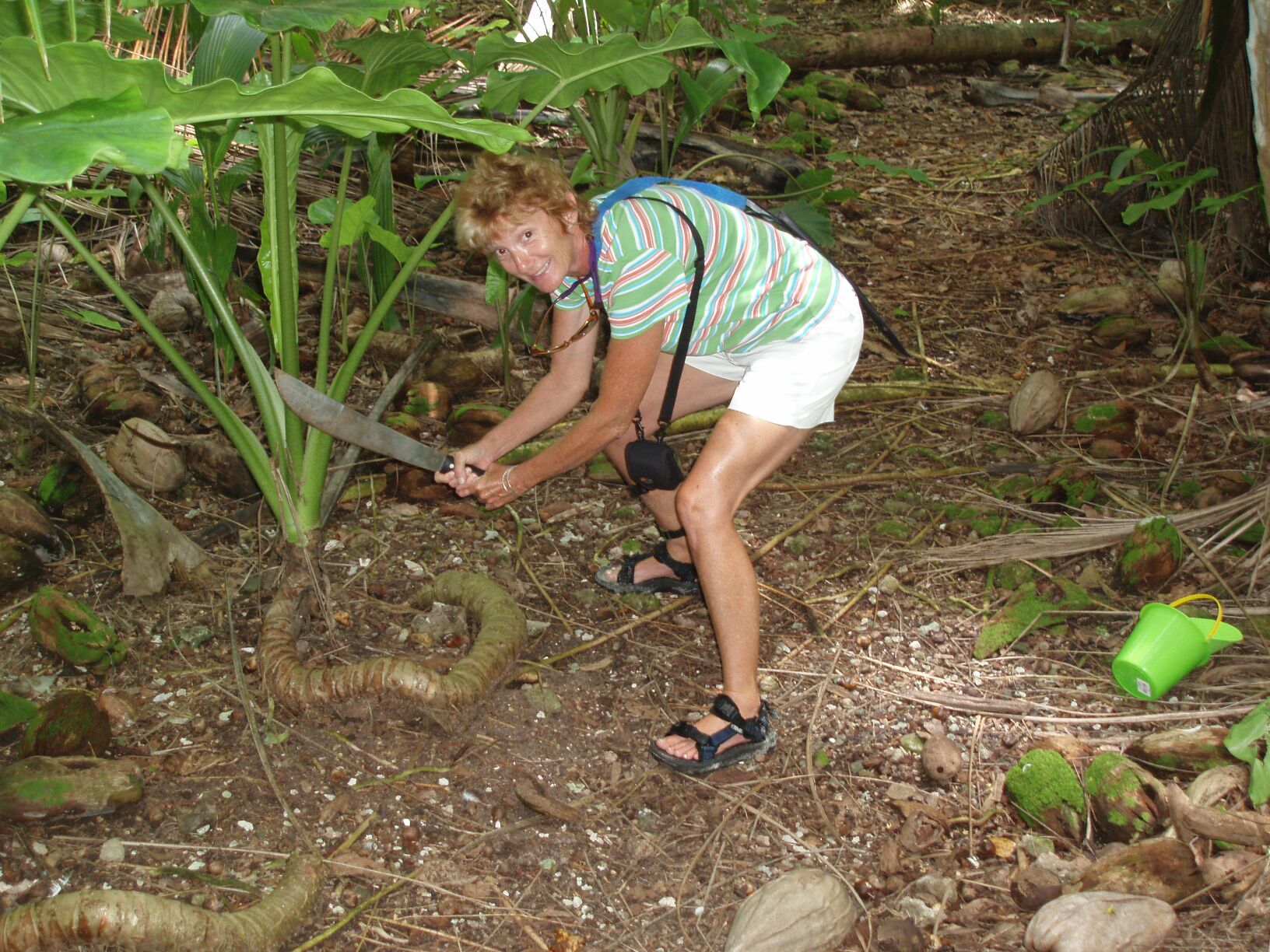
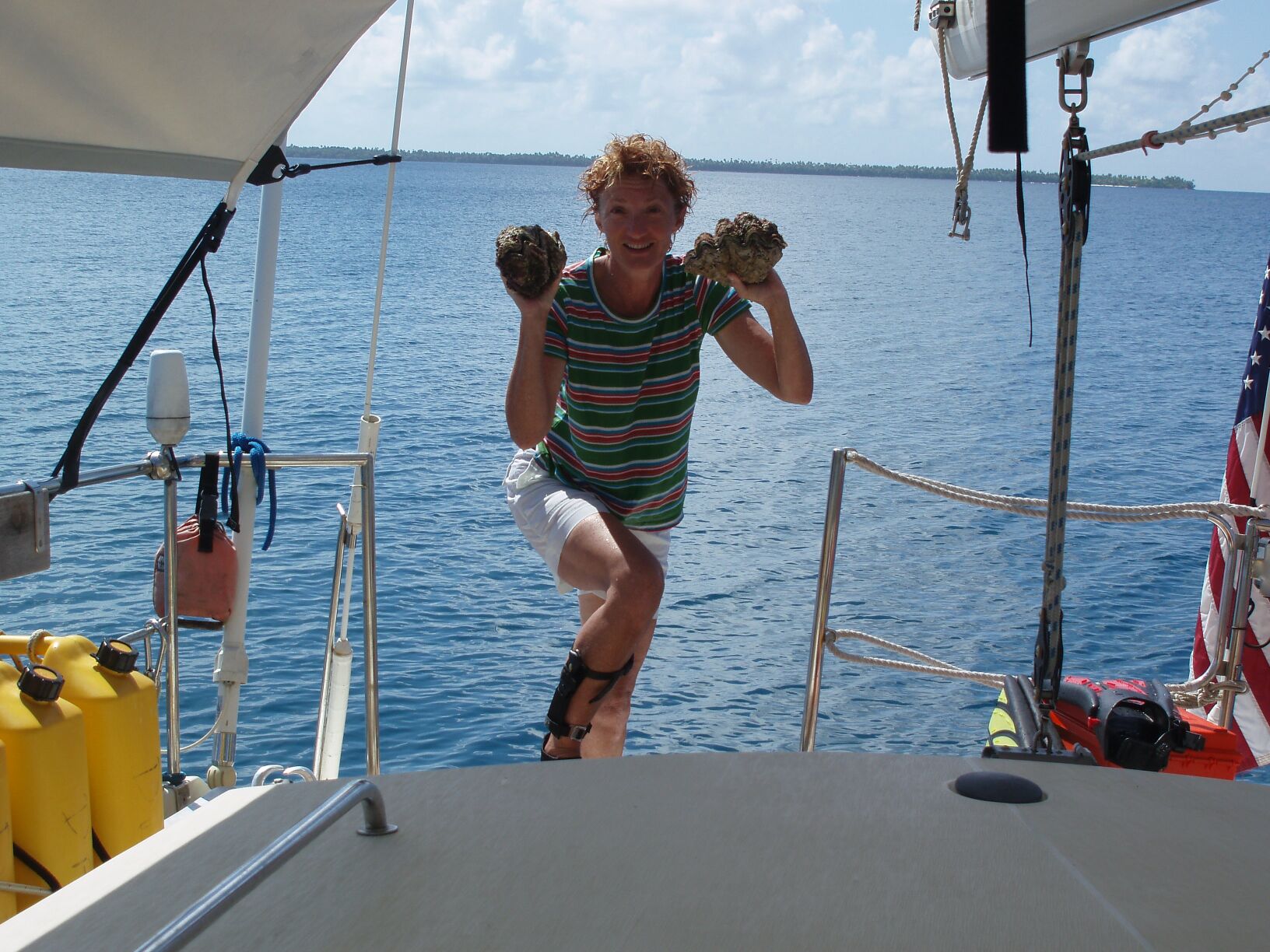
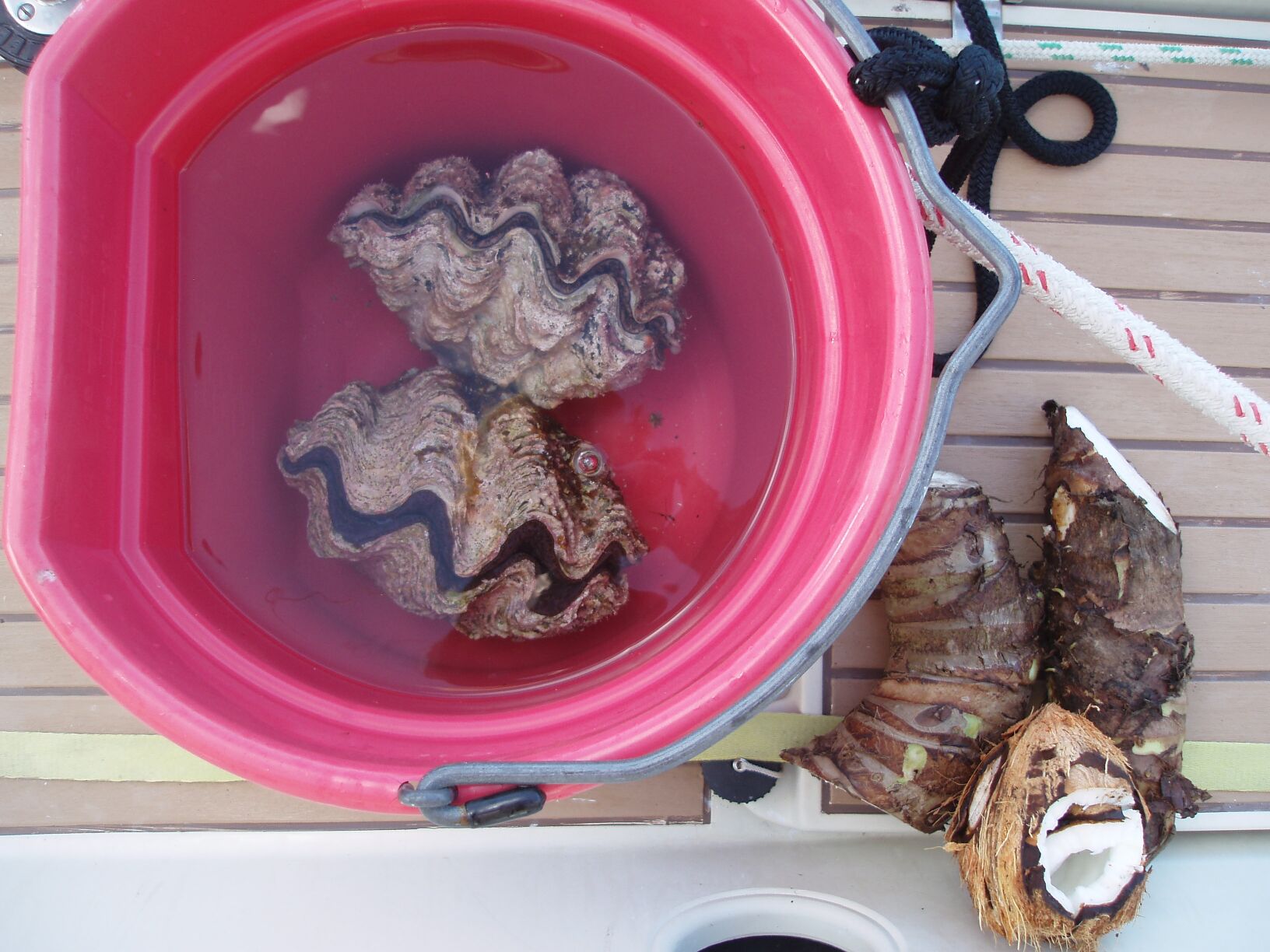
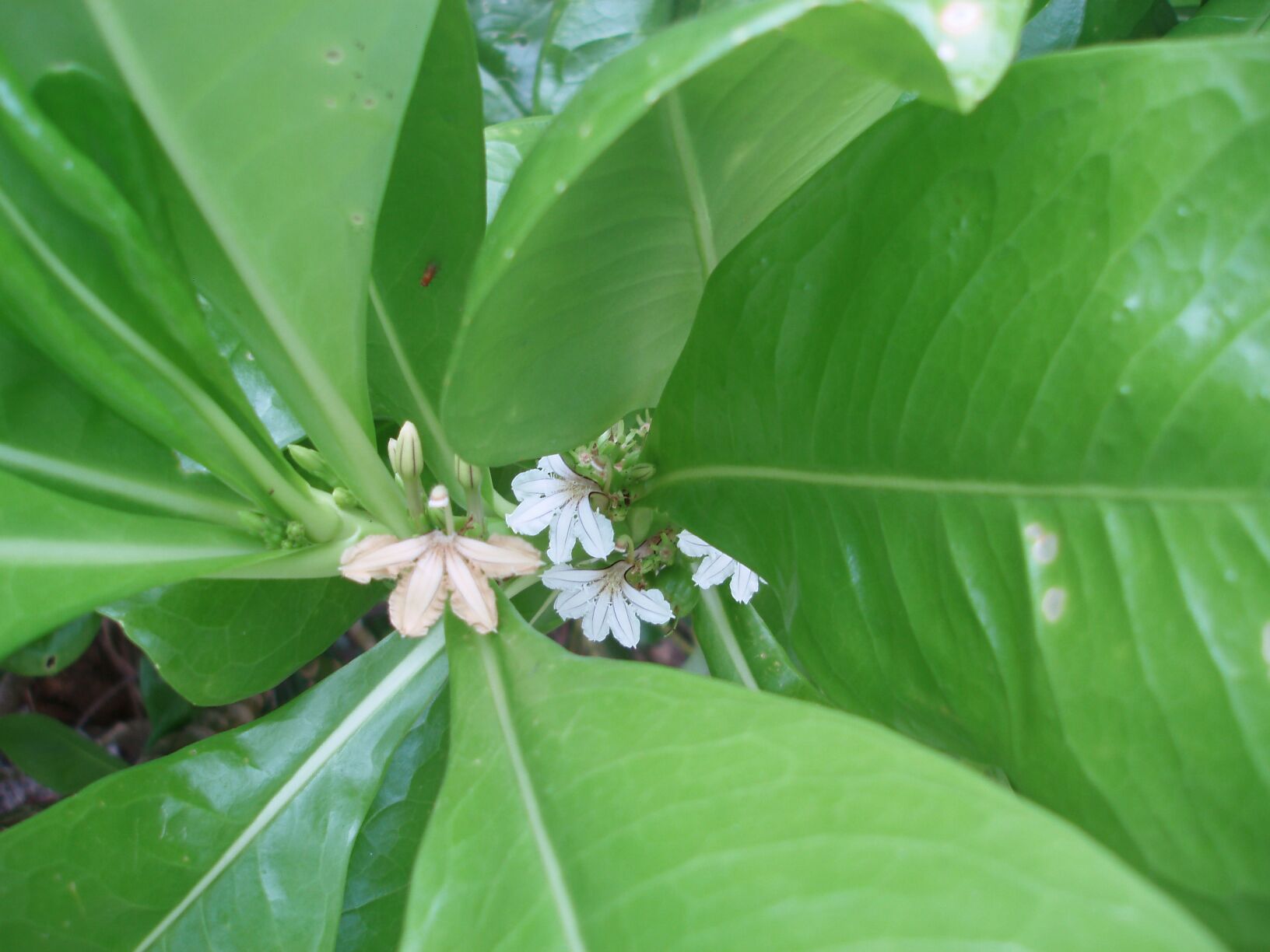
Annette hacked a recently dropped coconut down to it's edible constituents and also found a large patch of wild "taro". She hacked off a large root and we hauled our gatherings back to the dinghy. By this time we were sweaty, covered in bug-spay, itching with mosquito welts and definitely hot. We snorkeled the reef to cool down near Doodlebug and where we had seen the turtle/manta ray. The reef was in excellent condition with fish of all colors and sizes and a cornucopia of corals. Annette found a colony of large clams and decided to add a couple of these to the day's collection. These were deposited in a large bucket of sea-water back aboard DoodleBug and given a scoop of cornmeal to feast upon.
November 2, 2006
This morning Annette decided to fix the taro root with grated coconut, egg and flour. Fortunately (or unfortunately depending on your perspective) she
tasted a small piece of the cut taro. Immediately, her mouth began to burn as well as the hand that had touched the cut root. She spat out the partially chewed root
before she swallowed any but her mouth and throat were burning and inflamed. We spent the day medicating her and reading medical journals on the
 treatment of poisoning. The giant clams were also reprieved thanks to the taro and returned to the portion of the reef where they had been harvested. No more hunter/gathering in the
jungle! At least not this far from an emergency room.
treatment of poisoning. The giant clams were also reprieved thanks to the taro and returned to the portion of the reef where they had been harvested. No more hunter/gathering in the
jungle! At least not this far from an emergency room.
November 3, 2006
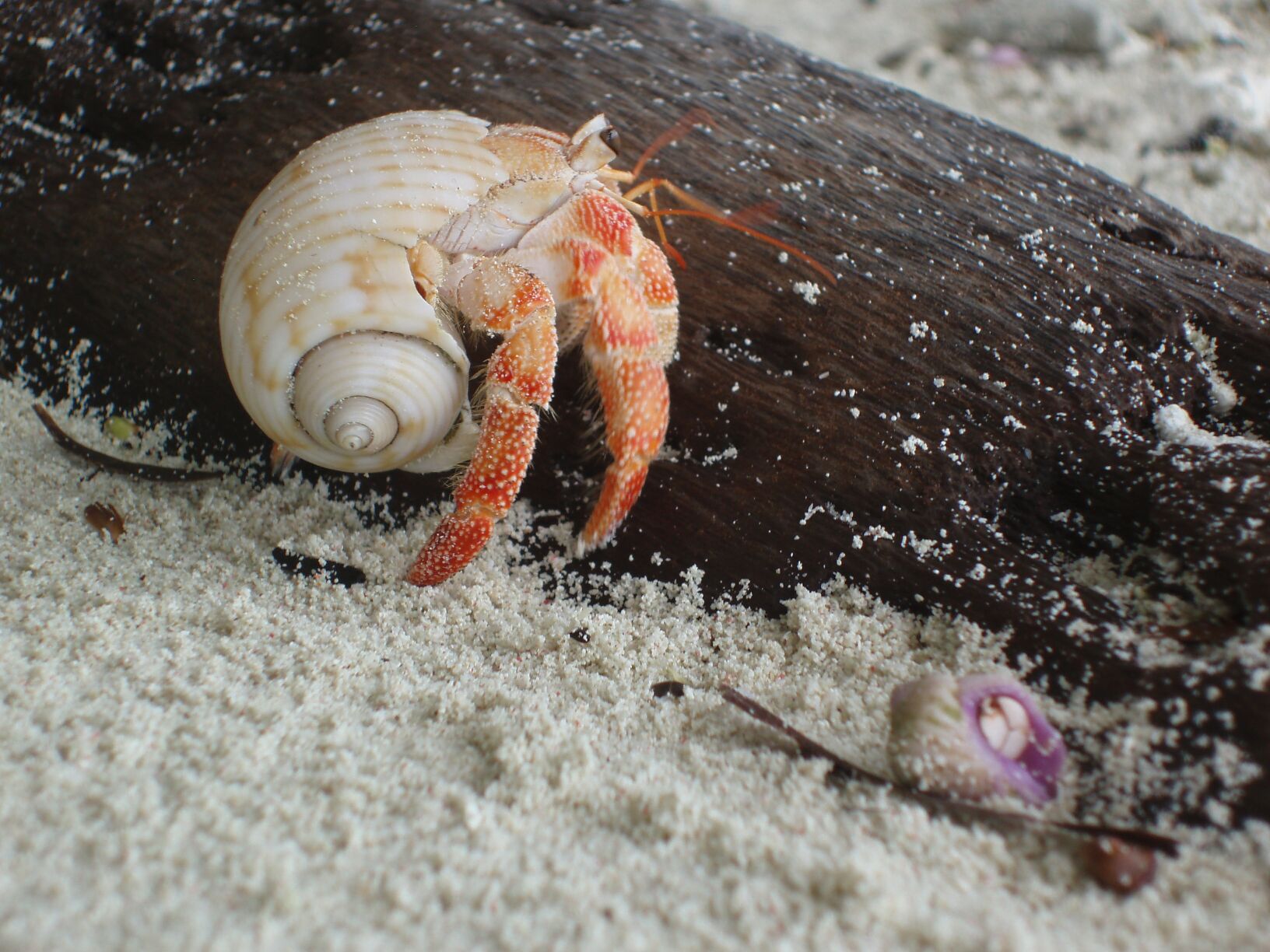
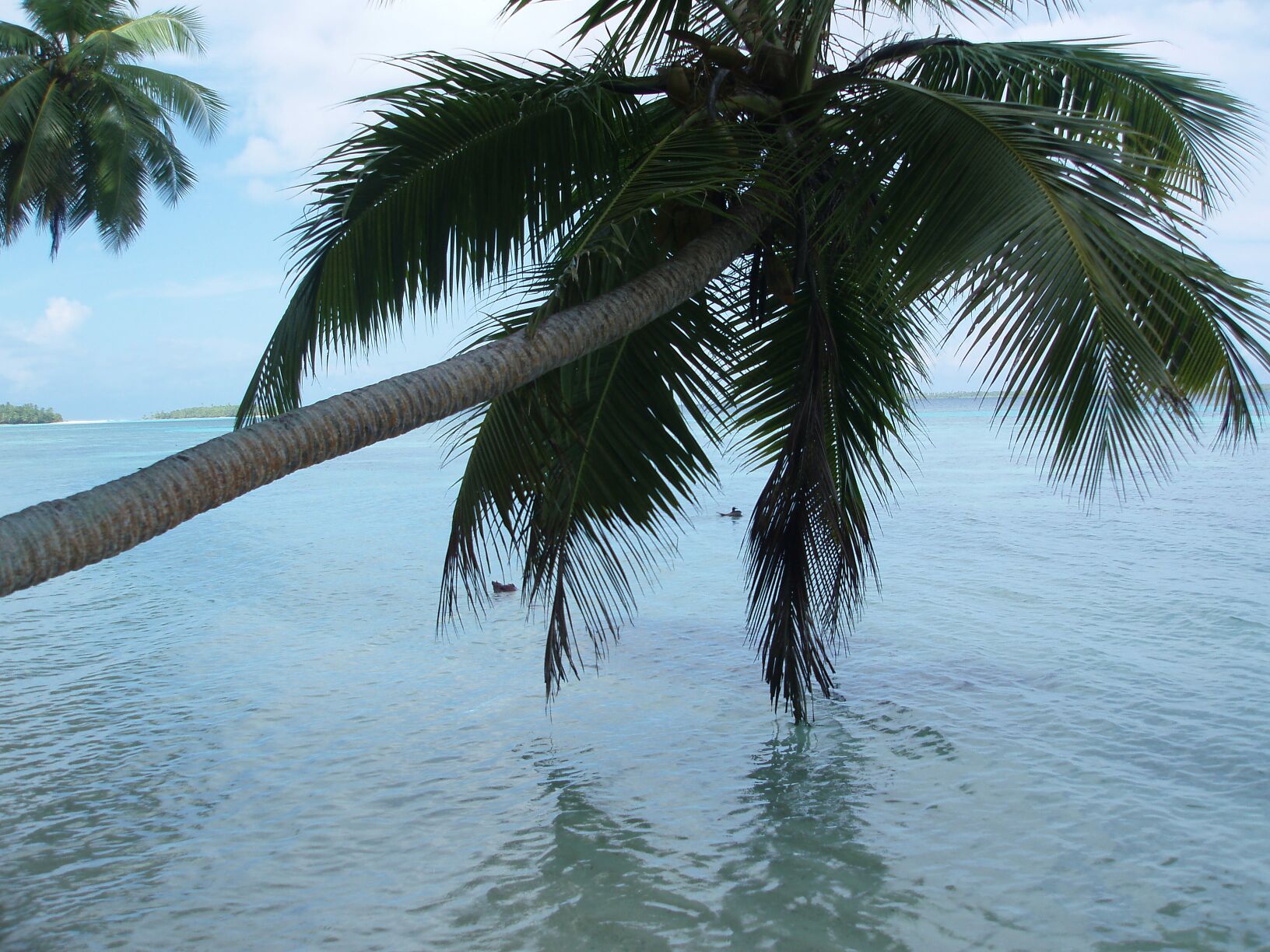
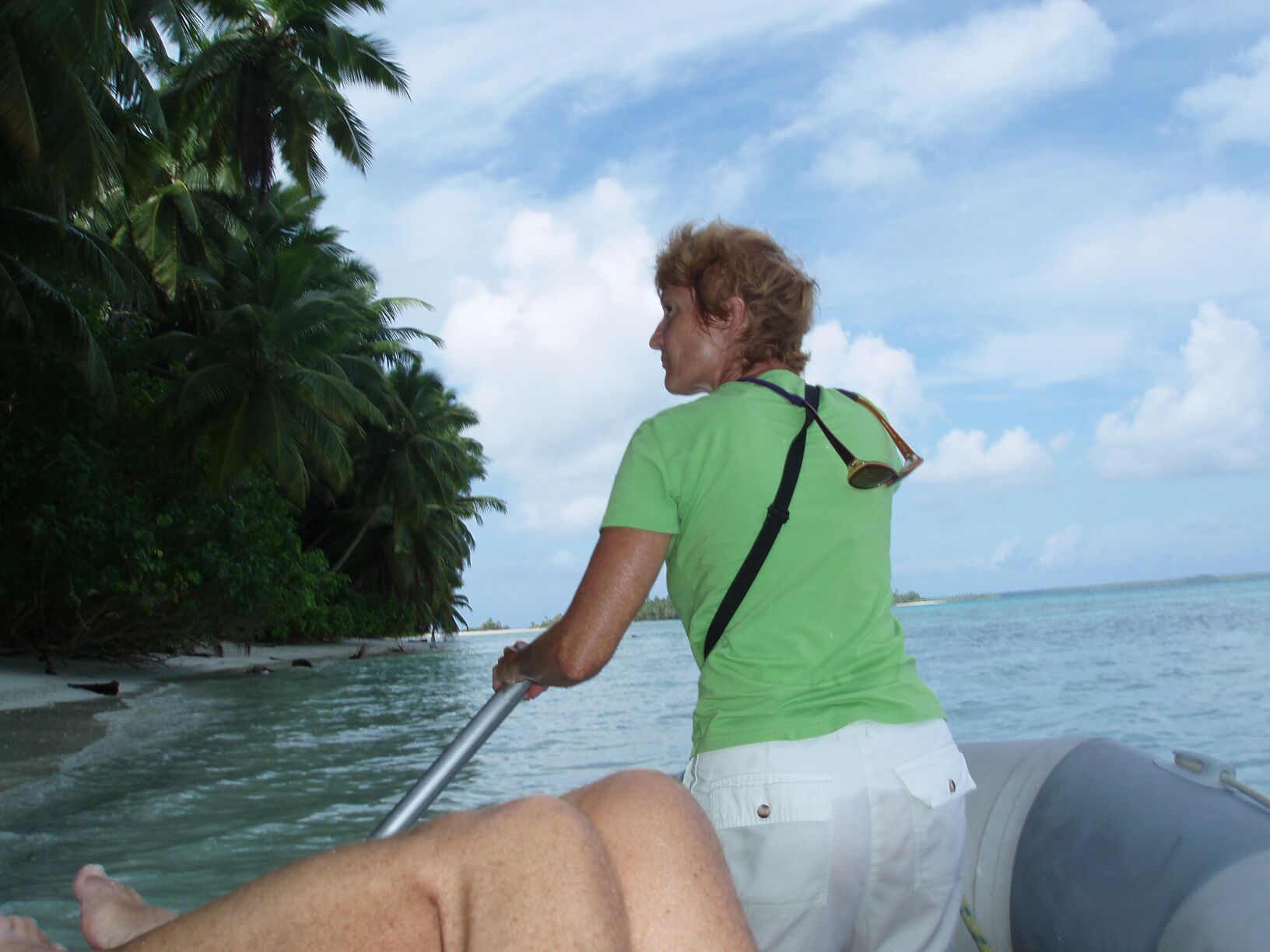
Annette has mostly recovered from her attempt at self-poisining with Calcium Oxalate crystal bundles (son, Matt, sent a Wikipedia extract on "taro") and we spent the morning beach combing along the Ile Fouquet lagoon-side beach. The white coral sand was exposed by low tide and we walked the length of the island trying to avoid stepping on the carpet of hermit crabs underfoot. The crabs and birds seem very tame and allow you to approach them within a foot or so. We had brought the dinghy up the beach and took turns in drifting under the overhanging palm fronds while the "on watch" person attempted to paddle us along the beach front with our remaining oar (our other oar was "stolen" in Cocos Keeling). At the end of the islet's lagoon beach, the water shallowed into a large sand bank with a band of coral running perhaps 50 yards offshore. We anchored the dinghy in a clear patch of sand and spent an hour or so snorkeling the reef. The water clarity was surprisingly good this close to the beach and the corals in good condition with lots of fish.
Annette found a large sting ray, perhaps 10 foot long head to tail, that was laying on the bottom and almost completely camouflaged by the sand on its' back. Its two eyes protruded and watched us as we swam around. I swam back to retrieve the dinghy in order to reanchor it further up the reef and keep pace with our explorations. When I returned, I found Annette dropping small pieces of coral and shells on the back of the beast from perhaps 10 feet above. The nasty little brat was trying to get it to move and there were by now perhaps a dozen items sitting on it's back. It would shrug as one hit but seemed very tolerant of the intrusion. This shallow, white coral sand bank seems to be a favorite with rays. We found two more sting rays on the sea bed and a pair of black eagle rays swimming over the reef.
November 4, 2006
We had intended to move DoodleBug to the other end of the lagoon this morning but we were hit by a squall at 0100 hours. The rain bucketed down and the winds gusted to around 25 knots. This is not enough wind to threaten our anchoring security but we had rigged our "Shade tree" awnings. These awnings cover the main cabin area and mizzen deck to make living conditions more tolerable in the heat of the day. They are not designed to be able to withstand winds of much more than 25 knots and we were monitoring conditions anxiously. We did not want to have to attempt to strike the larger of the two awnings in 30 knot winds, darkness, and pouring rain. Fortunately, the squall was gone in about 30 minutes. The wind had shifted to the north northeast and rain cells continued throughout the night and the rest of the day. During a lull, we struck the biggest awning and lashed it to the side deck. The wind direction has swung Doodlebug around so that she is now parallel to the beach. The wind was also blowing along the long axis of the lagoon and would be producing waves at our proposed anchorage. We decided to stay right where we are and call this a "rain day". We settled in to do a few chores, read books, and watch movies. It even rains in paradise.
November 5, 2006 through November 8, 2006
Sunday morning we waited until 1000 hours and then raised anchor and moved some 3 miles to the southwest motoring through the lagoon to anchor off "Ile Baddam". A midmorning start was necessary in order to spot the numerous "bombies" in the lagoon.
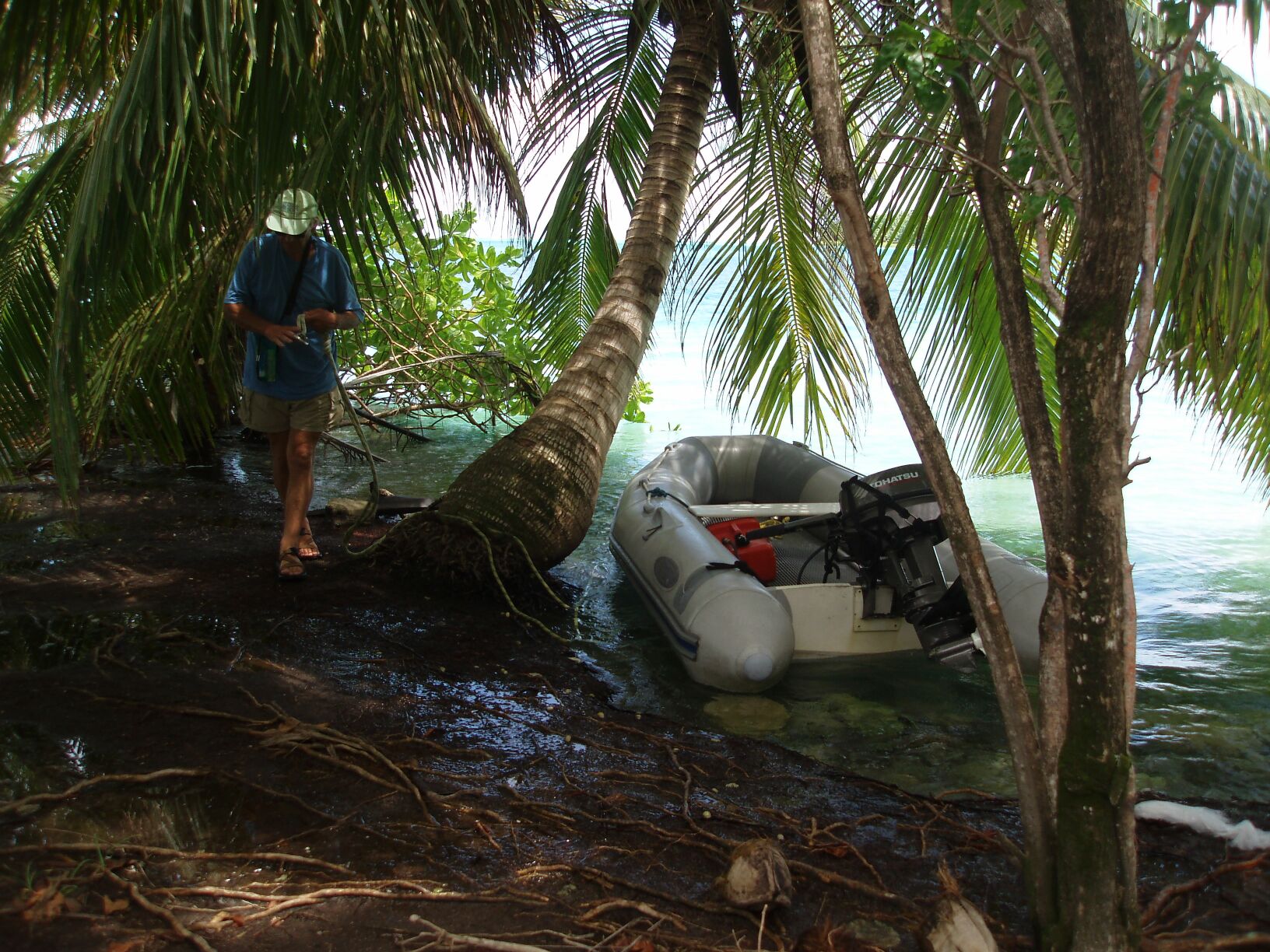
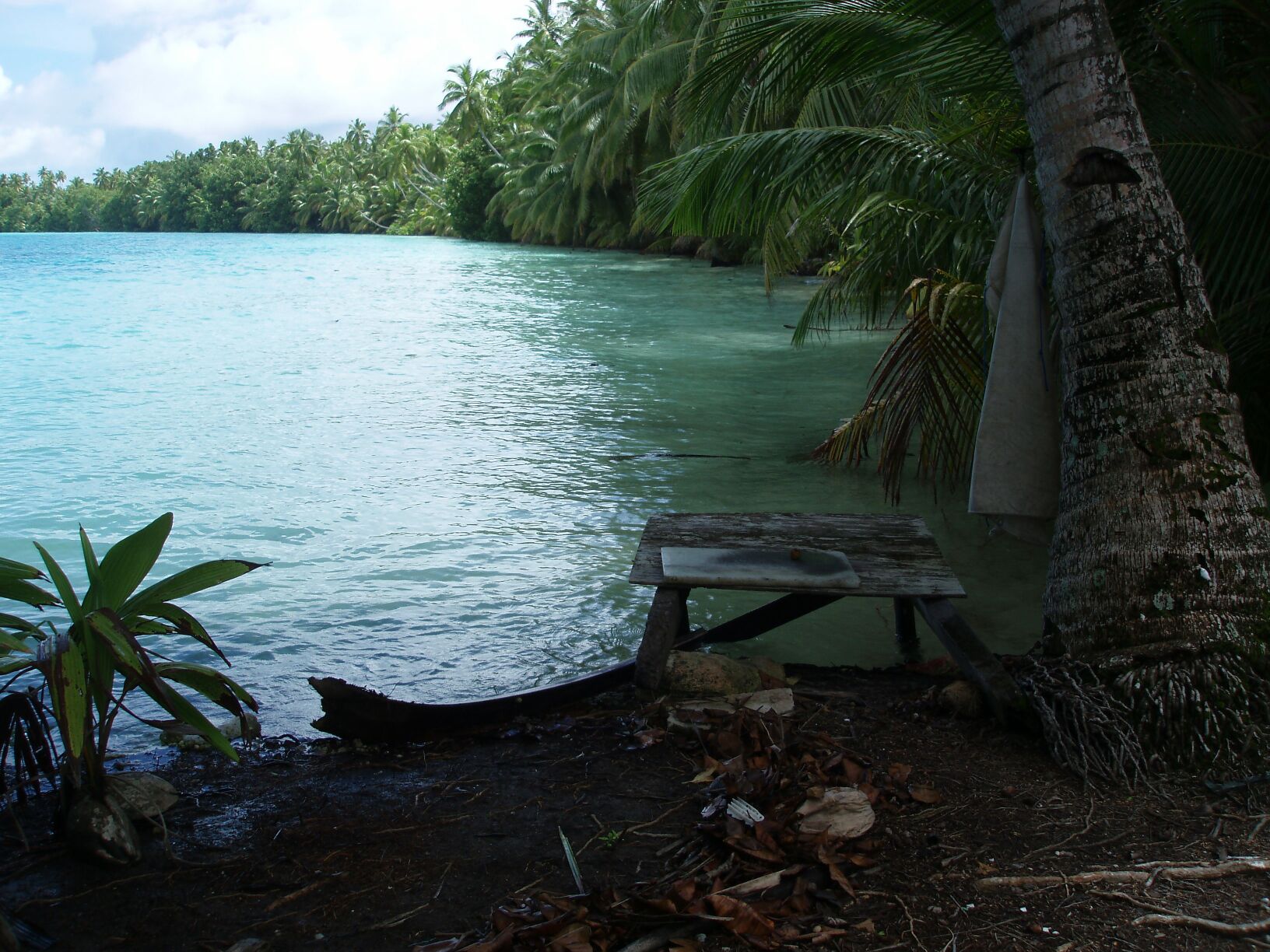
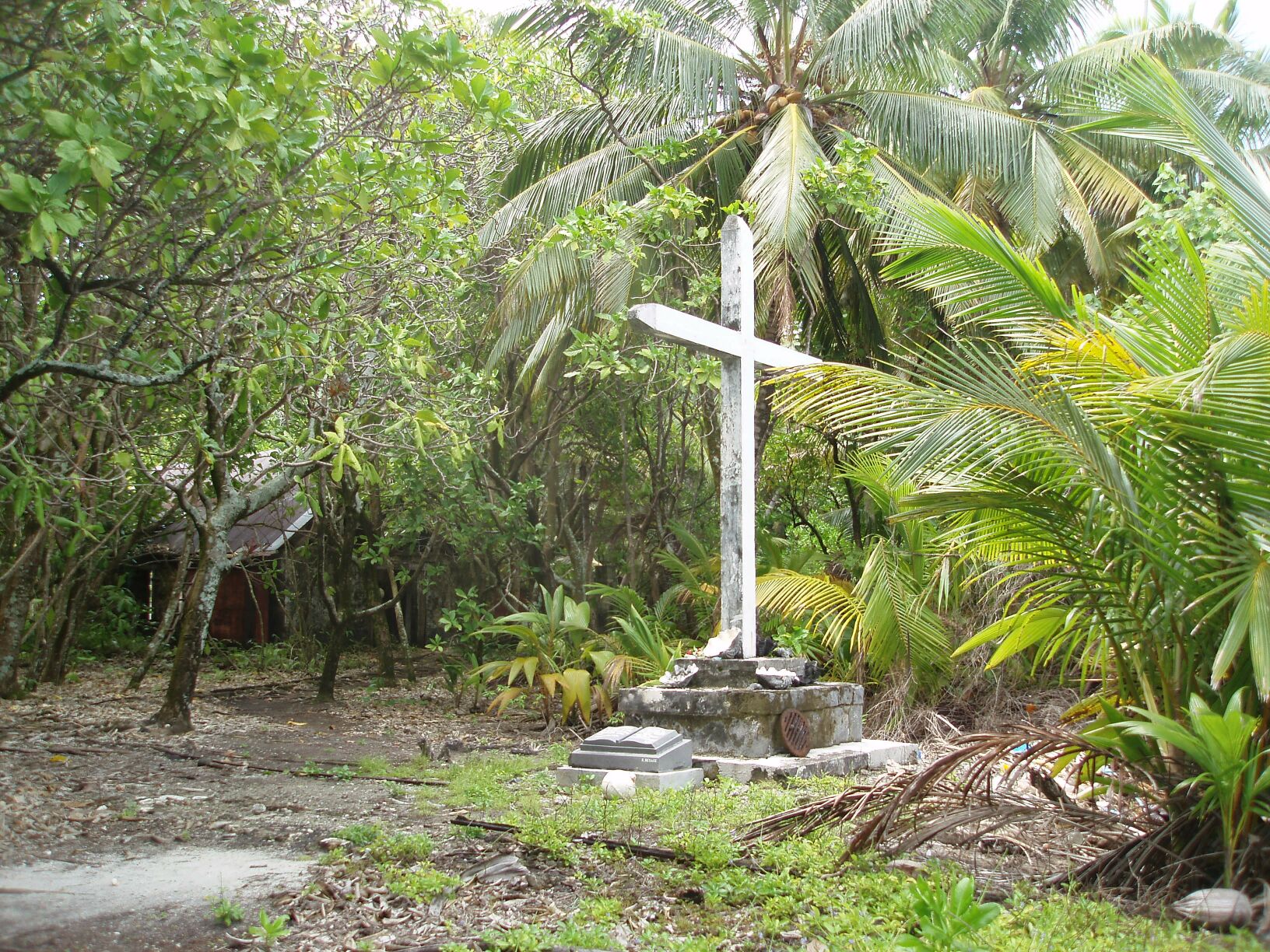
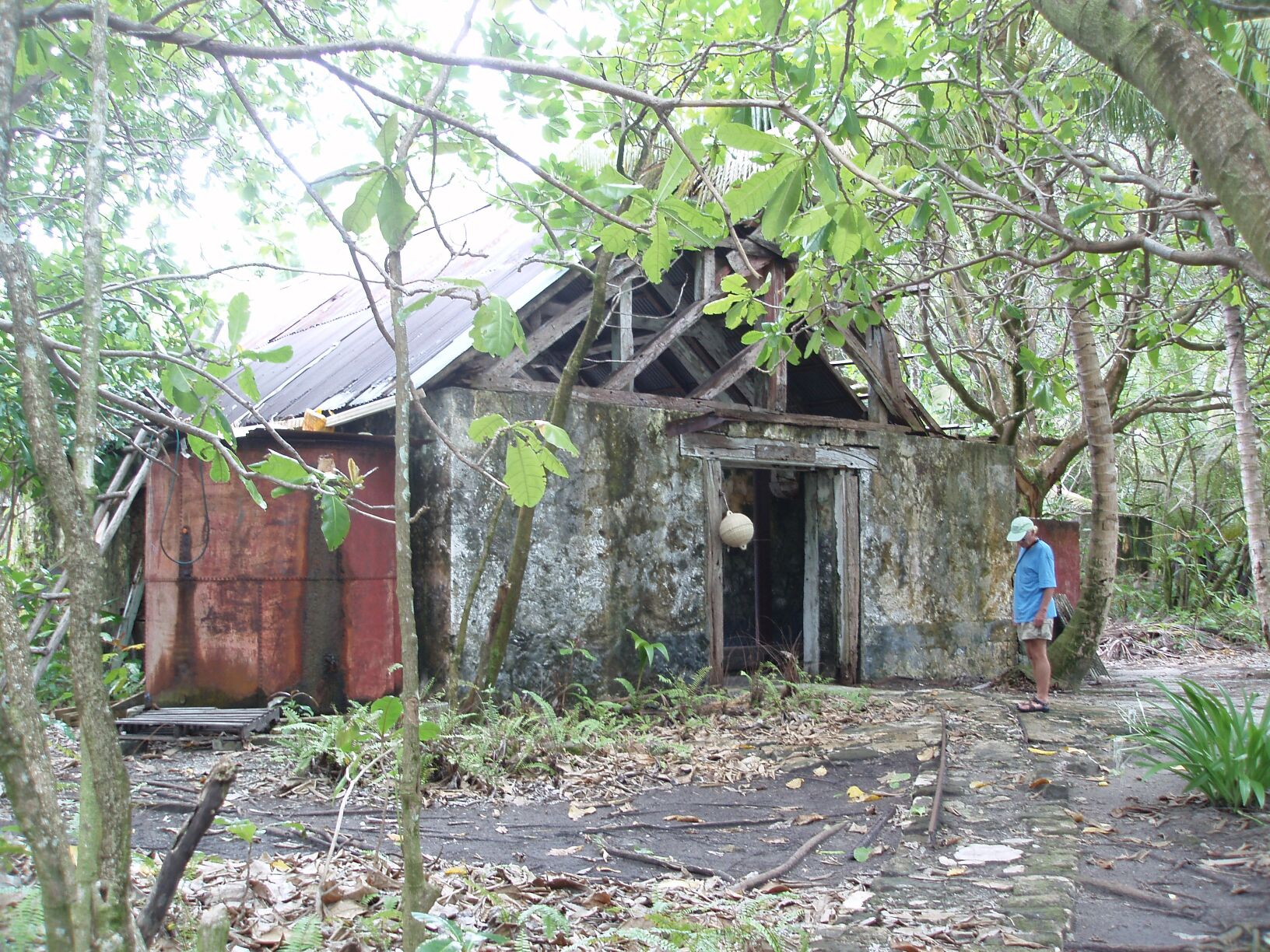
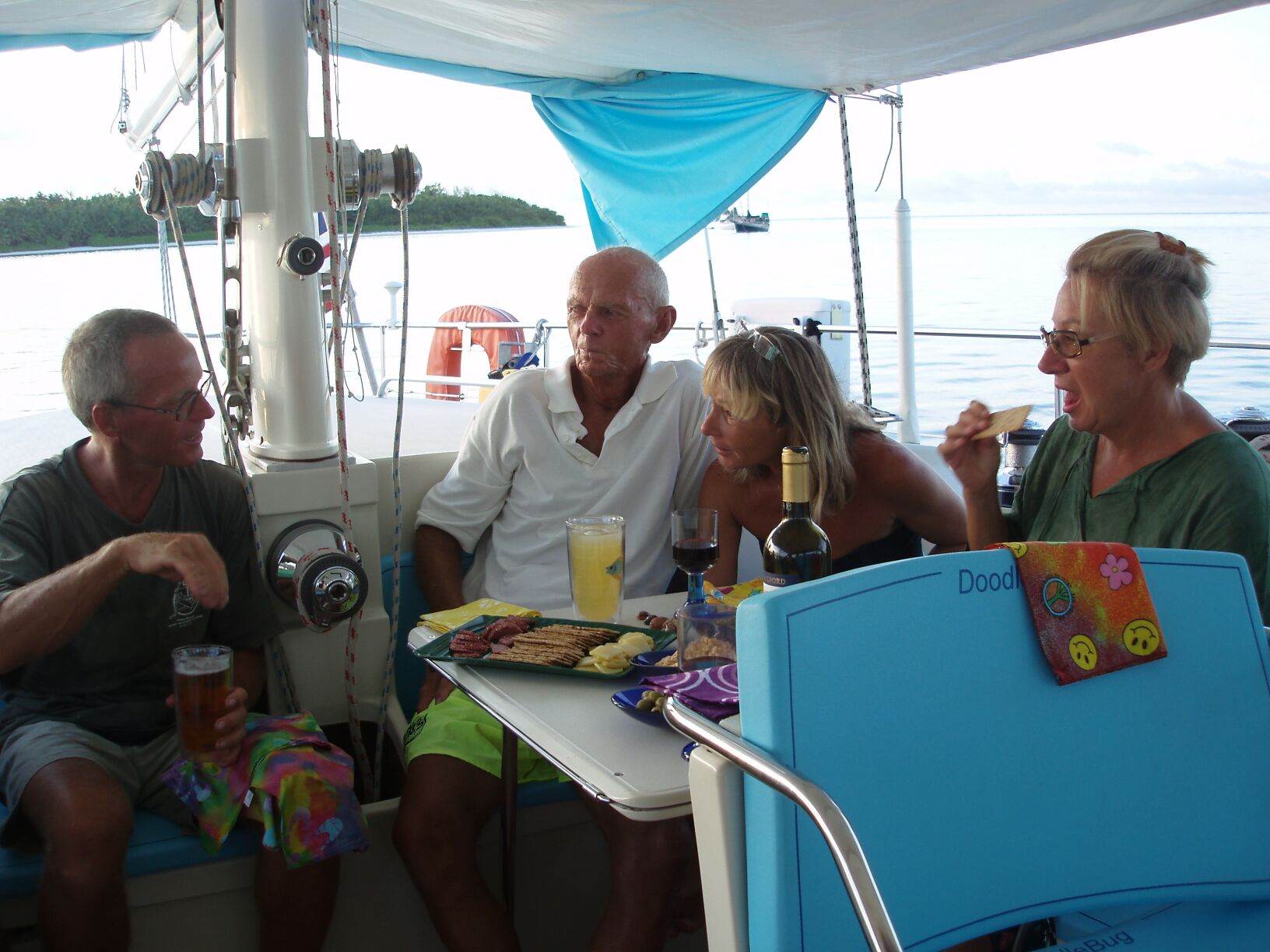
These are ship busting coral pinnacles and required some sharp maneuvers to weave between them, particularly as we approached the anchorage. There were five other yachts anchored off Ile Baddam. Jens on Carita had arrived a few days before we did, there were two French boats visiting from the southwest Indian Ocean, and two long term resident boats. We dinghied over to meet Kevin and Diane on Lady Guinevere and also Richard and Alev on Muggerl. Richard and Diane have spent months here out of every year during the past decade. This is the third visit by Richard on Muggerl. Three years ago he was diagnosed with multiple cancers and has had a portion of his tongue surgically removed. As a recovering cancer patient, he had made a vow to try and spend a year anchored here. Annette went ashore with Diane and Alev to bake bread in a "pit" oven and to wash bottles for brewing beer.
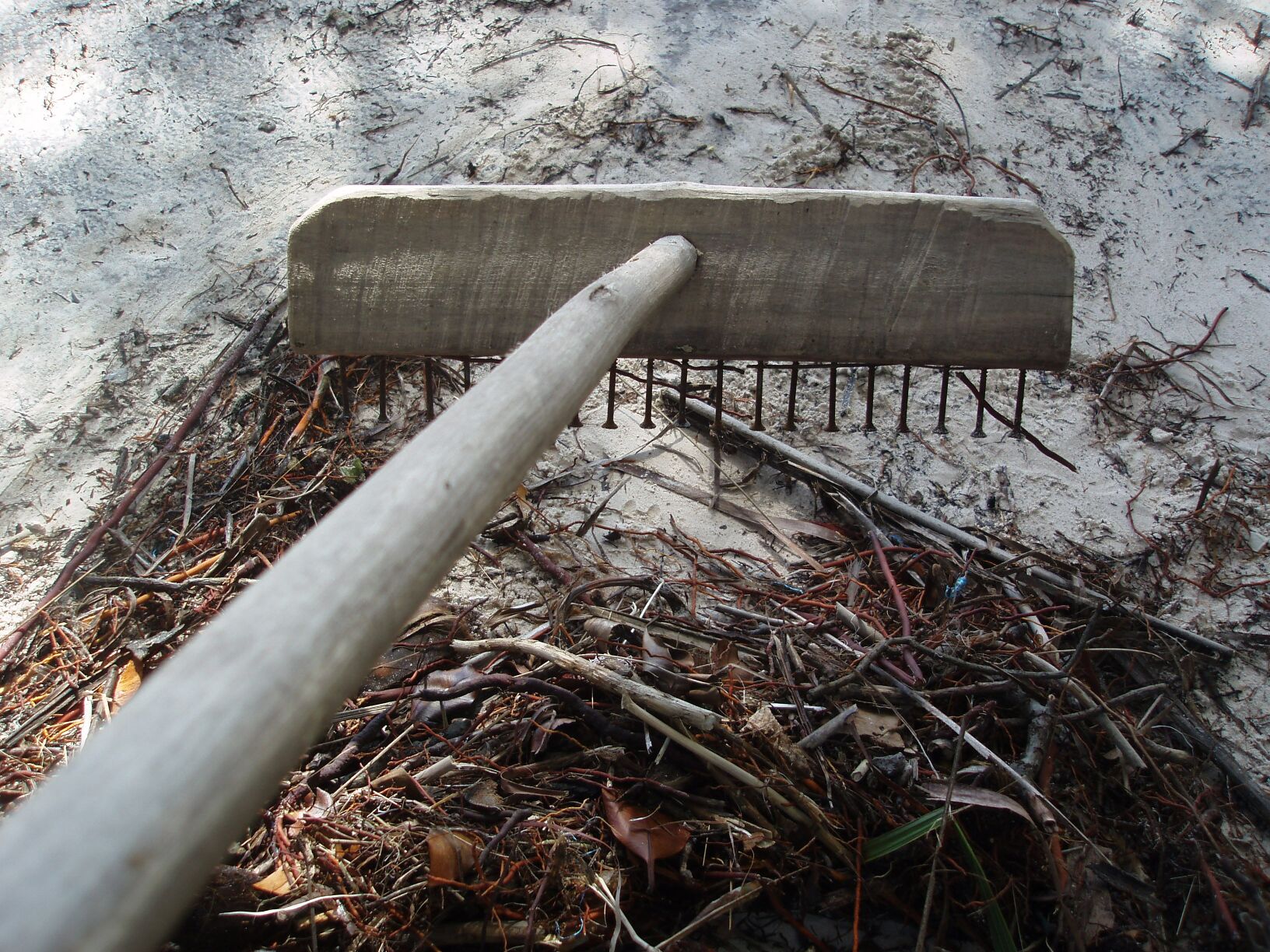
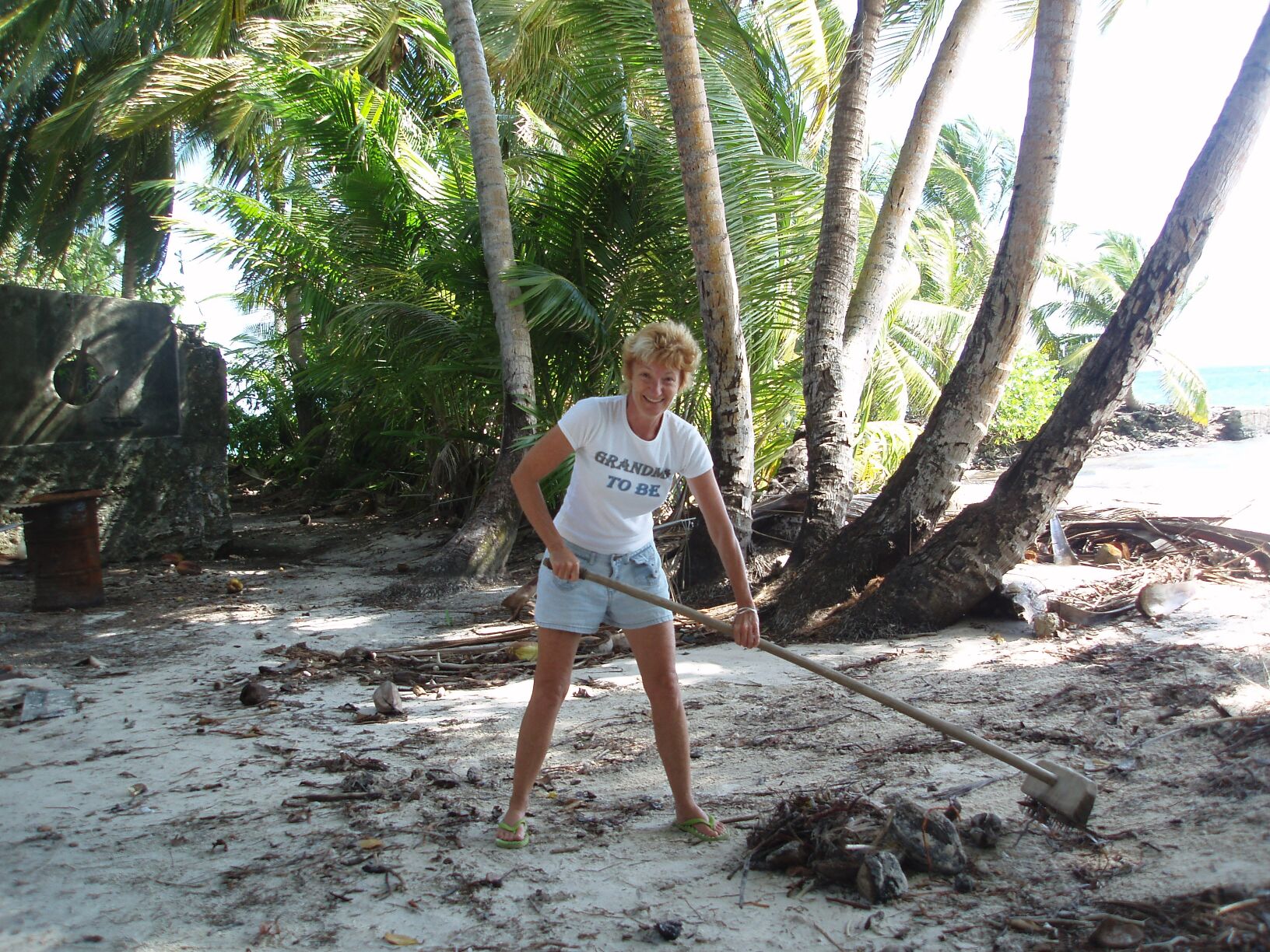
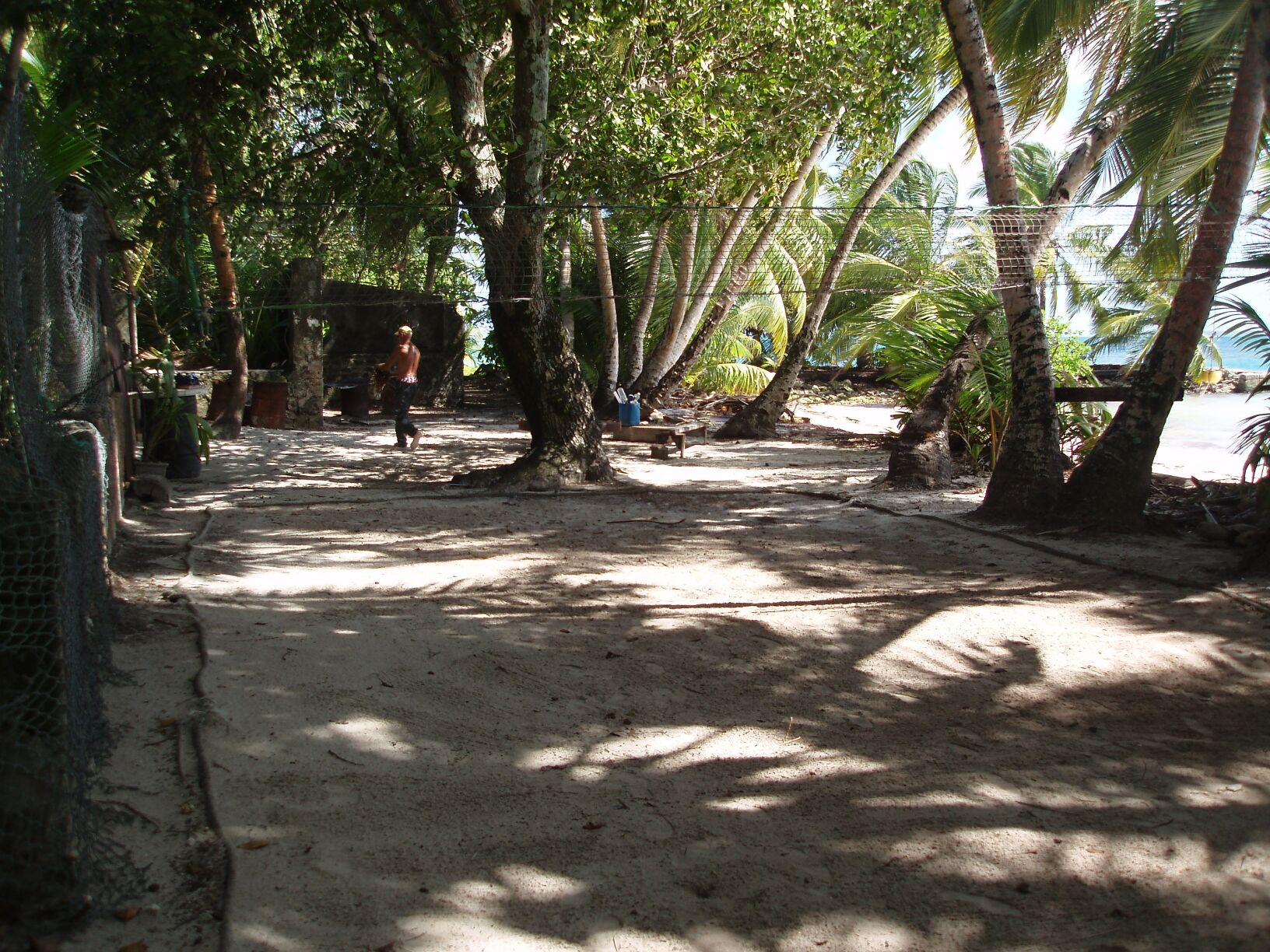
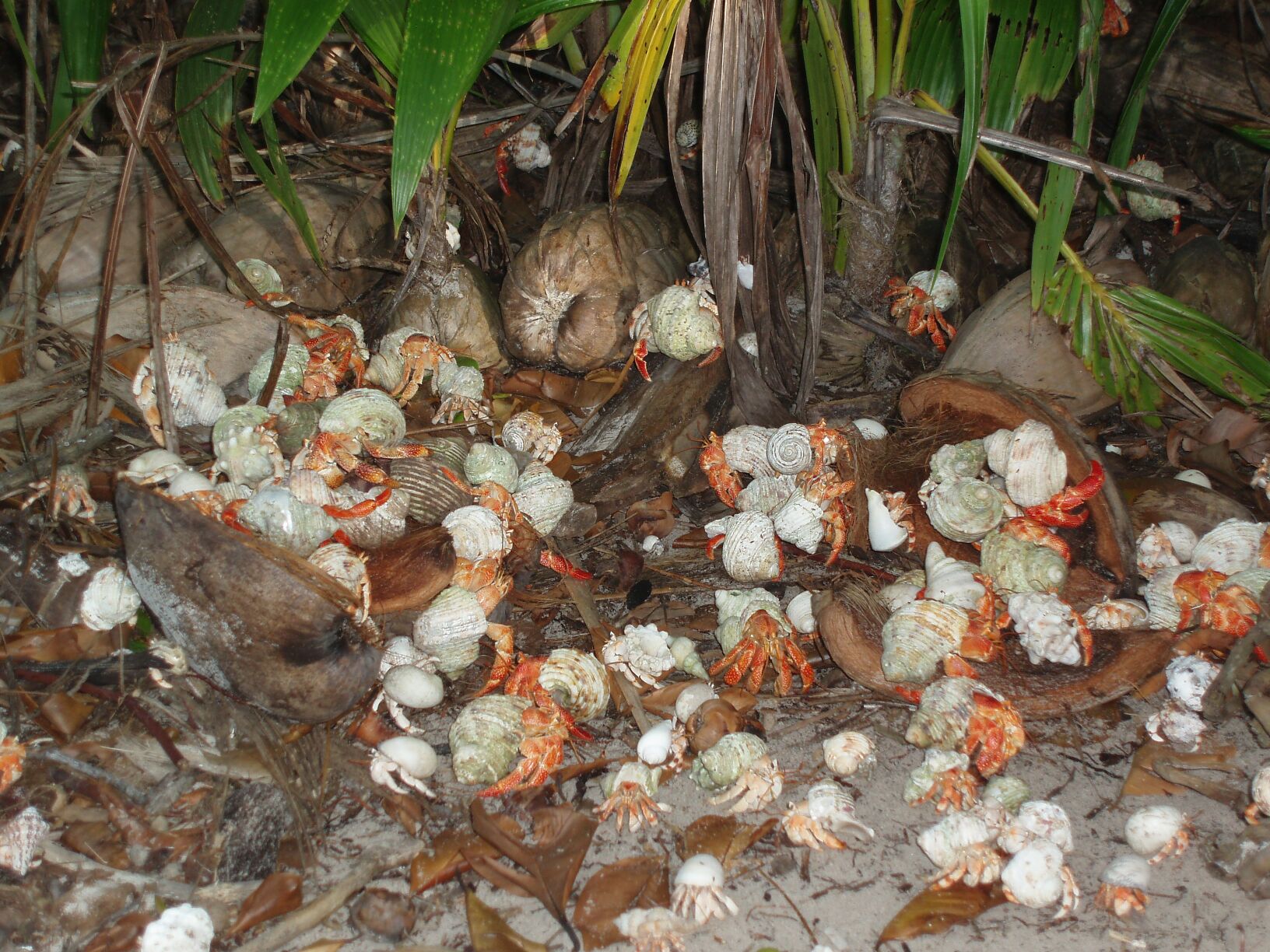
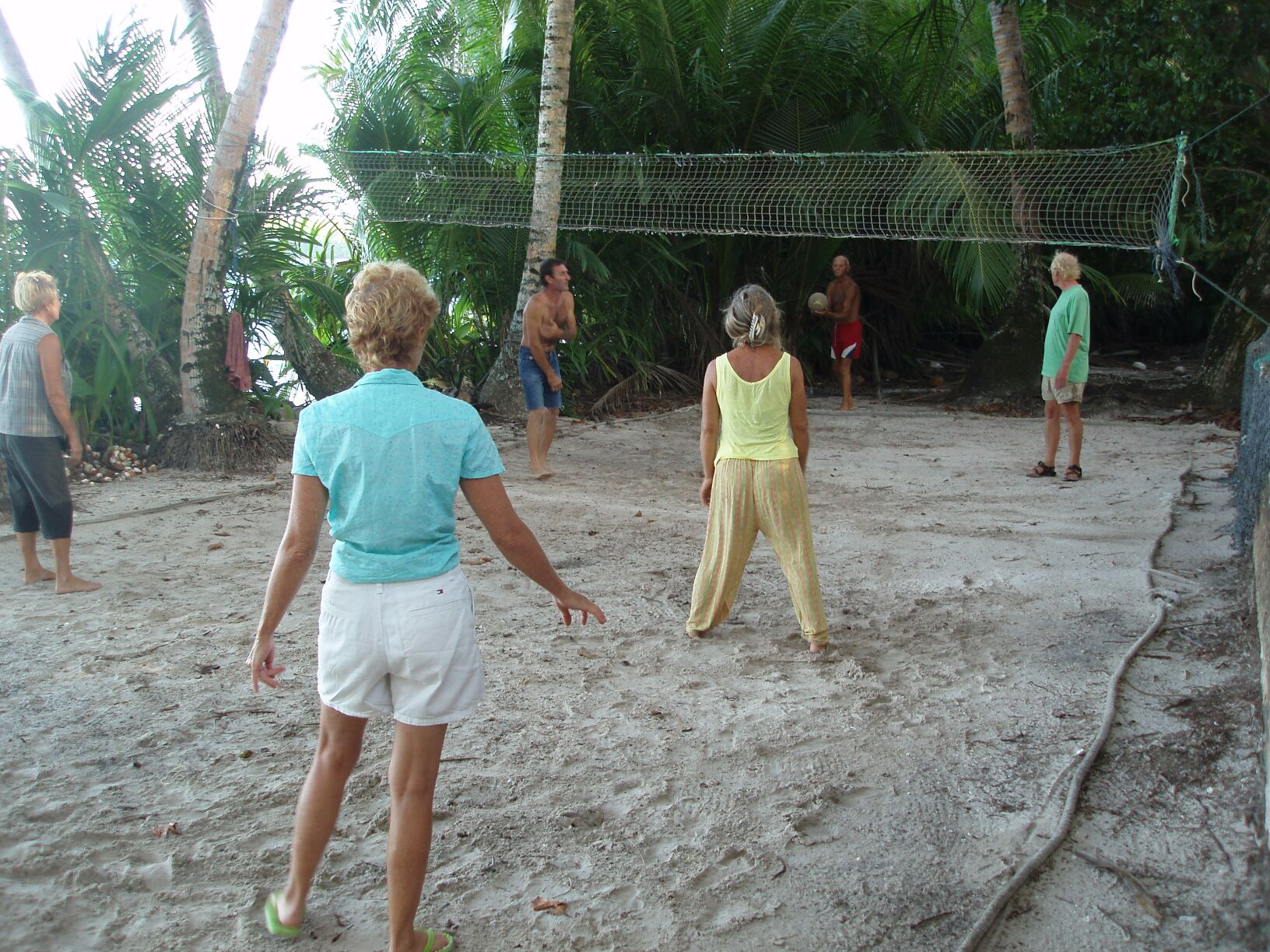
They also raked the beach and volleyball court clear of debris. Despite their efforts, we still had to spend a few minutes moving hermit crabs to safety before a
pre-sundowner volleyball game. The composition of the teams was sort of fluid, as several players had to leave the court in order to adjust their dinghy anchors to compensate for the incoming tide.
The scoring was definitely not subject to close examination. All of the boats had brought food to the "yacht club" to supplement their various "sundowner"
concoctions and, as dusk fell, the rats appeared. Annette set off in the dark with her digital camera to make a photo-essay of their activities. The rats of Baddam are
quite brazen in their theft of
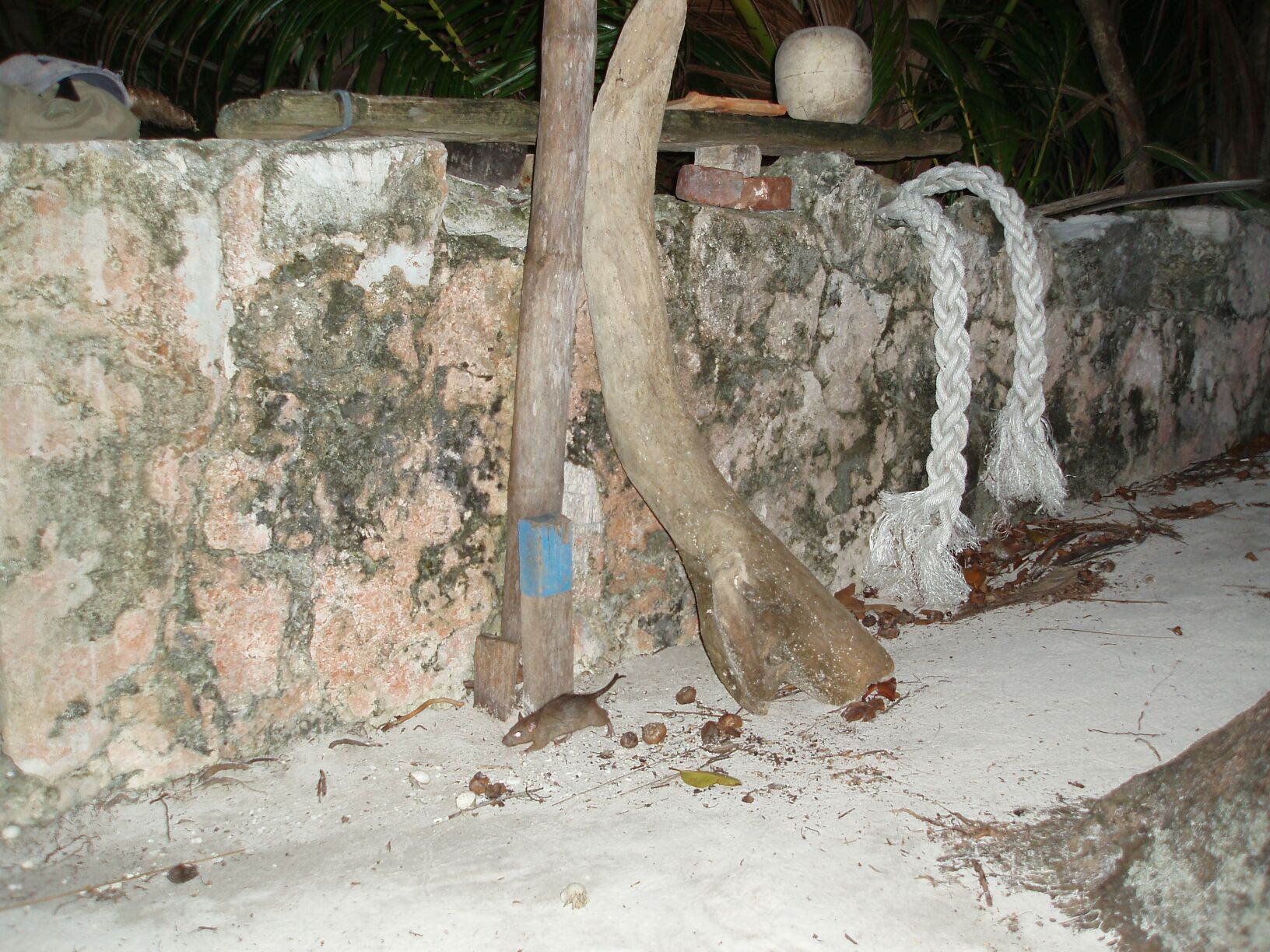 food and show little fear of man. We were warned to check our bags, drink coolers, and dinghy very carefully before leaving the beach, to ensure we had not picked up any hitchhikers. The return
trip to DoodleBug from the beach was slow and tedious. We could no longer see the bombies and the pitiful little flashlight we had brought was only useful to give a clue as to which way deeper water
might lie after we were confronted with a bombie in the dark and choppy waters.
food and show little fear of man. We were warned to check our bags, drink coolers, and dinghy very carefully before leaving the beach, to ensure we had not picked up any hitchhikers. The return
trip to DoodleBug from the beach was slow and tedious. We could no longer see the bombies and the pitiful little flashlight we had brought was only useful to give a clue as to which way deeper water
might lie after we were confronted with a bombie in the dark and choppy waters.
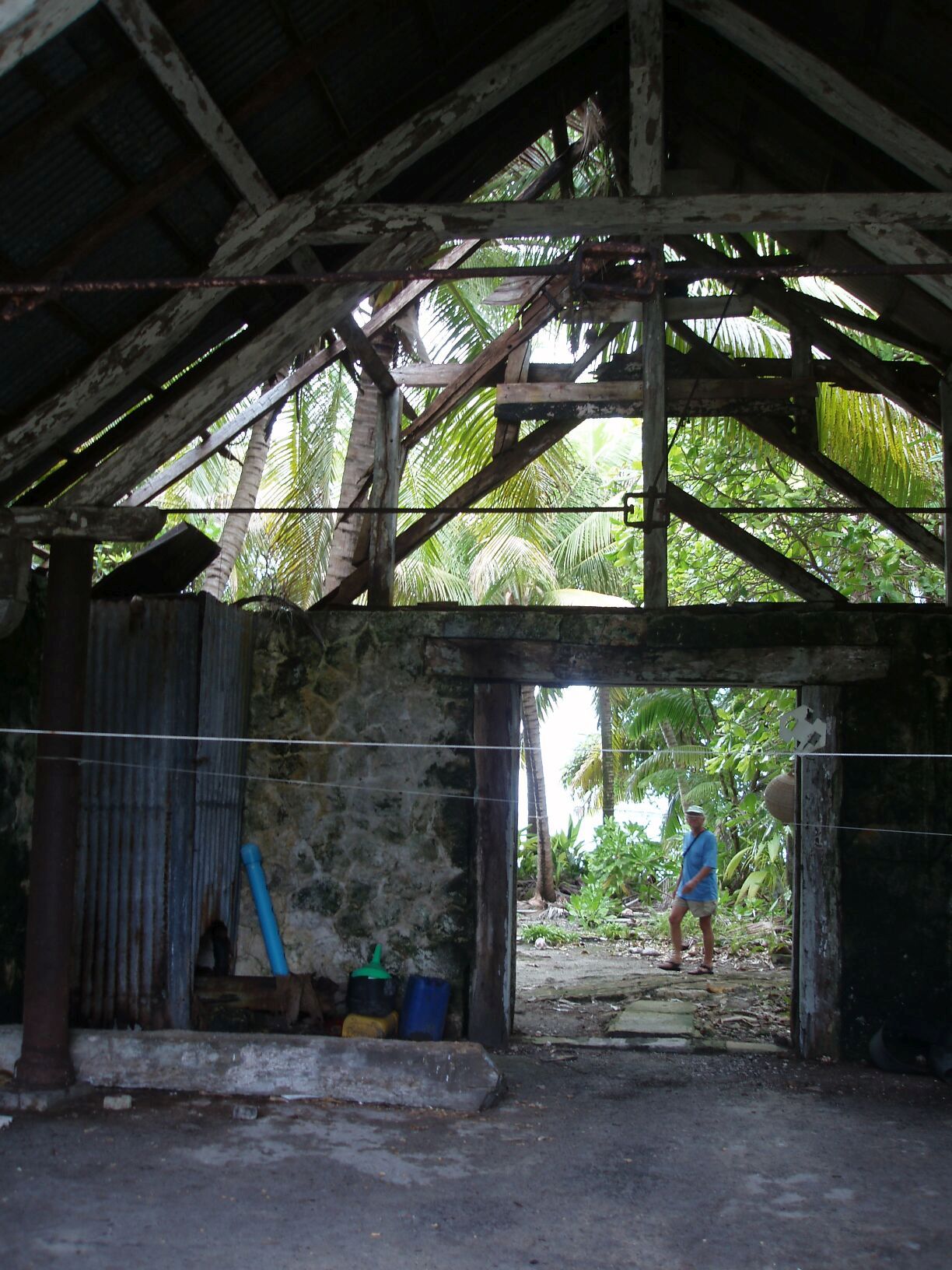
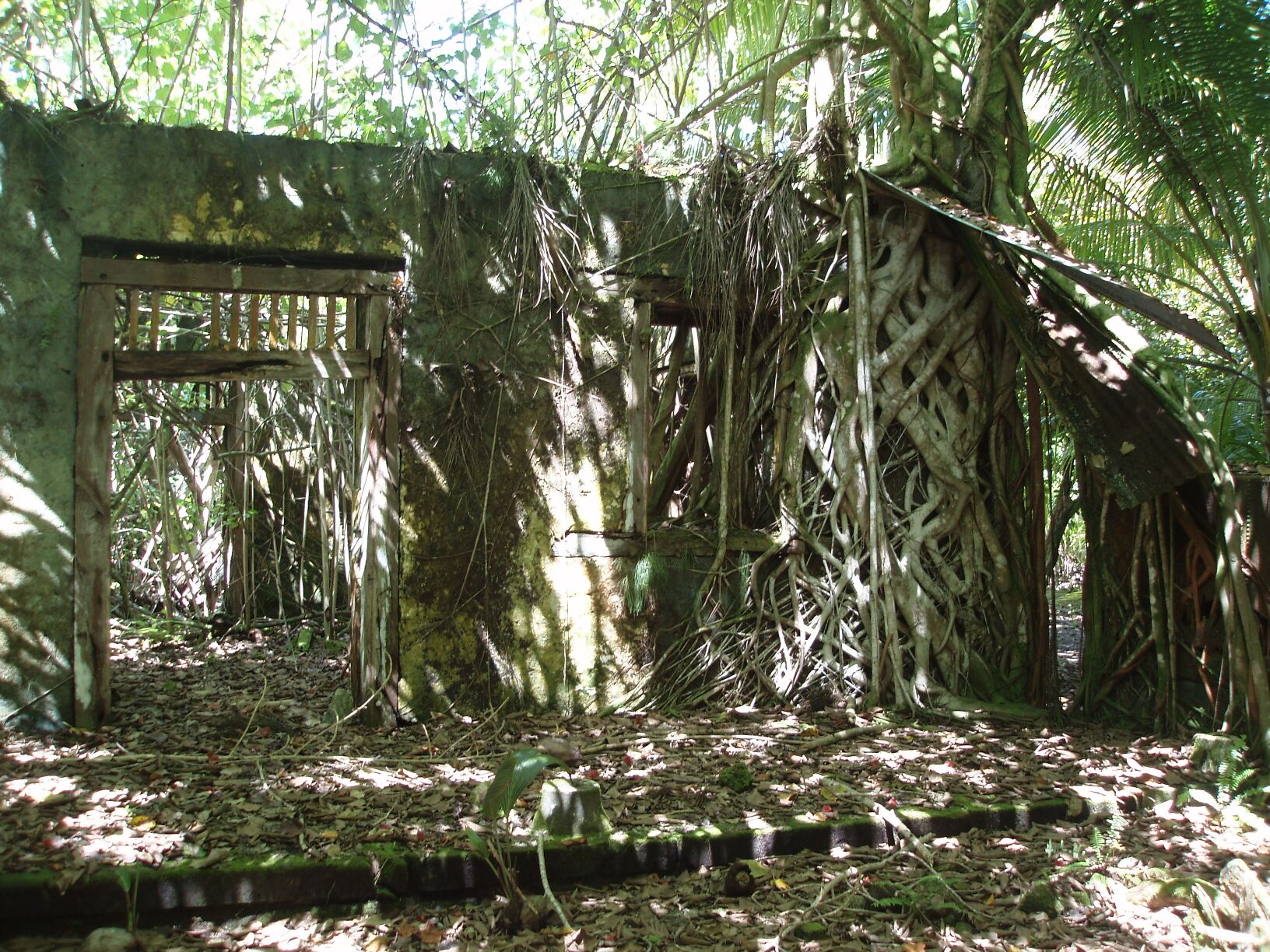
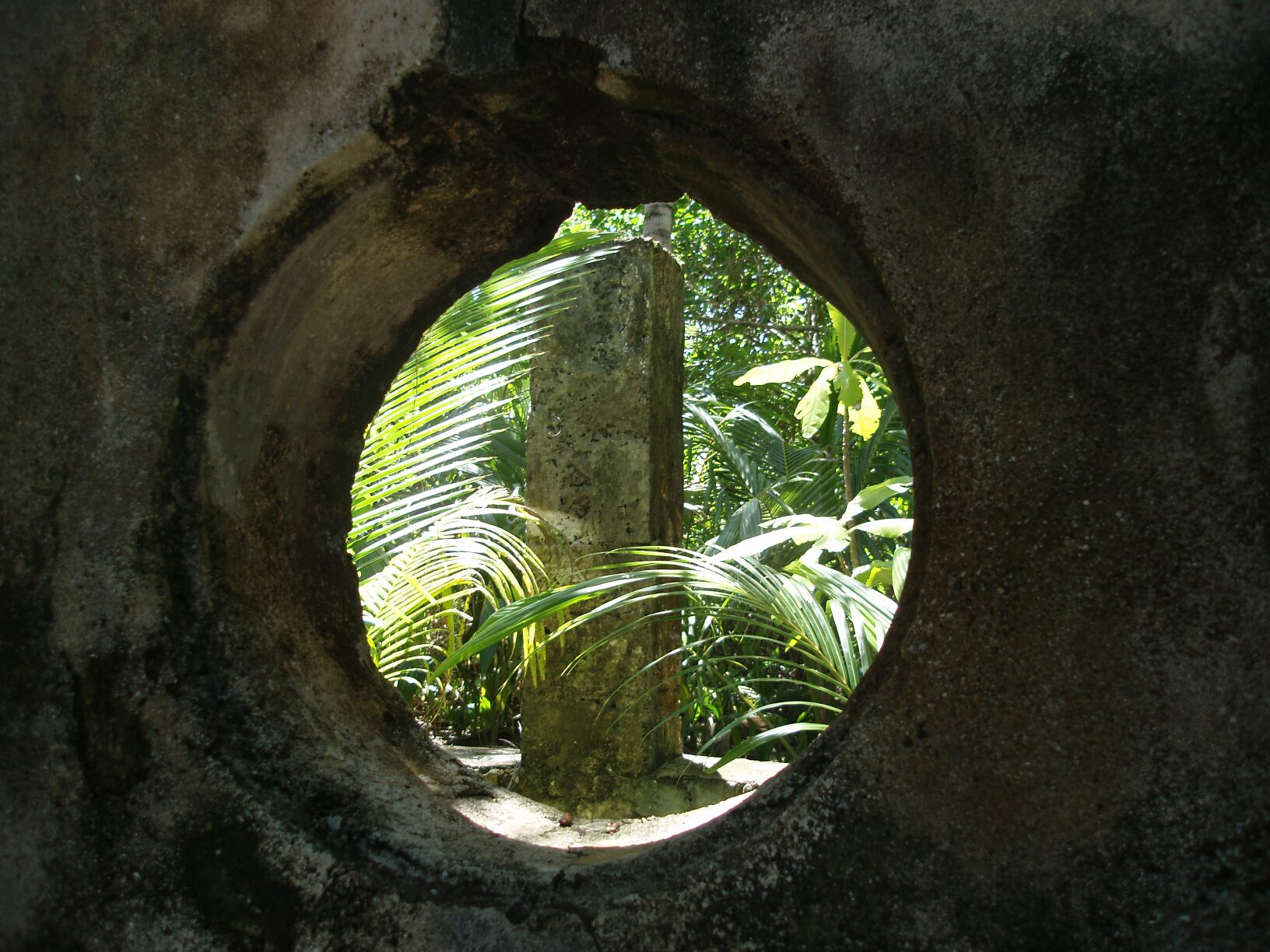
Chagos has been a very pleasant interlude. Ile Baddam was the site of a copra plantation and the several decaying buildings include a copra warehouse, church, and
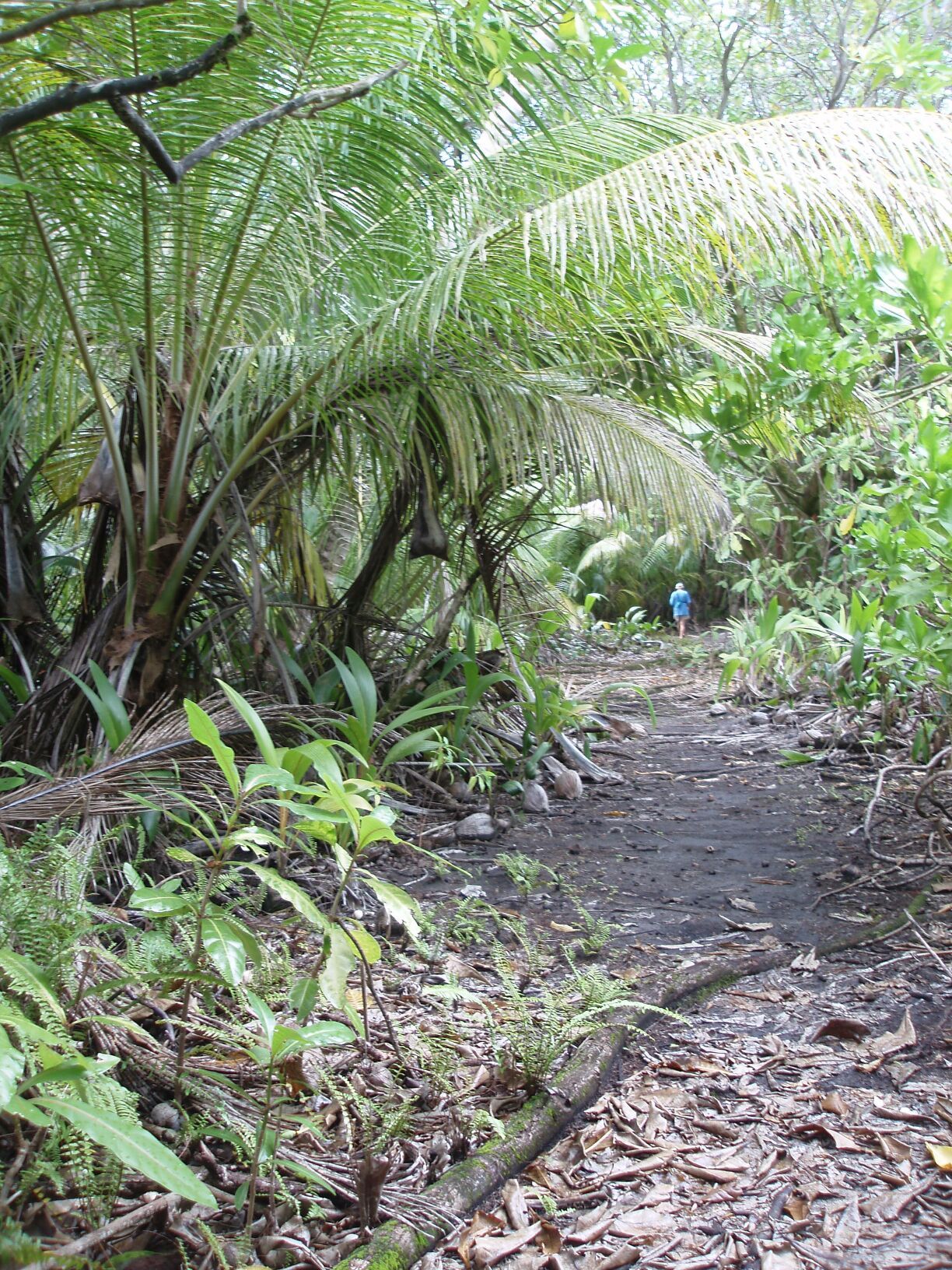
jail. It has been some 35 years since the operation was closed down and the extent to which the jungle has reclaimed the workings of man is astonishing. The isle has miles of trails through the
heavy vegetation and over the years, these trails have been maintained by the various visiting yachtsmen. We have examined the trails and walked the reef at low tide with Diane from Lady
Guinevere to scour the strand for fishing floats and the like. From these she scavenges the stainless steel clips. Diane and her husband, Keith, fish every
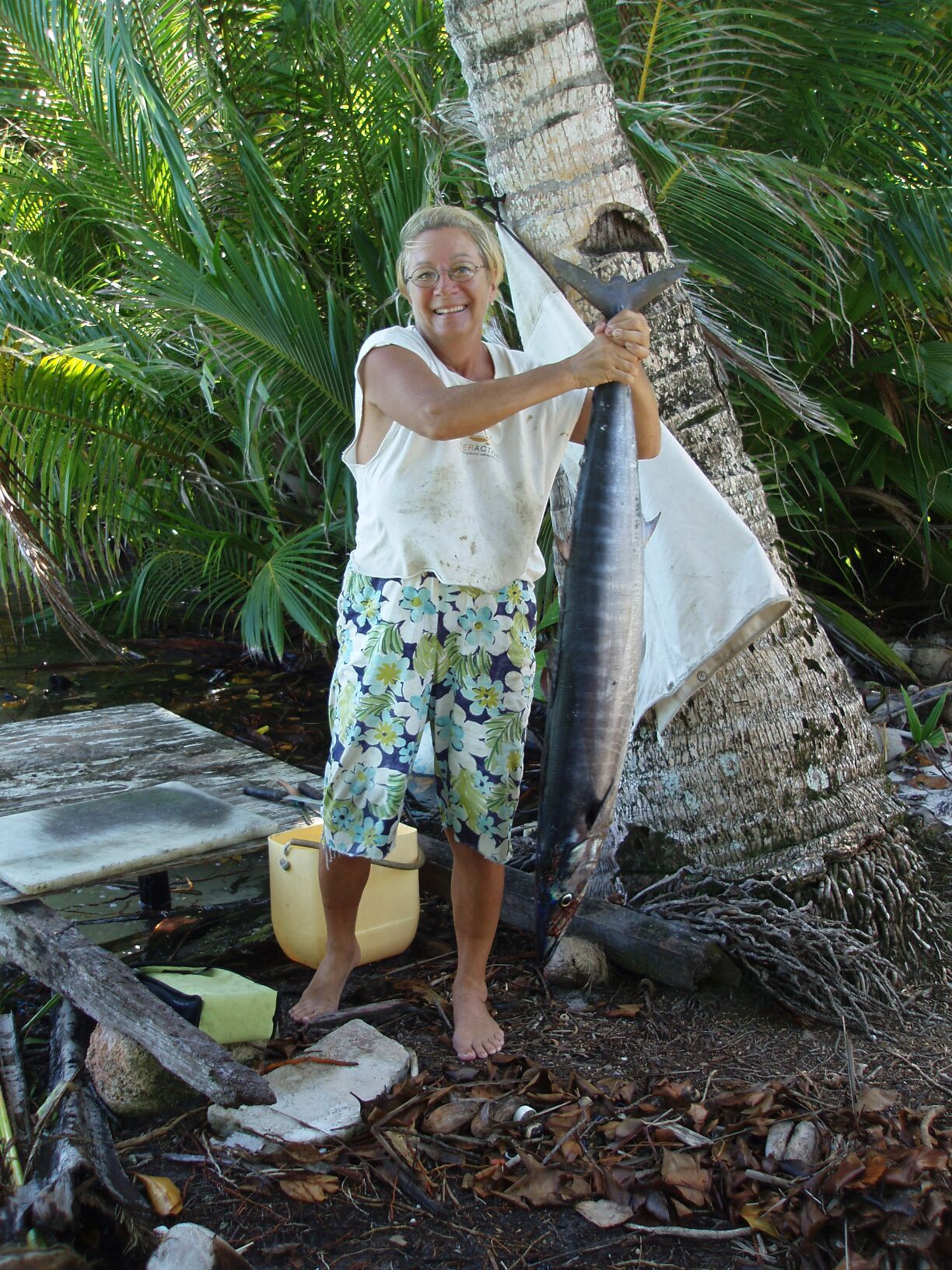
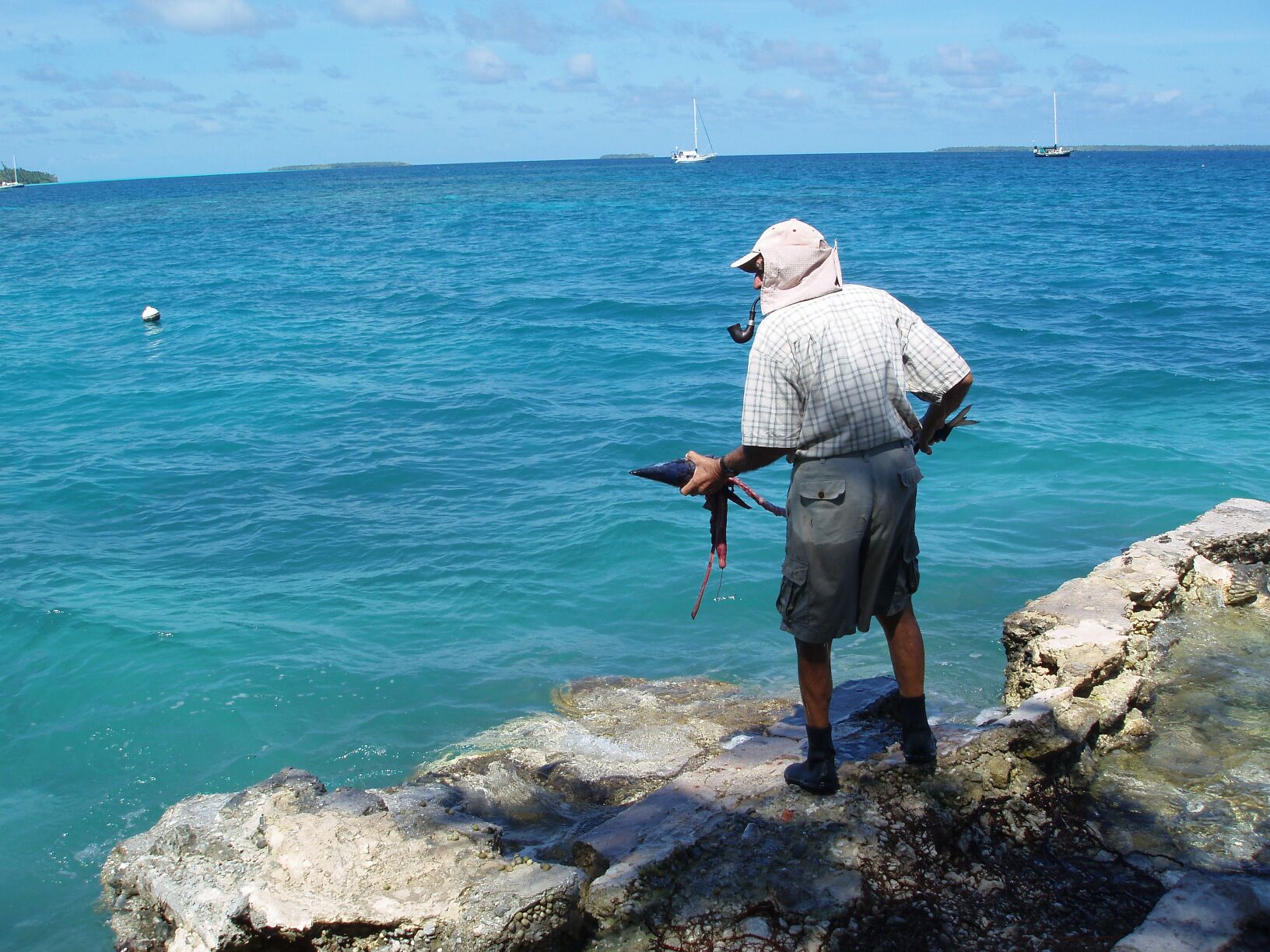
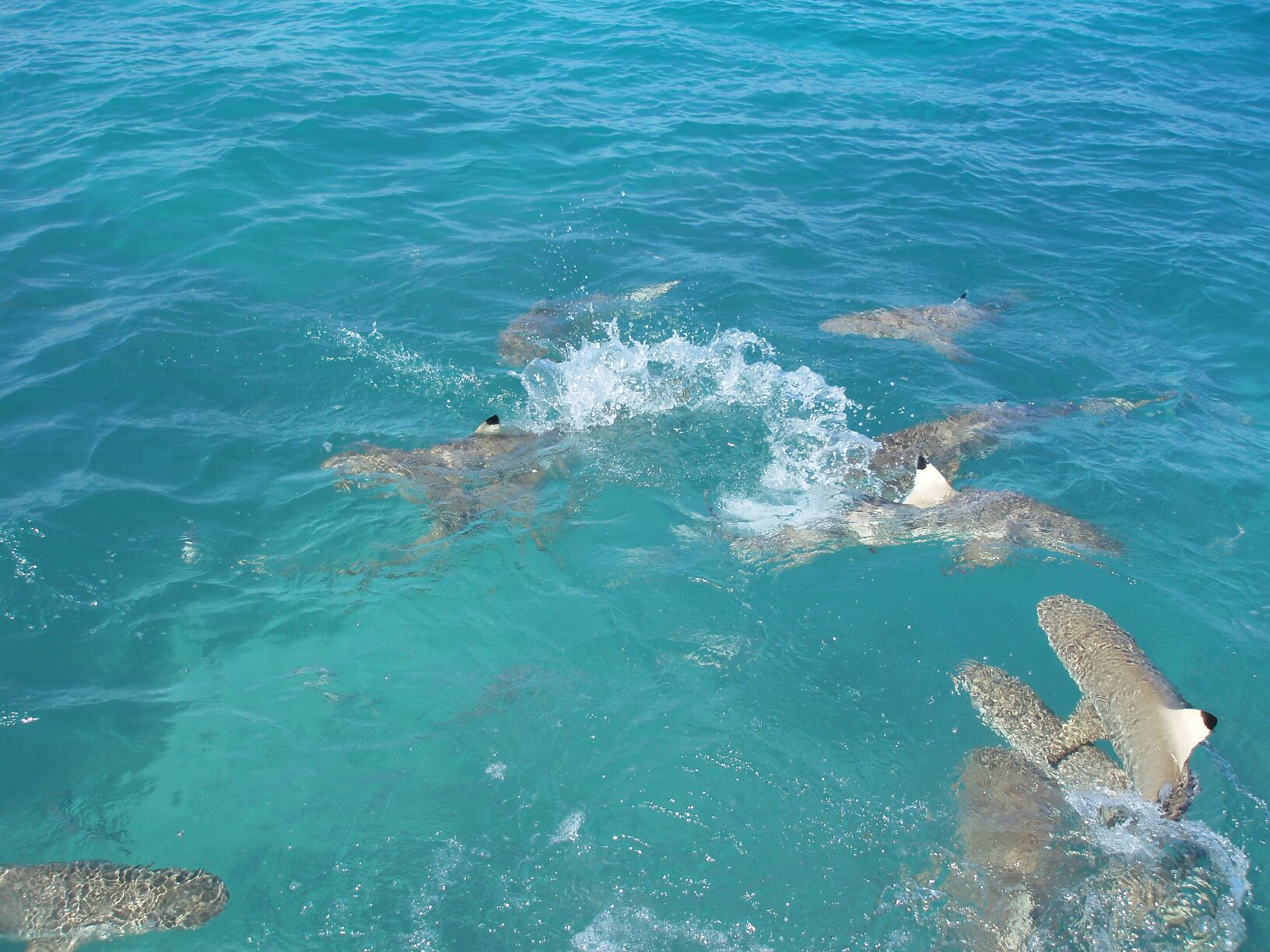 day outside the reef at high tide. We watched as they filleted a five foot Wahoo and then threw the carcass off the Baddam pier. Within seconds there were a dozen or more reef sharks fighting over
the carcass. The water was boiling and the sharks were jumping from the water in their frenzy. Our fish feeding exercise off DoodleBug was almost as
day outside the reef at high tide. We watched as they filleted a five foot Wahoo and then threw the carcass off the Baddam pier. Within seconds there were a dozen or more reef sharks fighting over
the carcass. The water was boiling and the sharks were jumping from the water in their frenzy. Our fish feeding exercise off DoodleBug was almost as
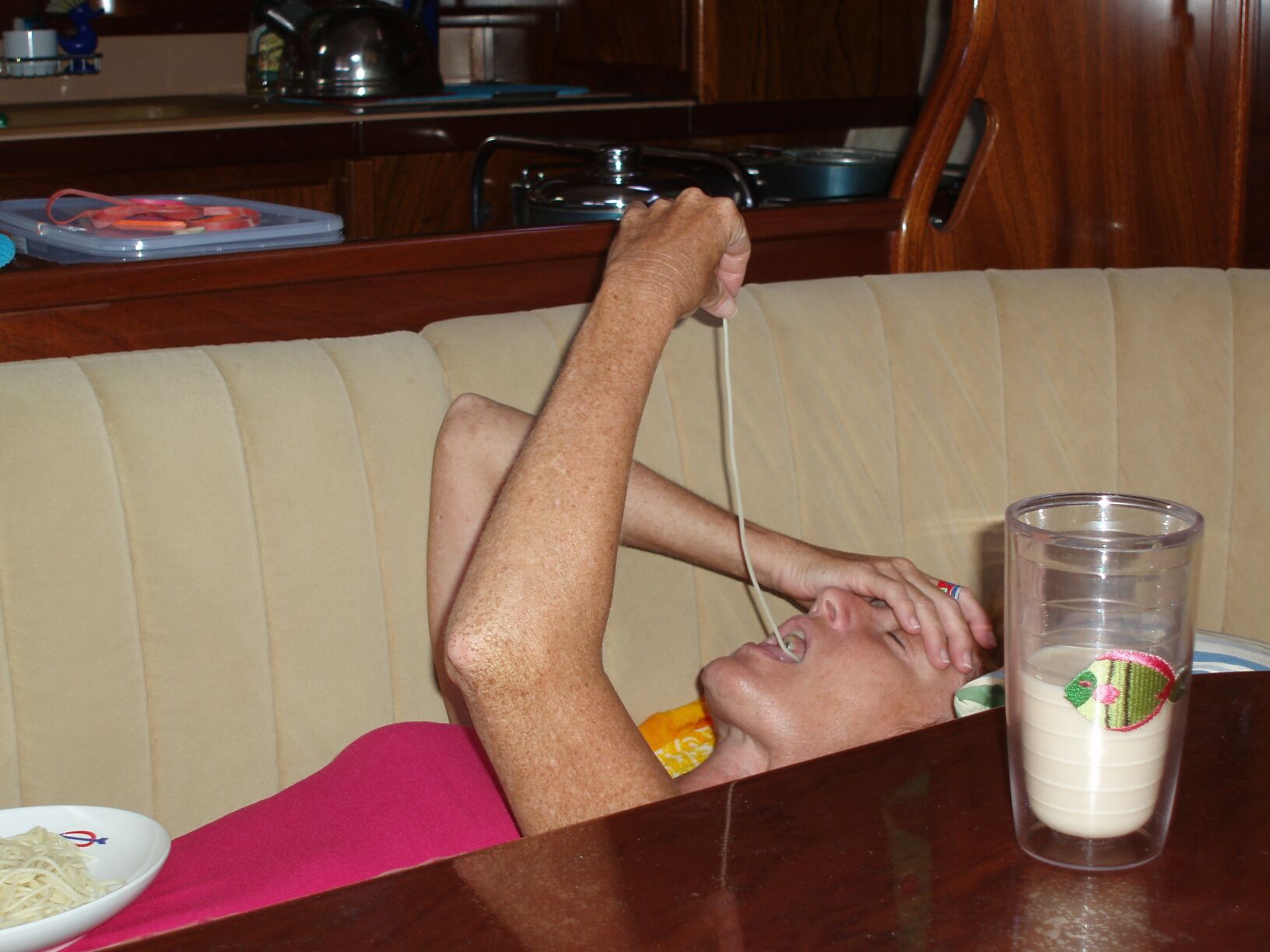
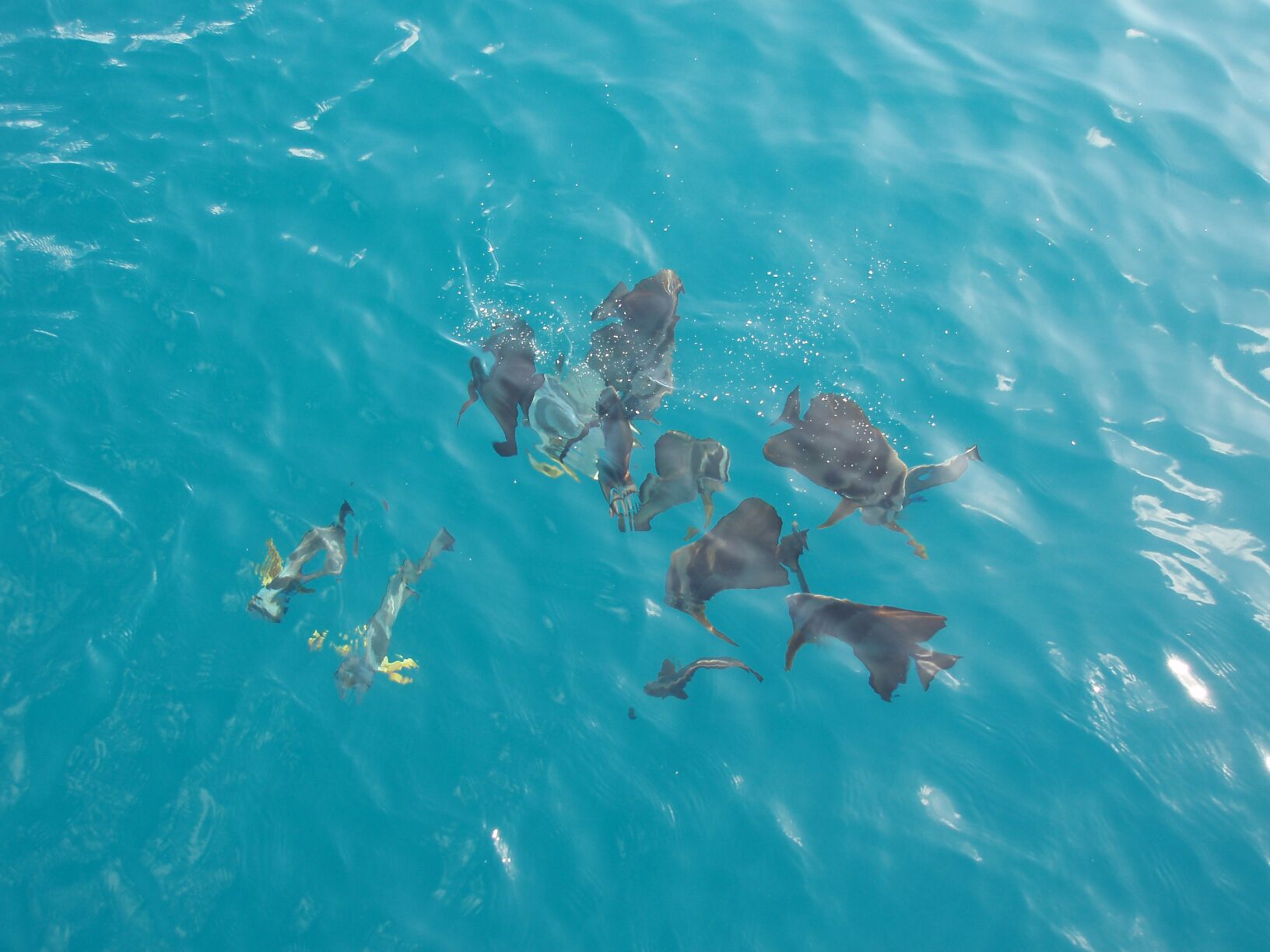 much fun but not quite as frightening to watch. We had acquired our own school of about a dozen reef fish that hang around. We watched their feeding frenzy as we fed them
leftover bowtie noodles. More fun than feeding ducks.
much fun but not quite as frightening to watch. We had acquired our own school of about a dozen reef fish that hang around. We watched their feeding frenzy as we fed them
leftover bowtie noodles. More fun than feeding ducks.
On Wednesday, we had gone ashore to help Richard and Diane gather, husk, and grate coconuts for Diane's cookie project. While we were in mid-grate, the British patrol vessel arrived and sent an inflatable with commandos aboard to visit the various yachts. I (Ed) dinghied back to DoodleBug for the usual formalities and to pay the "mooring" fee. The officials were very polite and handed me a "Notice to Mariners", warning of new fees and rules to take effect as of 1st. January, 2007. The fee to stay here has increased from USD $100 per three months to GBP 500 (pounds) per month - an increase of around 2,700 percent. In addition, future yachts visiting will need a permit in advance of their arrival and payment of the first 30 days fee, also in advance and by bank transfer. Wow! We will probably be amongst the last yachts to ever visit here.
The crews of Muggerl and Lady Guinevere were shattered by this news as they have effectively just been evicted from paradise. Annette and I went snorkeling off the reef for the afternoon while everyone absorbed the new situation.
November 9, 2006 through November 15, 2006
This has been a great stay in Chagos. We have snorkeled the reefs and the bombies in the lagoon and Annette has been able to enjoy some female company for a change. She has hacked down, husked, cracked, and shredded coconuts. She has fished, baked bread, and shredded coconut cookies on a ground oven and generally had a fine time playing
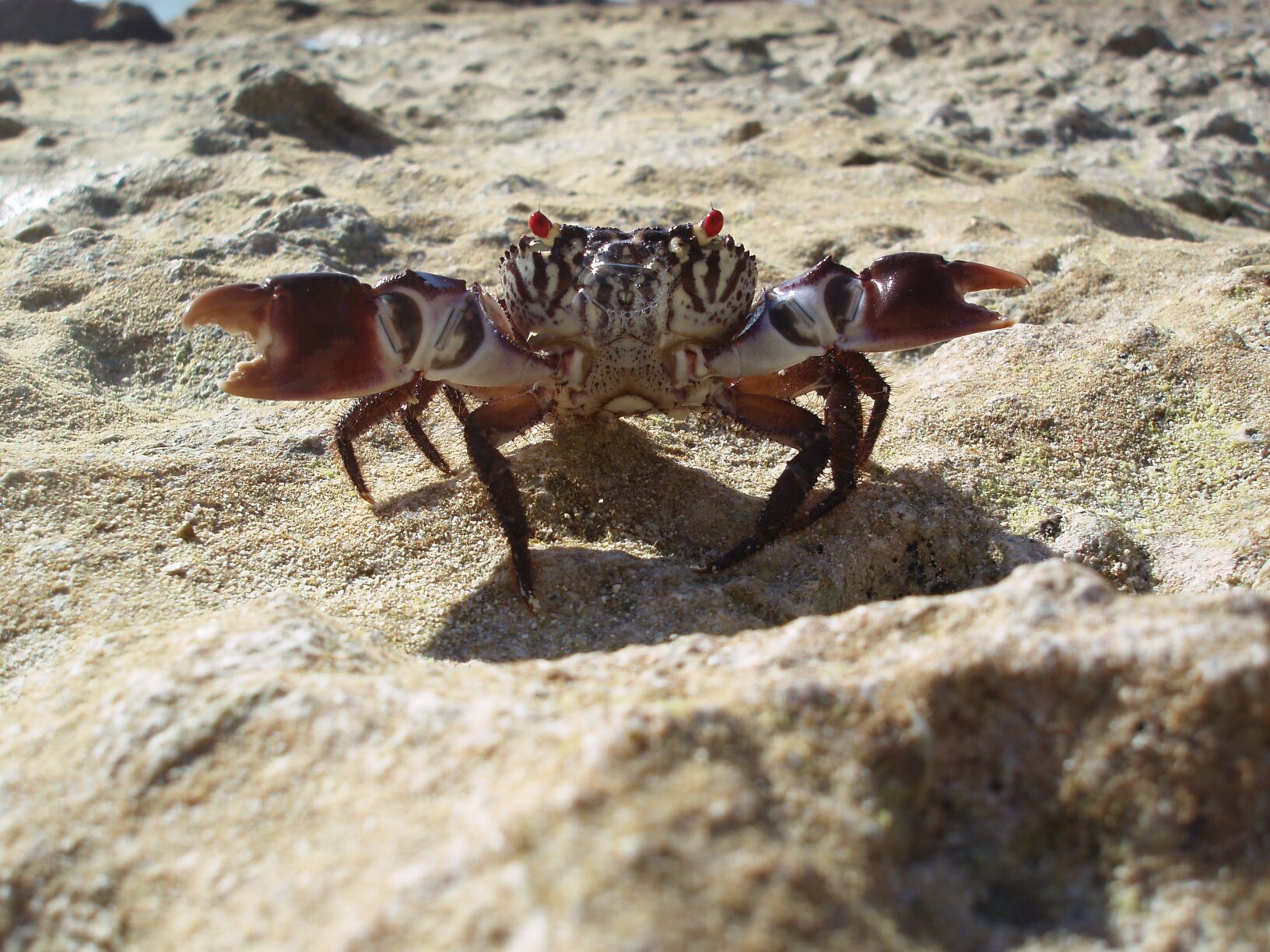
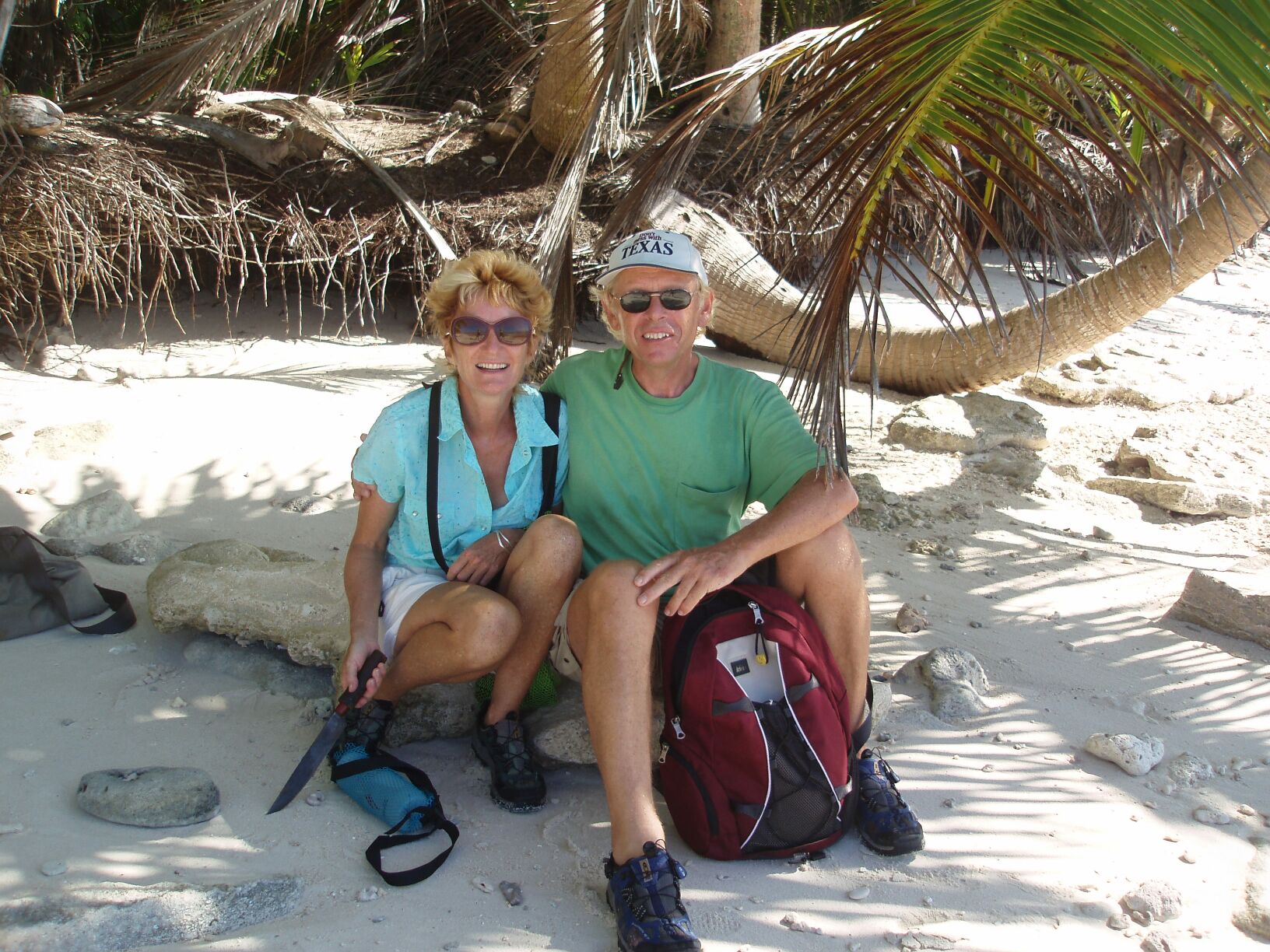
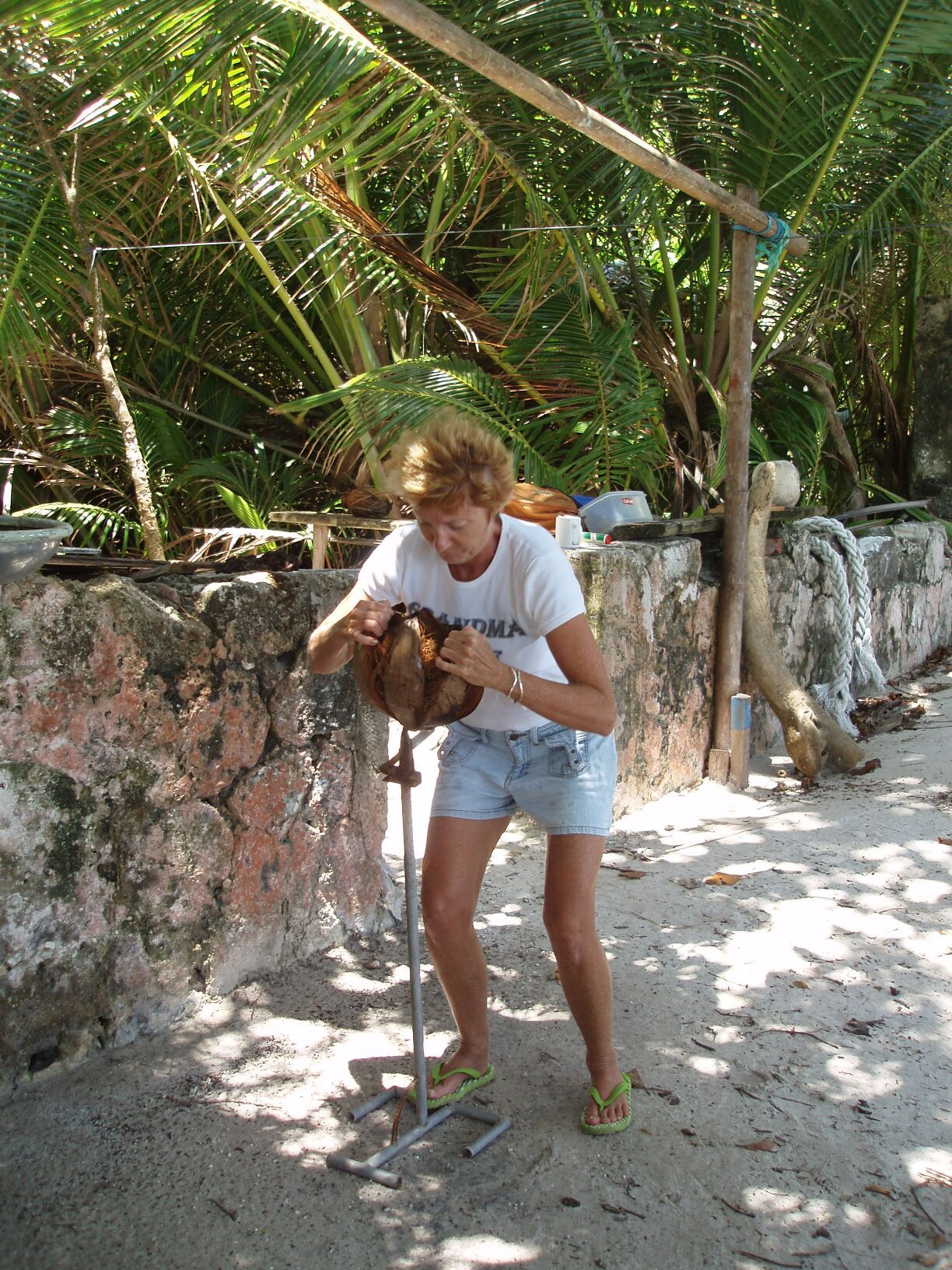
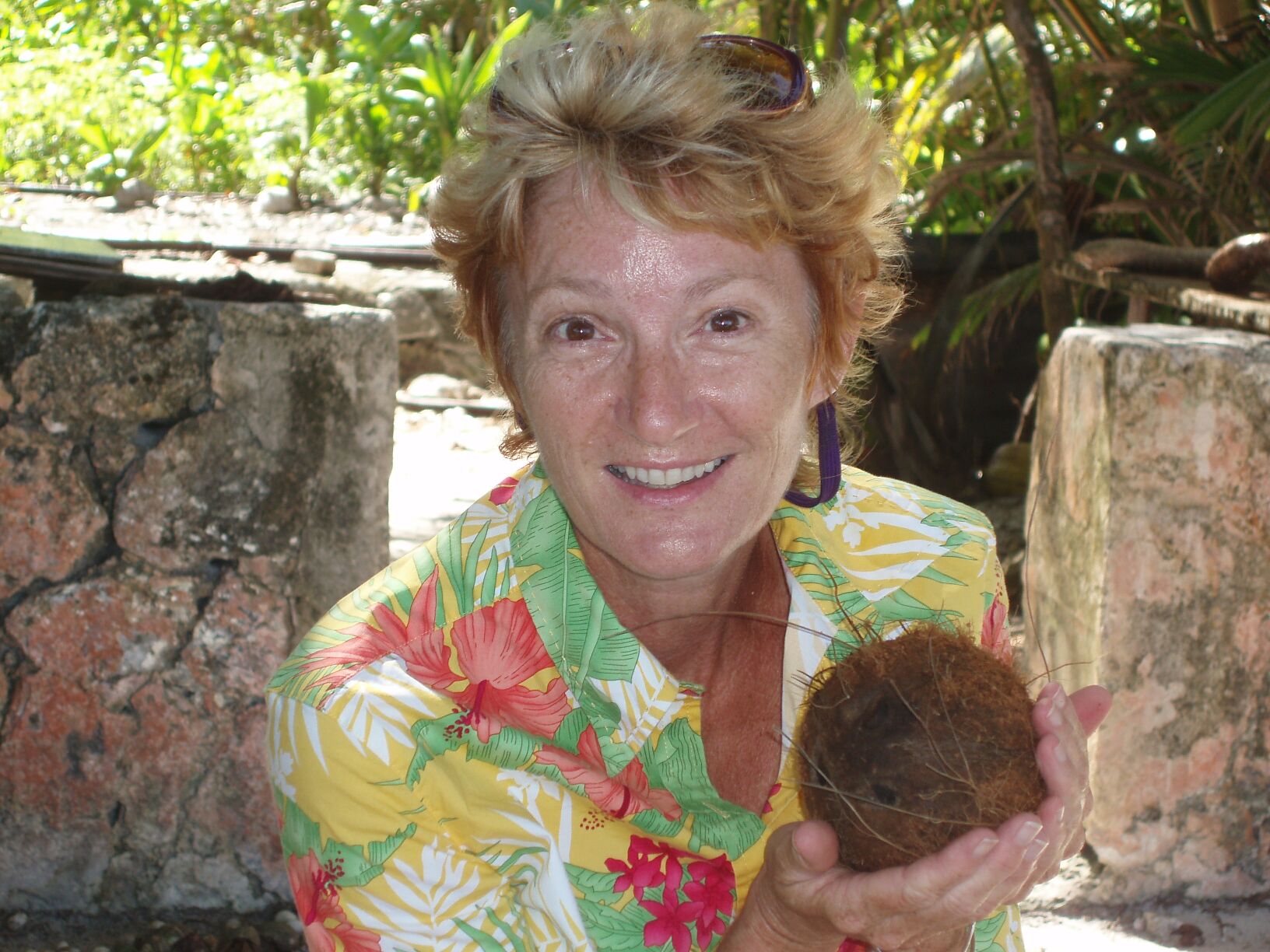
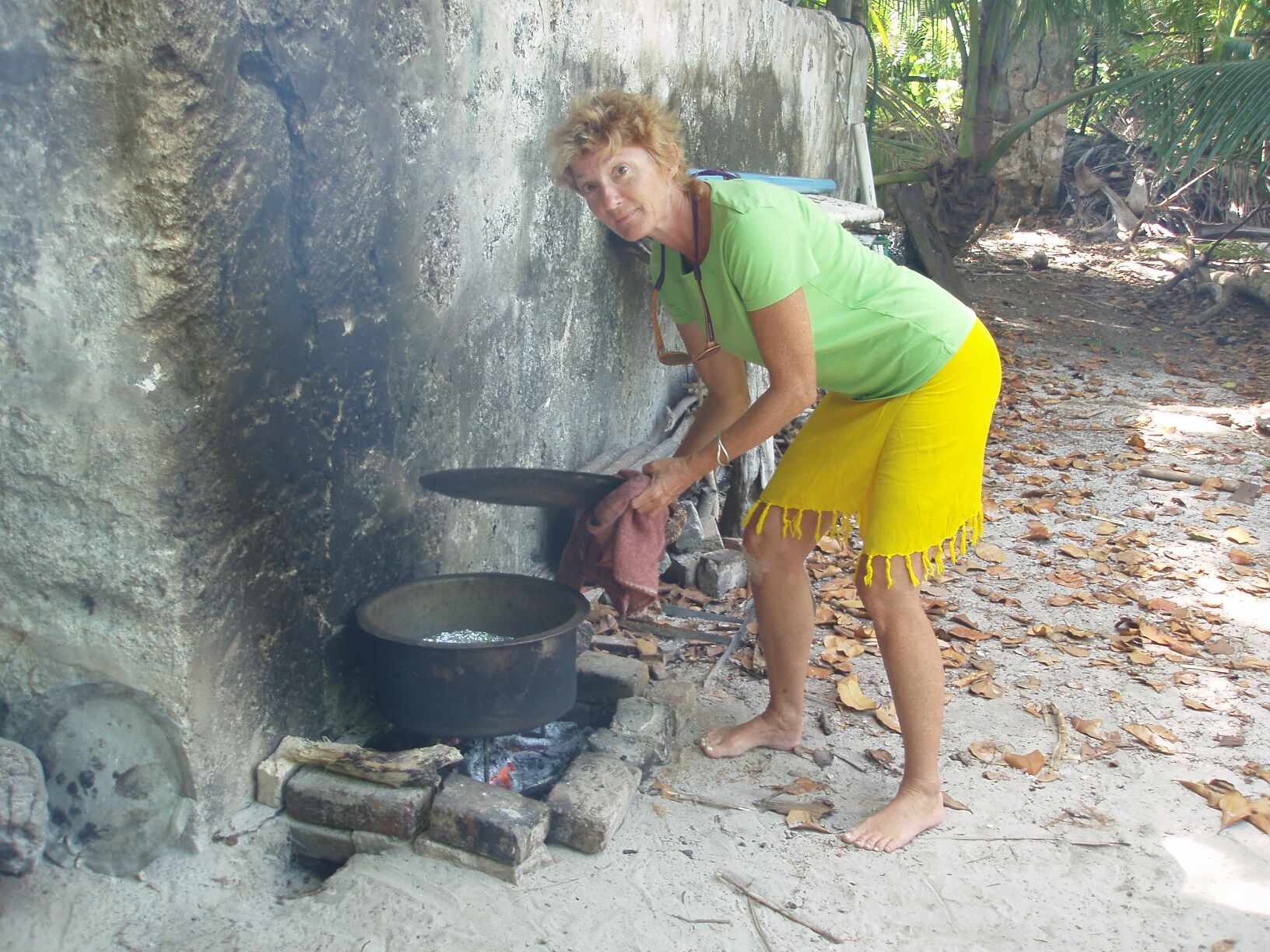
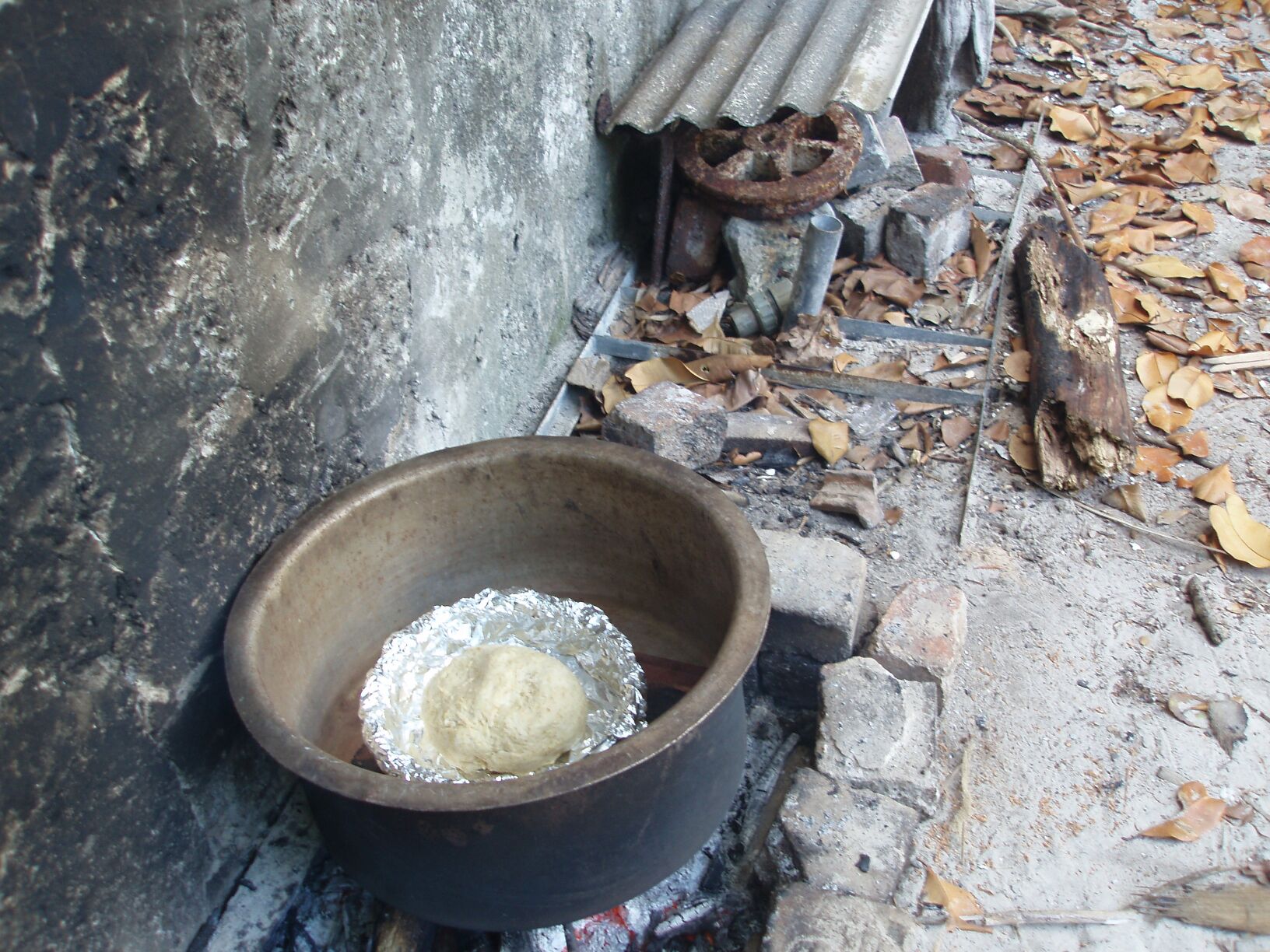
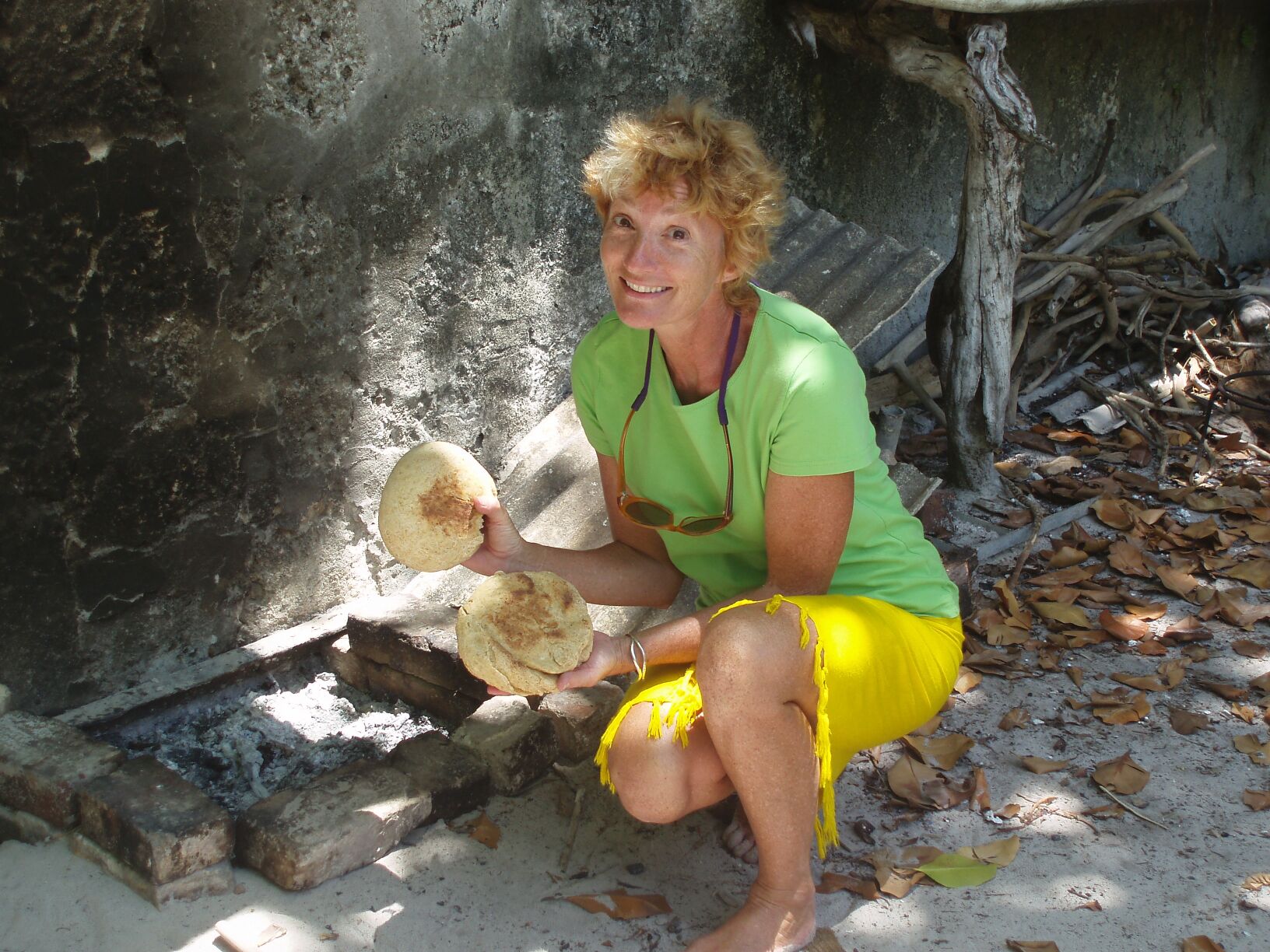
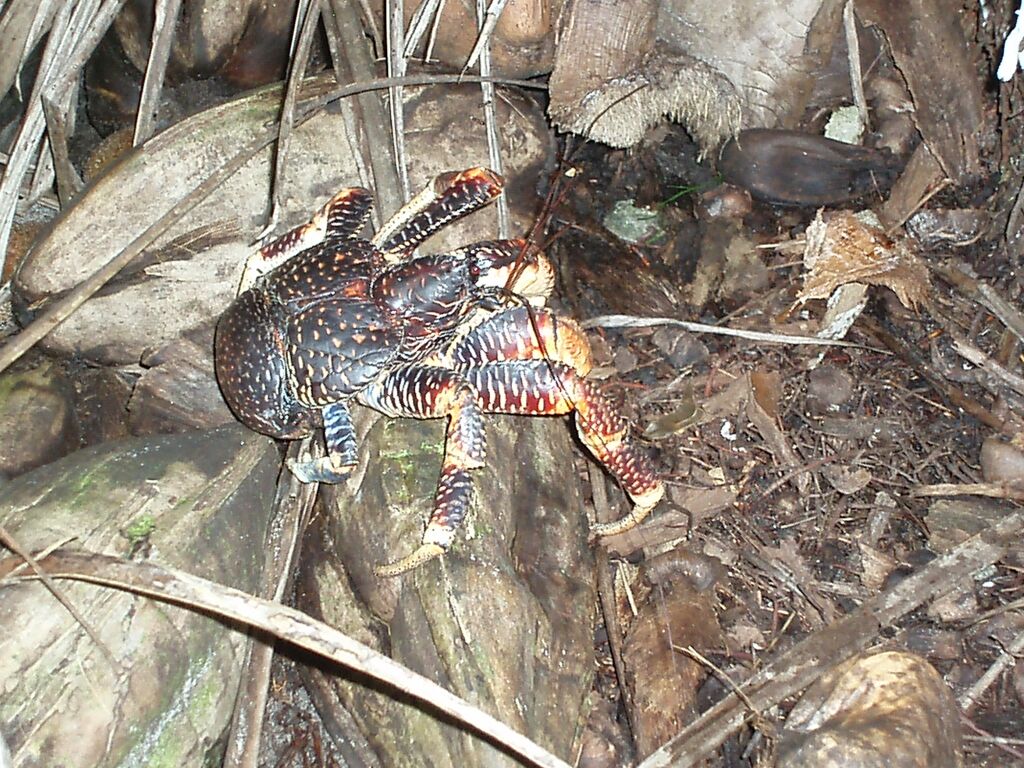
Robinson Crusoe (or perhaps Girl Friday?). We have thoroughly explored the islands and photographed all of the ruins and all of the coconut crabs. We have watched as a "heart of palm" was extracted and then eaten it in salad. The snorkeling has been excellent and on the shallow reef we have spotted a beautiful and venomous "lion fish" as well as a huge octopus. The later was amazing to watch as it changed color in an instant. The first time I spotted the beast, it was flashing dark brown and purple around it's eyes. I called Annette over to see and by the time she arrived, it had completely changed color to a light tan with dark brown speckles to match the surrounding coral. It has been very pleasant swimming here as the water is almost bathwater warm without sediment or pollution. When we snorkeled the bombies in the middle of the lagoon, we had perhaps 8 feet of water over the top of the bombie and the sides dropped away to 80 feet or so. The water was so clear we could see the sea bed below and out to 300 yards. The shoals of fish seemed to hang in blue space below us and the occasional shark was ignored by all. The corals were in great condition and were growing in profusion everywhere we looked. We saw a huge puffer fish that would probably have swelled up to meteorological balloon size if annoyed.
On Friday, the hard drive on my laptop crashed and we are now using the back-up machine and hoping it will last until we reach electronic civilization. We have cleaned the marine growths from the hull on DoodleBug and scoured the propeller clean. The propeller cleaning procedure was closely supervised by one of the fish that has taken up residence below our hull. We have acquired quite a school and they become very excited if we cast food scraps overboard or flush the toilet yummy!). Anyway, I was wearing a scuba tank as I cleaned the prop and my fish "supervisor" was no more than 10 or 12 inches from my hands as I worked.
Yesterday we burned our trash ashore and have restowed all of the escaped gear both within and without the boat. Tomorrow we will set sail for Uligamuin, the
northern Maldives Islands, a run of about 750 miles. I say "set sail" but we expect to lose the light trade winds that we have been experiencing as we head north
and cross the equator via the doldrums. This is why we have been hoarding our diesel as we can realistically expect to have to motor for perhaps four days.
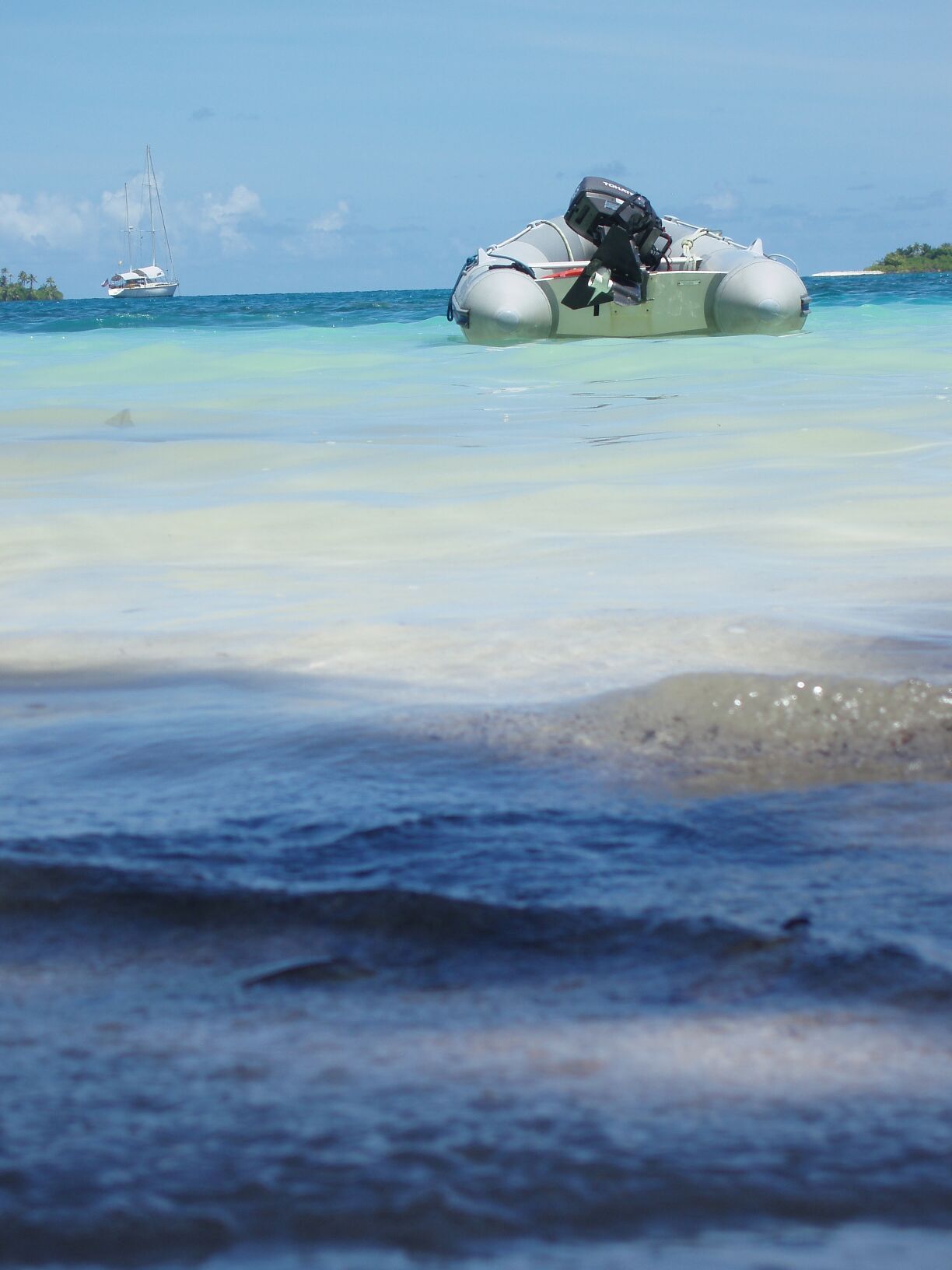 Over the past week, we have had several impromptu parties and barbeques ashore with the crews of Muggerl, Lady Guinevere, and Saltimbanque. Keith, on Lady Guinevere, is an expert harmonica
player and Paulo from Saltimbanque brought his guitar ashore and regaled us with folks songs in English as well as his native French. At the farewell "sundowner's gathering" last
night, we watched a rat attempt to dislodge two large hermit crabs from the coconut they were eating. The crabs were as big as the rat and they tried to nip it with their pincers. The rat was too
fast and just scooted them aside and tumbled them. Once the rat had triumphed, it buried itself inside the coconut while Alev from SV Muggerl took photos at a range of perhaps 12 inches. She twice
reached out and stroked the rat and it flinched, looked back to her as if to say, "What do you want?" and continued to eat. Are we talking "tame" here?
Over the past week, we have had several impromptu parties and barbeques ashore with the crews of Muggerl, Lady Guinevere, and Saltimbanque. Keith, on Lady Guinevere, is an expert harmonica
player and Paulo from Saltimbanque brought his guitar ashore and regaled us with folks songs in English as well as his native French. At the farewell "sundowner's gathering" last
night, we watched a rat attempt to dislodge two large hermit crabs from the coconut they were eating. The crabs were as big as the rat and they tried to nip it with their pincers. The rat was too
fast and just scooted them aside and tumbled them. Once the rat had triumphed, it buried itself inside the coconut while Alev from SV Muggerl took photos at a range of perhaps 12 inches. She twice
reached out and stroked the rat and it flinched, looked back to her as if to say, "What do you want?" and continued to eat. Are we talking "tame" here?
