


Tonga
September 8, 2004
Position: 15 56.4 S 173 46.1 W
We raised anchor and motored out of Apia harbor at 0700 hours. The wind seemed to be as forecast but lighter than expected and we made progress at 5 knots or so along the coast. There were rain showers around but so far they had passed us by. At 0900 hours the wind died and we began to motor. Where was our 20 knots of East wind? Just after noon we made the turn to the south towards Tonga and passed through the Apolima Strait that separates the islands of Upolu and Savaii. The wind began to blow from North Northeast and increased in strength and we began to sail again, with the wind off our stern. We had poled out Genoa, "winged" main and mizzen - making reasonable progress at 6 knots. A freighter loaded with containers came up behind us and passed us by. We have seen only a handful of ships at sea since we left the USA over 8 months ago.
1650 hours: We saw our first whales!!!!!! Our previous whale sighting was just the whales blowing in the distance but this pod was close enough to see the backs of and identify the Sperm whales. One of the whales swam within a hundred yards of DoodleBug before sounding and showing us those huge flukes. Annette's picture was out of focus. A deliberate malicious act by the camera in response to the amount of swearing directed at it by the operator.
1930 hours: The wind died completely and we went back on engine. The radar showed a large squall ahead of us and the lightning flashing all around confirmed that this was a big one. We tried to change course to pass between the various cells but we were between "the horns of the buffalo" and we resumed our original course. The skies opened and the wind was coming from all directions with lightning crackling and flashing throughout. As we emerged on the other side of the storm line, the wind was now blowing strongly from the South East (where is our North Wind??) and we were soon close reaching at 8 knots in 20 knots of wind using reefed Genoa, Main and Mizzen.
We were still passing through rain cells with strong random gusts of wind, so I dropped the main and continued on reefed Genoa and Mizzen. We were sailing at 7 knots or so but the rain was producing poor visibility as the seas began to build. Suddenly I noticed a strobe light, seemingly directly ahead. It is difficult to judge distance at sea with strobes and it seemed that there were multiple strobes here, with about a 10 second interval. With choppy seas and 10 seconds delay, the next time you see a flash, you aren't sure if it is the same strobe or not. I changed direction to avoid what I assumed was deployed fishing nets and hoped that we were seeing the entire array on our starboard side and not driving at 7 knots into the middle of some unlit mess of buoys and fishing nets.
0145 hours: What day is this? Tonga is across the date line, so although we left Samoa on Wednesday morning, it is now Friday. Goodbye Thursday. The wind is beginning to veer around and we are now beam reaching in increasingly bigger seas. By 0730 hours we are broad reaching with 25 knots of wind, gusting over 30 knots and 10 to 12 foot seas. We have about 30 miles to go to reach Niuatoputapu and I hear a conversation on the radio between boats at anchor there. They are discussing the size of the breakers sweeping the entrance to the pass and have concluded that it would be dangerous to attempt to leave and they should consider staying there several more days.
I try to join the conversation but Roger from "Equanimity" (last seen in Bora-Bora) answers. We discuss the weather and the fact that what was and is being experienced was nowhere in the forecasts. Roger offers to scout the reef pass by dinghy when we are close, as it is difficult to judge breakers from the "sea side". He will give me his opinion of the breakers from the "land side". The weather forecast consensus is that the winds should go to the South eventually and should drop in the next day or so. The winds increase. We now have 30 knots steady with higher gusts and we are sailing at 9 knots plus with a scrap of Genoa and Mizzen. The wind is blowing from just port of our stern and should be in just about the worst possible position for entering the reef pass. The pass at Niuatoputapu is quite narrow and shallow and all the charts warn of the hazard of breakers sweeping the pass entrance. This does not look good. Annette and I discuss the options of heaving to and waiting for better conditions - no sea room for this, just off the pass. We would have to sail completely around the island and head South for sea-room. A second option would be to just bypass the island and continue on to Vavau some 160 miles further South. The boat motion has been uncomfortable, to say the least and Annette has been very queasy. Neither of these options are attractive but we will certainly choose one before we risk our boat at the reef pass.
Just 3.5 miles of North of Niuatoputapu is the volcano of Tafahi. Our route takes us within a mile of the Tafahi breakers as we pass. The wind is still blowing at 30 knots with confused seas of 15 feet or so, as we are now coming into shallow water. A squall hits us at this point with the rain so heavy, visibility is reduced to a couple of hundred yards. The wind crosses the stern and the Mizzen jibes so I take it down. I have to close the cockpit sliding door as the rain is driving horizontally from the rear. I can see almost nothing and have started the engine to make sure it will be available when and if needed. The rain is cold and Annette passes me a rain jacket from below in the cabin, which I gratefully don. I am relying on the chart plotter and radar, as I can see neither our destination two miles away, nor the volcano a mile off our starboard. We are minutes from our waypoint off the reef entrance and decision time is close.
The radar shows a break in the rain, the sky ahead is turning blue. We break out into sunshine and the wind seems to be dying. The seas don't seem quite as high. I line up the pass entrance and with binoculars can make out the range markers ashore. Roger from "Equanimity" and Mike from "De la Mar" are in the pass entrance in a dinghy with a hand-held radio. Mike opines that the pass is tricky but doable. We are on engine in bright sunshine with squalls and rain all around us. Every minute that passes the wind seems less and the seas seem lower. Just hold off the rain for a few minutes so we can see what we are doing. We drive for the pass. Just at the pass entrance, a breaker hits us broad side and DoodleBug staggers and slews. I hastily correct and line up again. The second breaker hits us but it isn't so bad and we can see the dinghy in the water just ahead. The third breaker we shrug off with barely a twitch and we are in the pass! We gratefully follow the dinghies around the dogleg and into the anchorage. What a beautiful sight! The anchor goes down and we are sitting at 15 56.4 S 173 46.1 W. The beer is well deserved.
September 10, 2004
Postion: 15 56.4 S 173 46.1 W
We are in Tonga across the dateline on Friday. We anchored safely in the harbor at Niuatoputapu. Exciting details of the voyage to follow! Movie rights still available......
September 11, 2004
The anchorage at Niuatoputapu is well protected on all sides and just 3 miles or so north of the protecting reef, a perfectly conical volcano, heavily covered with trees, rises out of the Pacific. This is probably one of the prettiest anchorages we have been to. We began the morning by moving anchor positions to allow our neighbors more room, as the weather is still unsettled and the wind swings the dozen or so boats in the bay around in wide arcs. Will and Tiffany from S/V Clare came by in a dinghy and visited briefly. They were returning from whale watching and had just had a wonderful time.
There was an announcement on the radio of a Tongan feast organized by some locals to be held on a nearby motu (small islet) later that afternoon. We headed
over to the motu in our dinghy and threaded our way through the shallow reefs until we found a white coral sand beach.


Other dinghies began to land and we soon had the beach filled with rubber boats. We knew at least four boats in the anchorage plus we had been in the same harbor before with most of the other boats. I suppose this is the way it usually happens as everyone funnels down the "Coconut Milk Run" towards New Zealand at the end of the winter sailing season. We had a pleasant time visiting with everyone but wished we had remembered to bring flashlights for our return journey. We had help carrying our dinghy back down the beach and launching it but it would have been less memorable and far less amusing, if we had remembered to untie the painter from the tree it was attached to, before we attempted the launch process.
September 12, 2004
We had decided to revisit yesterday's motu and were loading our boat with vital emergency rehydration supplies (and a bottle
opener) when we were invited to join "Clare", "Apsara" and "De la Mer" on a whale watching expedition. We all four couples had hand held radios and set off
in convoy with our dinghies to cross the protecting reef into the open ocean. There was supposedly a dinghy pass that


 had been dynamited through the reef but we never found it. We just lifted the outboard and used the paddles to take us
over the top of the reef into a calm lead on the other side. From here we motored out into the ocean. At first it was a little intimidating to be on the
Pacific in a 10 foot inflatable but the swells were manageable. The plan was to motor to where Will and Tiffany had found whales yesterday and then motor
slowly, line abreast with a couple of hundred feet spacing and look for whales. We stopped for a period and turned engines off. One of the highlights of the
trip was to see and hear Will, put on a mask and snorkel, hang his head underwater while dangling over the side of his dinghy and make whale noises.
"Doris" from "Finding Nemo" would have been impressed. (If you haven't watched the movie - go rent it!). We could hear Will over a hundred yards or so. I don't
know if the whales could hear it but a humpback whale sounded and we fired up the engines and took off after it. At one point we were about 50 feet or so away
and Bill and Tiffany were ahead of the whale. Bill rolled off his dinghy into the water to snorkel with the 50 foot long whale. We spent a pleasant morning bobbing around in the ocean, trying to get
ahead of whale pods and then turn off the engine and wait for them to surface. We finished up several miles offshore with the dinghies scattered everywhere and
in touch only by radio. By lunch time we had exhausted our vital emergency rehydration supplies (Corona) and decided we would head back to DoodleBug. About
a half mile off the place where we had crossed the reef, we met up with a cow and calf humpback whale. We watched them for about an hour, with the calf
breaching, flopping on it's back and generally behaving as a puppy would, while it's mother rose hugely from the deep alongside, every now and then. Since the
calf was leaping randomly out of the water, we were a little concerned that it might land on us, as we were that close. Eventually the pair swam slowly away
and we headed back across the reef and back to DoodleBug for a vegetarian lunch.
had been dynamited through the reef but we never found it. We just lifted the outboard and used the paddles to take us
over the top of the reef into a calm lead on the other side. From here we motored out into the ocean. At first it was a little intimidating to be on the
Pacific in a 10 foot inflatable but the swells were manageable. The plan was to motor to where Will and Tiffany had found whales yesterday and then motor
slowly, line abreast with a couple of hundred feet spacing and look for whales. We stopped for a period and turned engines off. One of the highlights of the
trip was to see and hear Will, put on a mask and snorkel, hang his head underwater while dangling over the side of his dinghy and make whale noises.
"Doris" from "Finding Nemo" would have been impressed. (If you haven't watched the movie - go rent it!). We could hear Will over a hundred yards or so. I don't
know if the whales could hear it but a humpback whale sounded and we fired up the engines and took off after it. At one point we were about 50 feet or so away
and Bill and Tiffany were ahead of the whale. Bill rolled off his dinghy into the water to snorkel with the 50 foot long whale. We spent a pleasant morning bobbing around in the ocean, trying to get
ahead of whale pods and then turn off the engine and wait for them to surface. We finished up several miles offshore with the dinghies scattered everywhere and
in touch only by radio. By lunch time we had exhausted our vital emergency rehydration supplies (Corona) and decided we would head back to DoodleBug. About
a half mile off the place where we had crossed the reef, we met up with a cow and calf humpback whale. We watched them for about an hour, with the calf
breaching, flopping on it's back and generally behaving as a puppy would, while it's mother rose hugely from the deep alongside, every now and then. Since the
calf was leaping randomly out of the water, we were a little concerned that it might land on us, as we were that close. Eventually the pair swam slowly away
and we headed back across the reef and back to DoodleBug for a vegetarian lunch.
September 13, 2004
Today is Monday and we need to trek to "town" to exchange dollars for Tongan money - called Pa'angas, and pay the various customs and agriculture fees. "Town" is about a one and a half mile walk from the dock and when we arrived at the "Treasury" building it looks like something from the "Wild West". A wooden building with a raised deck with a hitching rail. Inside a small counter with an ancient safe with it's door hanging open. Not too many bank robberies here, since everyone knows everyone else. We exchanged some cash and then stepped two paces to the right to deal with the same person in the "next" office. We paid our fees and then headed down the road to the bakery. The bread still had ten minutes to finish baking, so we chatted with the Catholic pastor who was lounging outside. When we purchased our bread it was too hot to hold at first. We headed back to the boat for a lunch of something or other and "fresh bread"!
September 14, 2004
This morning we sat drinking tea and coffee in the cockpit and watched the whales spouting on the other side of the reef. Annette then "flagged down" a local fisherman and traded a pack of Marlborough cigarettes (we don't smoke of course) for a fresh flopping fish he had just caught. We ate fish for breakfast! Later that morning we took the dinghy out to the reef and snorkeled for an hour or so. At first we anchored the dinghy but later drifted with the dinghy over the top of the reef out into the ocean.


The visibility was superb as we passed out of the inner lagoon and saw the sea bed drop rapidly away into deep blue. Annette saw a 6 foot black-tip reef shark and didn't even have a heart attack.
We hiked the motu we had "Tongan feasted at" on Saturday. We found a "coconut-knocking-off-the-tree" stick and captured a live coconut. We had no ice skates with us of course, so we used a dive knife to open it. Delicious! Scavenging for food in the jungle (even if we can still see Doodlebug in the background).

 This afternoon the local ladies had arranged a craft display and Annette found some souvenirs to purchase. I trekked back to the Customs office to request a
clearance. Since we aren't leaving until Thursday morning, this was refused, although the lady told me I
could pick the clearance up from her home tomorrow evening. I should have lied about our departure time, like everyone else and
saved myself the trouble. Tomorrow we hike the volcano we see on the nearby island and then sail Thursday morning for Vavau some 170 miles further south.
This afternoon the local ladies had arranged a craft display and Annette found some souvenirs to purchase. I trekked back to the Customs office to request a
clearance. Since we aren't leaving until Thursday morning, this was refused, although the lady told me I
could pick the clearance up from her home tomorrow evening. I should have lied about our departure time, like everyone else and
saved myself the trouble. Tomorrow we hike the volcano we see on the nearby island and then sail Thursday morning for Vavau some 170 miles further south.
September 15, 2004
Today was the volcano hike. Our tour guides picked us up from DoodleBug in an ancient wooden fishing "panga". The volcano is about 4 miles or so from Nuiatoputapu and the sea between the two islands was choppy with 6 to 8 foot swells. The fisherman who was driving the boat, was obviously very skilled but the panga rolled and pitched violently at times. I thought that any vessel in this stage of dilapidation was probably very seaworthy and noticed that not all of the plastic fuel jugs thrown into the panga's rude cabin were full. They might serve as life floats if we sank. The boat driver and our guide trolled for fish on the crossing but caught nothing.


We landed near a small village and were surprised at how many dwellings there were on the steep flanks of the volcano. We climbed the slopes between the village homes and then through family fruit and taro plantations. Pigs were rooting everywhere and we paused above the village at a gated loose stacked stone wall. We were told the wall and gate were to keep the pigs out of the plantations. Our guides for the trip were a 20 year old lady "Maylee" and her older brother. It soon became apparent that neither was carrying anything for the trip. They apologized for not offering coconuts for drink, as they had forgotten to bring a machete. I was carrying four small bottles of water in a backpack in order to supplement the anticipated coconut diet.
We shared this water between the four of us and continued the upwards climb. At one point Maylee's brother climbed an orange tree and picked oranges for us. We ate these but they were not the same as having a quart of water in a handy bottle. I was conscious of the fact that I was spitting orange seeds just as though it was a water-melon seed spitting contest. In case this was offensive to the Tongans, I began to discreetly spit the seeds into my hand while I surreptitiously watched our guide. Maylee was calmly eating her orange with the seeds just dribbling down her face - no taboo here! Maylee spoke excellent English but her style of guiding can be demonstrated as follows. "Hey, Maylee, is that a lemon tree?".. .."No". The climb to the summit of the volcano took two hours and the path was almost vertical at times, with feet scrabbling in the loose dirt and grabbing on vines and vegetation for purchase. At times the jungle was so thick you could not see the person 6 feet ahead. The cloud at the summit prevented us from seeing across to the other island but we could look down to see the sea at the base of the almost perfectly round volcanic cone.
We shared our lunch with our guides, who would otherwise have to watch us eat. Lunch was hard boiled eggs, tomatoes, buttered bread and pimento stuffed olives. Maylee had never tasted an olive and after trying one, screwed up her face and spat it onto the ground. We laughed and could not tempt her brother to try one. We descended into the crater of the volcano, which had even thicker jungle growth if that were possible. Annette thought it looked like "Jurassic Park". The huge trees were interspersed with pineapple, banana, papaya, mango, oranges, coconuts, plus many we are not familiar with. I was looking for a Heineken tree but never spotted it. I had finally remembered to bring our hiking poles with us on this trip, so the descent was easier than the climb.
We stopped again at the village and visited the school - two class rooms with two teachers that educated less than a score of children

 through something like 5th. grade. Our guide emphasized how little the schools had and suggested we might want to donate something. This was slightly irritating when we are on
a strenuous hike with a possession-less guide, who had to keep borrowing my pen-knife. Perhaps they thought I had a chalkboard in the back pack. I knew
that the church was visited once a month by the pastor on Nuiatoputapu because we had met him earlier at the bakery. What was interesting was the huge log
drum in front of the church which was beaten to call the faithful. There was a single village telephone in a telephone booth near the boat landing. The trip back
to DoodleBug was rougher than the morning crossing but highlighted when the boat driver caught a good sized tuna on his trolling
line. When we boarded DoodleBug I found a spare stainless steel pen-knife that I gave to Maylee's brother, as he must have borrowed mine a dozen times and
had handled it wistfully before slowly handing it back to me.
through something like 5th. grade. Our guide emphasized how little the schools had and suggested we might want to donate something. This was slightly irritating when we are on
a strenuous hike with a possession-less guide, who had to keep borrowing my pen-knife. Perhaps they thought I had a chalkboard in the back pack. I knew
that the church was visited once a month by the pastor on Nuiatoputapu because we had met him earlier at the bakery. What was interesting was the huge log
drum in front of the church which was beaten to call the faithful. There was a single village telephone in a telephone booth near the boat landing. The trip back
to DoodleBug was rougher than the morning crossing but highlighted when the boat driver caught a good sized tuna on his trolling
line. When we boarded DoodleBug I found a spare stainless steel pen-knife that I gave to Maylee's brother, as he must have borrowed mine a dozen times and
had handled it wistfully before slowly handing it back to me.
After showering, drinking a glass of water and a couple of beers, we were headed to the nearby village to pick up our clearance documents for the morrow from "Pesi" the customs lady. We had covered ourselves liberally with mosquito repellent for the volcano hike but had since showered it all off. We regretted this and probably had more bites in the next twenty minutes than we had received all week.
Safe and scratching aboard DoodleBug, we heard a conversation on the radio between "Equanimity" and "De la Mar". Equanimity had left that morning but contrary wind conditions and high seas had convinced them to return to Nuiatoputapu. It looked like they would arrive after nightfall and we volunteered to help bring them into the narrow unlit pass. This was accomplished with three dinghies, plus hand held radios and flashlights, forming an "approach path" lined up with the pass range markers. Equanimity safely at anchor, back to DoodleBug for supper. Annette had begun to have some cramping of the muscles around her stomach. These cramps had slowly become more intense. After supper her cramps were getting severe and I took her temperature and measured her blood pressure etc. I found my copy of "Where there is no doctor" and was in the process of eliminating peritonitis, appendicitis etc. as possible diagnoses. By late evening Annette was really hurting and said she had never experienced anything like this. With thoughts of night time searches for the island doctor and charter aircraft evacuations, I got on the radio and asked if there was a doctor in the few remaining boats at anchor. Miracle! The next boat, a Canadian flagged catamaran had a lady doctor on board. She graciously visited DoodleBug and decided that Annette was suffering from an electrolyte imbalance caused by dehydration on the hike. I gave Annette a strong pain-killer which she obligingly threw up. This action seemed to stop the stomach cramping and she recovered rapidly thereafter. Dr. Catherine had suggested having Annette drink a solution of salt and baking soda interspersed with "tang" to get it down. Since Annette had given me such a scare and been such a nuisance, I insisted she drink the noxious brew as punishment. What a scare! Makes you realize how many things you take for granted when safely at home in our Western civilization.
September 18, 2004
Position: 18 39.7 S 173 58.9 W
0700 hours local time (local time is GMT + 12 hours). We arrived in Neiafu Anchorage,Vava'u, Tonga this morning at 18 39.7 173 58.9 W
after a 23 hour 30 minute run from Niuatoputapu. We had northeast winds for most of the trip giving a fast beam reach. In the first 12
hours after we left Niuatoputapu we covered 98 miles.
 We just can't seem to get to those double century days. As we left the pass yesterday morning we missed a whale by about 20 feet. We could see it's huge shape underwater.
As we arrived in Neiafu, I glanced up and saw a large buoy immediately ahead of us. I
hurriedly switched the autopilot to "standby" and wrenched the wheel over. The "buoy" then dived. It was another whale (or maybe the same one?).
In the early dawn we glanced up at huge flocks of birds passing overhead. Then realized they were large fruit bats not birds. Neat.
We just can't seem to get to those double century days. As we left the pass yesterday morning we missed a whale by about 20 feet. We could see it's huge shape underwater.
As we arrived in Neiafu, I glanced up and saw a large buoy immediately ahead of us. I
hurriedly switched the autopilot to "standby" and wrenched the wheel over. The "buoy" then dived. It was another whale (or maybe the same one?).
In the early dawn we glanced up at huge flocks of birds passing overhead. Then realized they were large fruit bats not birds. Neat.
September 19, 2004 - September 20, 2004
What an unusual anchorage Neiafu, Vavu'a is! There must be a hundred sailing vessels moored here. The choke point of the
"Coconut Milk Run". The cruisers will hang around the Tongan islands until the end of October and beginning of November before making the dash to New Zealand.
Our trip here from Nuiatoputapu has given us clues as to what to expect on this final leg. To date, most of our sailing has been "trade wind" sailing with the
from wind behind the beam, blowing us benignly across the Pacific. Now we have turned south. The wind is no longer comfortably behind the beam and as we get to
higher latitudes, we will run into more strong winds and winter gales. If we wait too long, the cyclone season begins and the damage reports from the current
batch of hurricanes that have been plaguing the northern hemisphere, should wean even the most tardy sailor from hanging around in "cyclone alley". The small
town associated with the anchorage is full of bars and restaurants, internet cafes, hotels, laundries etc. catering to the "yachties". If you
 cruise slowly past the seafront watering hole "The Mermaid", you can guarantee a half dozen hands waving at you and calling your name. Friends from earlier anchorages. We
tied up here on Monday for "Mermaid fish and chips" and enjoyed visiting with all of the passing crews. Several crews got caught in adverse weather on the
trip from Nuiatoputapu and spent several days at sea in rough conditions (we considerately downplay our 23 hour passage time). One boat "Billabong" hit a
sleeping whale sufficiently hard to come to a complete stop. This had worried us during night passages. What happens when you are sailing at 8 knots and 18 tons
of boat hits a whale? Or an unlit fishing panga? One crew describes how they were trapped by non-forecast strong winds inside a remote atoll. They lost two
anchors and had to cross the lagoon in the dark with spreader height waves, making 0.2 knots at maximum engine RPM, with no way to see or avoid the coral
heads in the lagoon. The tales go on but we have to visit the bank to exchange money, the internet cafe to check land e-mails and web-sites, buy some
groceries, gas for the dinghy, get rid of the accumulated trash on board etc. We move on.
cruise slowly past the seafront watering hole "The Mermaid", you can guarantee a half dozen hands waving at you and calling your name. Friends from earlier anchorages. We
tied up here on Monday for "Mermaid fish and chips" and enjoyed visiting with all of the passing crews. Several crews got caught in adverse weather on the
trip from Nuiatoputapu and spent several days at sea in rough conditions (we considerately downplay our 23 hour passage time). One boat "Billabong" hit a
sleeping whale sufficiently hard to come to a complete stop. This had worried us during night passages. What happens when you are sailing at 8 knots and 18 tons
of boat hits a whale? Or an unlit fishing panga? One crew describes how they were trapped by non-forecast strong winds inside a remote atoll. They lost two
anchors and had to cross the lagoon in the dark with spreader height waves, making 0.2 knots at maximum engine RPM, with no way to see or avoid the coral
heads in the lagoon. The tales go on but we have to visit the bank to exchange money, the internet cafe to check land e-mails and web-sites, buy some
groceries, gas for the dinghy, get rid of the accumulated trash on board etc. We move on.
My (Ed's) brother Brian is coming to visit next week and we make a pilgrimage to the airline office to buy a ticket to fly him up from Tongatapu in the south to our current location. The office already has more than a dozen people waiting outside so we will return tomorrow. We pick up a freshly baked tropical fruit strudel from a local Austrian owned bakery and head back to DoodleBug to see if we can find two forks, tea and coffee.
September 21, 2004
We arrived at the Royal Tongan Airlines ticket agent this morning at 0811 hours. It was closed but by asking around, we determined it would open in twenty minutes or so. There were several chairs outside the office. I established myself as "first-in-line" and waited. Several other potential customers soon showed up and after engaging my neighbor in conversation, was told the following. The story goes that until a couple of weeks ago, there were "Royal Tongan Airlines" and a "new" competitor. The competitor used modern aircraft, operated efficiently like a real airline and was also cheaper than Royal Tongan Airlines. The latter however is owned by the Prince of Tonga, so the King of Tonga arbitrarily shut down the competing airline, simply because they were blowing away the family operated business. Now there is just Royal Tongan Airlines. They fly a WW2 vintage DC3 - carrying 20 passengers per trip. This is why service has been chaotic, as they try to take up the extra business from their shut down competitor. The ticket office door opened on time and I slid into the seat in front of the desk. I explained that my brother was flying into Tongatapu (the capital) next week on an International flight and I need to fly him up to Vava'u. The young lady looked at me as though I had just asked for a seat on the space shuttle. I repeated myself with variation and asked if they had a flight that day. This involved her crossing the room to examine a piece of paper taped on the wall, to determine the times of the two flights per day of their single aircraft. I asked her to book the ticket. She picked up the telephone and began to make one of many attempts to call Tongatapu. She told me that all tickets are handled by the main office in the capital. By now the office had filled with all sorts of people and she began holding multiple conversations while clutching the phone. 45 minutes later I left with a receipt for a ticket, that allegedly will be waiting for my brother at the ticket counter in Tongatapu when he arrives. We will see.
 Annette wanted cut flowers and we stopped at the tourist information office to see if they have a flower shop. There isn't one but the lady
at the tourist information office took a pair of scissors and began denuding Tonga of flowers until Annette convinced her to stop. Now we have our flowers and didn't even
have to rob a grave!
Annette wanted cut flowers and we stopped at the tourist information office to see if they have a flower shop. There isn't one but the lady
at the tourist information office took a pair of scissors and began denuding Tonga of flowers until Annette convinced her to stop. Now we have our flowers and didn't even
have to rob a grave!
 We did a little shopping and while Annette cruised the store, I stood outside clutching my bunch of flowers and people watching. The Tongans have two dress
styles we haven't seen before. One is that the ladies are wrapped up in what looks like a rug or mat woven from pandanus leaves and tied at the waist. It is
quite bulky and looks very uncomfortable. Some of these rugs showed
distinct signs of wear - holes etc. as though they had spent a year or so lying on the kitchen floor. They are wearing the same clothing beneath the rug as other "rugless"
Tongans are wearing - dark shirt and dark trousers or lava-lava. The rug is presumably some kind or adornment. The second style is obviously just adornment
and consists of strips of elaborately woven fiber, decorated with patterns of small sea shells. These strips are worn from a belt around the waist, similar to
the way we see pictures of Roman legionnaires leather kilts. We noticed some variation of style and Annette admired one and commented to the lady. She said
she had made it herself and had interspersed plastic video tape with the pandanus or coconut fiber to get a shiny look. Clever.
We did a little shopping and while Annette cruised the store, I stood outside clutching my bunch of flowers and people watching. The Tongans have two dress
styles we haven't seen before. One is that the ladies are wrapped up in what looks like a rug or mat woven from pandanus leaves and tied at the waist. It is
quite bulky and looks very uncomfortable. Some of these rugs showed
distinct signs of wear - holes etc. as though they had spent a year or so lying on the kitchen floor. They are wearing the same clothing beneath the rug as other "rugless"
Tongans are wearing - dark shirt and dark trousers or lava-lava. The rug is presumably some kind or adornment. The second style is obviously just adornment
and consists of strips of elaborately woven fiber, decorated with patterns of small sea shells. These strips are worn from a belt around the waist, similar to
the way we see pictures of Roman legionnaires leather kilts. We noticed some variation of style and Annette admired one and commented to the lady. She said
she had made it herself and had interspersed plastic video tape with the pandanus or coconut fiber to get a shiny look. Clever.
Later that evening we hosted a pizza party aboard DoodleBug for several of our friends. Annette grumbled about the quality of the pizza (purchased locally) but I noticed that the guests didn't leave much.
September 22, 2004
Nuiatoputapu has mosquitoes like most South Pacific Islands. There is no malaria there but there are still reports of "lymphatic filariasis" commonly called "Elephantitis". The local doctor had recommended we take a prophylaxis in the form of pills for same but he had run out of pills. At last night's pizza party, we had been told that we could obtain these pills quickly and painlessly at the local hospital. We found the hospital this morning and were first asked our age. The nurse then carefully counted out 10 pills each and handed us a rather battered plastic kitchen measuring cup containing water, so we could swallow all 10 pills on the spot.
We continued our perambulation around town, when about 45 minutes later Annette became nauseous. We hurried back to DoodleBug where Annette parted company with her breakfast and took to her bed. I was not feeling so good either, so I lay in the main cabin watching a DVD of "Patton" and drinking Guinness stout, until I recovered enough to drink Samoan beer. By evening we were both doing better. We had planned on leaving tomorrow morning to cruise the nearby islands but that is now postponed.
September 23, 2004
We are recovered today but decided to spend Thursday at our mooring and leave Friday morning. We went to immigration and extended our Tonga visas for another month and shopped for packaging and mailing materials. Sort of like a Tongan treasure hunt. We also solved the mystery of the wearing of the kitchen floor rug. It seems that this is a form of mourning dress in Tonga. When a parent dies, the children will often wear this uncomfortable extra garment for the next 12 months to show respect. Sort of like the early Christians wearing sackcloth and ashes to show repentance. I thought that there must be a lot of dead parents but was told that the Prince of Tonga's brother had just died. Thank goodness the USA is a republic. I would hate to have to do group penance for the sins of our political leaders.


Cathleen and Pierre had been expecting a guest on "S/V Olla" to arrive on the same flight as my brother will use next week and take the same DC3 shuttle from Tongatapu to Vava'u. They waited at the airport but their guest was not on the flight. Royal Tongan Airlines had no record of her an any other flights either. They did say the plane looked in great condition though.........
September 23, 2004
Position: 18 42.0 S 174 01.9 W
Last minute shopping - Annette bought a fish, pineapple and shrimp. We cast loose our mooring and headed off to find a pretty anchorage. This we found almost immediately about an hour or so from Neiafu. The tiny bay is marked on the charts as "Port Maurelle" and is lined with gray coral cliffs, topped with coconut trees, fronting a white coral sand beach. There were two other boats here when we arrived but they both left shortly after we anchored. I snorkeled the anchor chain after we were settled and found it wrapped around coral in about 40 feet of water.
For lunch we had the fish we had bought earlier that morning and I helpfully dropped Annette's fish scaling board over the side into 30

 feet of water. I could see it lying on the sea bed and was able to free dive to retrieve it, while Annette tried to photograph the event. There were so many fish swimming
around that Annette wanted to invite several for supper. Unfortunately they all declined her bait choice of pineapple and corned beef, although they consumed
these choice morsels once they had fallen off the hook.
feet of water. I could see it lying on the sea bed and was able to free dive to retrieve it, while Annette tried to photograph the event. There were so many fish swimming
around that Annette wanted to invite several for supper. Unfortunately they all declined her bait choice of pineapple and corned beef, although they consumed
these choice morsels once they had fallen off the hook.
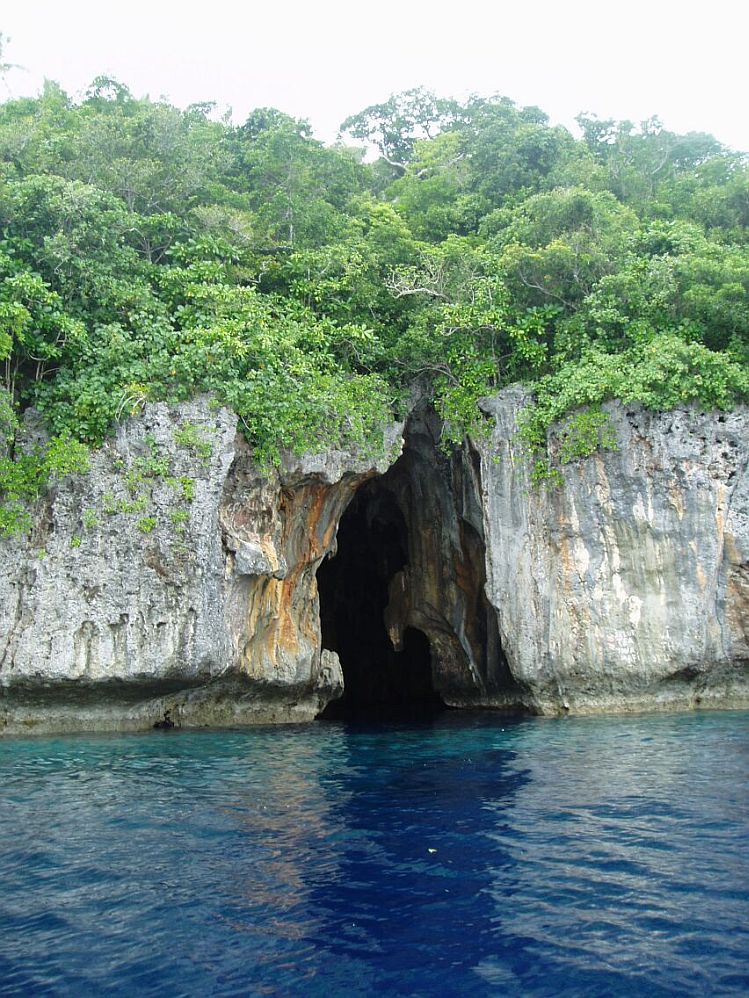
 In the afternoon we took the dinghy and explored "Swallows" cave. This is about a mile from the anchorage and is a cave with an
entrance that you can dinghy inside. Once you are inside, you see it is huge with a high ceiling and from the deep blue of the water below the dinghy, you can see it is also very deep. The
cave walls are covered in graffiti - some dating back to whaling days. Most of the graffiti I read was the more tedious sort though.
In the afternoon we took the dinghy and explored "Swallows" cave. This is about a mile from the anchorage and is a cave with an
entrance that you can dinghy inside. Once you are inside, you see it is huge with a high ceiling and from the deep blue of the water below the dinghy, you can see it is also very deep. The
cave walls are covered in graffiti - some dating back to whaling days. Most of the graffiti I read was the more tedious sort though.
We walked the pretty beach in late afternoon looking for shells, before heading back to DoodleBug anchored at 18 42.0 S 174 01.9 W.
September 24, 2004
Position: 18 45.1 S 174 04.9 W
As we were preparing to depart this morning, two more boats arrived. One was flying a Japanese flag and when they dinghied close
to DoodleBug, we invited them on board. The dinghy contained a couple from New Zealand with a 21 month old baby. Daddy was teaching

 the baby to drive the dinghy. The baby already had the twist throttle worked out but could only turn to port since his arms were too short. We were fascinated to see this child
stand with his toes curled on the edge of painful drop-offs aboard, swaying easily with the motion of the boat. He was very steady on his feet and was able
to drop his hat over the side with both skill and ease. Annette dived in after it and retrieved it as it was sinking from sight. He then looked for more stuff
to drop overboard. It was with some relief when they left, as we could get our heart rate down to something normal.
the baby to drive the dinghy. The baby already had the twist throttle worked out but could only turn to port since his arms were too short. We were fascinated to see this child
stand with his toes curled on the edge of painful drop-offs aboard, swaying easily with the motion of the boat. He was very steady on his feet and was able
to drop his hat over the side with both skill and ease. Annette dived in after it and retrieved it as it was sinking from sight. He then looked for more stuff
to drop overboard. It was with some relief when they left, as we could get our heart rate down to something normal.
We raised anchor and motor sailed for another anchorage off Ovalau Island. Beautiful location and when we snorkeled the anchor chain to check it out, we
saw that the anchor was set perfectly on soft white sand at 18 45. S 174 04.9 W. The guide book had recommended this as an anchorage with excellent protection. During the afternoon the wind swung from southeast to
northeast and an uncomfortable chop set up. We decided we did not want to suffer with this all night, so we upped anchor and sailed over to Nuku island to

 check out another recommended anchorage. We eased up on this one but decided the guide book author was either drunk or kidding, so we slipped back into last night's
bay just around dusk and dropped the anchor in almost the same position as last night. Annette is getting more determined with her fishing and has two lines
hanging over the side.
check out another recommended anchorage. We eased up on this one but decided the guide book author was either drunk or kidding, so we slipped back into last night's
bay just around dusk and dropped the anchor in almost the same position as last night. Annette is getting more determined with her fishing and has two lines
hanging over the side.
September 26, 2004
We found a small island called Tapana and anchored close to the southeast corner of the island and the reef that connects it to the next island. There was a pretty little beach that beckoned and we dinghied in to the beach and walked it's length looking for shells. The day's highlight occurred as we were sitting for a few minutes on the sand, when a man with dog appeared at the other end of the beach. The dog was a brown Doberman and hurled itself at us. It rushed up to both of us spraying cartwheels of sand and began licking our ears, faces etc. before running off again. The owner was a Venezuelan cruiser and came up to us apologizing in a mixture of English and Spanish. Annette is missing Attila so it was hardly a problem. We circumnavigated Tapana by dinghy and found nearly thirty other cruising yachts anchored on the opposite side of the island. It is a popular spot, as there is a restaurant there called "La Paella" which supposedly has a reputation known as far away as Spain. I (Ed) then spent the afternoon with scuba tank under the boat replacing the propeller anode and cleaning the growth off the prop. Amazing how quickly it grows. I cleaned it last in Apea, West Samoa.

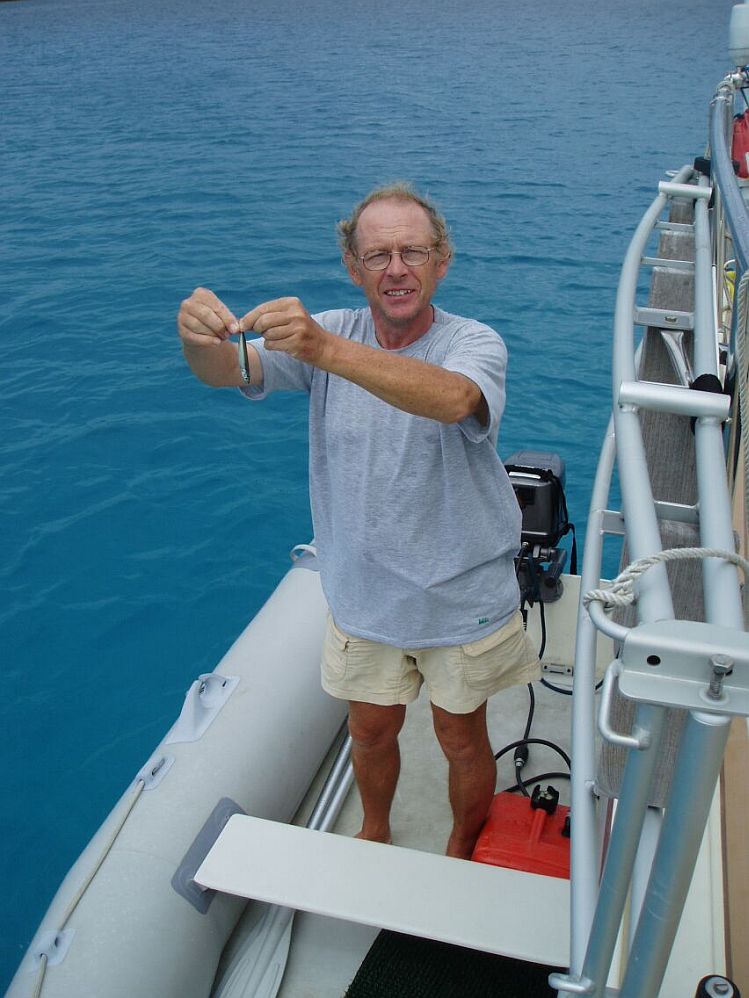


We did enjoy the solitude and beauty of our anchorage spot into the evening. The wind shifted from southeast to northeast and then to northwest as forecast but we had good shelter. Unfortunately when the boat swung with the wind, I discovered that I had not set enough distance range on the anchor alarm and it went off at 0300 hours - thereby terminating my blissful sleep.
September 27, 2004
Moved on to anchor off the village on the island of Ofu. We walked the beach searching for shells and visited the local
elementary school. One of the children showed us that when you hold a hermit crab upside down and whistle at it from a range of 6 inches or so, it squirms
out of it's shell. Annette tried it and it worked! Now we have to find another hermit crab to see if this one was specially trained or if they all do that.
 We go back to Neiafu anchorage tomorrow and wait for Brian to arrive on Thursday. He leaves from Tongatapu on October 19th. We will sail down from here to there
(about 160 miles) so we he won't have to fool with the return domestic flight. We will then get a customized weather forecast from a commercial forecasting
company for the trip to New Zealand. I expect about an 8 day passage to NZ and then we begin to arrange for our return flight to the USA!
We go back to Neiafu anchorage tomorrow and wait for Brian to arrive on Thursday. He leaves from Tongatapu on October 19th. We will sail down from here to there
(about 160 miles) so we he won't have to fool with the return domestic flight. We will then get a customized weather forecast from a commercial forecasting
company for the trip to New Zealand. I expect about an 8 day passage to NZ and then we begin to arrange for our return flight to the USA!
September 28, 2004
Christina and John on S/V Tataipo anchored next to us last night and joined us for "sundowners". This morning we visited them for coffee and toured their unusual vessel.


It is a 20 year old wooden Dutch built catamaran. It seemed very seaworthy and they had sailed it from Gibraltar despite losing their mast twice. They said the second time they lost the mast they were very experienced at retrieving the pieces.
We moved on and anchored behind Lape island. We were intending to go to the south anchorage on Vaka'eitu but we could see there were already 8 boats crammed into the anchorage. Later S/V Equanimity (we met in the Societies) cruised around looking for a spot before anchoring next to us. We went ashore on Lape and did find more hermit crabs. The first one responded to the whistle trick but the others we found just ignored us. We haven't yet figured out which are the musical ones.
September 29, 2004
We returned to Neiafu and picked up a mooring right off the Mermaid bar. Convenient for late night returns in the dinghy but tended to be noisy into the wee hours.
September 30, 2004
This morning we went to the travel agent to see if brother Brian was still confirmed on his afternoon flight and if they were
holding his ticket at the check-in counter. We were told yes to both questions. Returned to DoodleBug and after checking e-mail, found out that Brian was in
Tongatapu and had his ticket in hand. Miracle indeed! We took a taxi to the airport and the flight arrived a few minutes

 early, with Brian aboard. It was a 1944 vintage DC-3 - built 60 years ago and 40 years after the Wright brother's first flight. Brian said they had allowed him to visit the cockpit on the trip
down and it was very plush inside, as it had originally been fitted out for the King of Tonga's use when purchased by Tonga. We took Brian to a seafood
restaurant for a meal but he wasn't really conscious for the entire meal. Tonga is just about on the opposite side of the earth to his starting point in England
two days earlier.
early, with Brian aboard. It was a 1944 vintage DC-3 - built 60 years ago and 40 years after the Wright brother's first flight. Brian said they had allowed him to visit the cockpit on the trip
down and it was very plush inside, as it had originally been fitted out for the King of Tonga's use when purchased by Tonga. We took Brian to a seafood
restaurant for a meal but he wasn't really conscious for the entire meal. Tonga is just about on the opposite side of the earth to his starting point in England
two days earlier.
October 1, 2004
Annette's shopping skills kicked in and we wandered the "town" of Neiafu visiting all of the gift shops and looking for
treasures. We


 ordered Tongan mud tee shirts emblazoned with "Kick-Ass Kiwi Kickoff" to wear at the big party scheduled for Saturday night at the Mermaid.
The "Tongan mud tee shirts" are just that. They are died an orange mud color by being doused in a barrel of mud. The color is then "set" by soaking in the sea
and then rinsed in fresh water so the color doesn't permanently affix itself to the wearer. If it does, it just looks like a sun tan anyway.......
ordered Tongan mud tee shirts emblazoned with "Kick-Ass Kiwi Kickoff" to wear at the big party scheduled for Saturday night at the Mermaid.
The "Tongan mud tee shirts" are just that. They are died an orange mud color by being doused in a barrel of mud. The color is then "set" by soaking in the sea
and then rinsed in fresh water so the color doesn't permanently affix itself to the wearer. If it does, it just looks like a sun tan anyway.......
October 2, 2004
Paid our mooring fee in anticipation of leaving Sunday morning. Lazy day, ice cream, restaurants, picked up our tee-shirts. The part was a loud and fun affair. There were presentations to various cruisers for running into whales etc.


The young lady who had volunteered to hand out the "award certificates" was extremely pretty and dressed in a very provocative outfit - "bad girl" shoes etc. I got to hug her. Nice. There was also kegs of beer and barbeque. We didn't get any awards though. Fixed!
October 3, 2004
Motor sailed to Port Maurelle where we swam and snorkeled before exploring the beach. After lunch, Brian and I took the dinghy to explore "Swallow's cave" and also some adjacent caves. The big afternoon project was to reattach the gas barbeque to the rail. I had broken the bracket when trying to remove it for the Panama Canal passage and had picked up a new bracket I had mailed to Pago Pago. We haven't used the barbeque since last December. This was memorable since it blew out and when Annette tried to relight the beast, it exploded with a bang and singed her eyebrows. Our guest at the time was impressed. He was a lieutenant in the US Coast Guard. I have instructions that as Captain of this vessel, I am responsible for lighting barbeques in future.
October 4, 2004
This morning Annette had the boat festooned with fishing lines and she and Brian experimented with various forms of bait and the jiggling up and down of same. Their lines were hanging over the side of DoodleBug, in water so clear, you could see starfish on the sea bed 50 feet below. You could also see the fish swimming and Brian said he had never before fished, when he could actually see the fish nibbling at the bait. He caught the only fish of the morning and although it was well photographed, it was determined to be too small to feed three adults and was therefore cut up for bait.
We raised anchor in mid morning and motor sailed to Tapana Island. The anchorage we enjoyed last week was already occupied and we picked up a mooring in the adjacent bay.


We found snorkeling an effective way to cool off from the heat of the afternoon and also discovered an amazing number of large shells on the sea-bed within free diving reach. In the evening we celebrated Brian's divorce at "La Paella" restaurant. Because we are across the date-line, Brian maintained that he was divorced 12 hours ahead of his ex-wife.
The food was interesting and we were entertained with live music. The bartender jumped out into the middle of the restaurant looking like a kind of matador Rasputin as he strummed away furiously on a guitar. The large number of resident dogs enjoyed this routine and would burst into song when they heard another dog howling in the distance. The restaurant had a fabulous sunset view but when we left, it was quite dark. We used flashlights to make our way down the hillside to the beach. As soon as we had launched the dinghy and were motoring off into the blackness at planing speed to find DoodleBug, Annette turned off the "big" flashlight to conserve batteries. We doing 12 knots or so in inky nothingness and I asked her to turn the gosh darned light back on. This she did and we discovered that we were barreling directly at an anchored vessel 50 or so feet away. We narrowly avoided the rather large obstacle and continued the remainder of our homeward trek with the flashlight turned to the "on" position.
October 5, 2004
We dropped our mooring and headed over to the "Blue Hole" bay on the western edge of Vava'u. As we approached from the south, we saw a large pod of a dozen or so whales, breaching, rolling on their backs, beating their huge flippers on the surface of the sea etc. We changed course so we could drift close to them and watched the display for almost an hour.
The "Blue Hole" is a circle of five islands connected by reefs enclosing a lagoon. The water depths vary considerably so it produces a kaleidoscope of
blues - hence the name. There were plenty of other boats in the main anchorage and we chose to maneuver ourselves
 into a secondary location between the reefs with just room for ourselves. There were 8 or 9 white sand beaches that were
visible from our cockpit and we raised the energy to motor ashore and wander the beach. That evening we could see the whales frolicking on the outside of the
protecting reef and watched large turtles swimming in the lagoon. Perfect opportunity to sip a glass of wine and watch the sunset.
into a secondary location between the reefs with just room for ourselves. There were 8 or 9 white sand beaches that were
visible from our cockpit and we raised the energy to motor ashore and wander the beach. That evening we could see the whales frolicking on the outside of the
protecting reef and watched large turtles swimming in the lagoon. Perfect opportunity to sip a glass of wine and watch the sunset.
October 6, 2004
 We raised anchor at around 0800 and sailed south of the "Blue Hole" until we could pass over the line of reefs and cross into the
Pacific. We then turned back north and sailed up the west coast of "Hunga" island along it's line of dark cliffs and crashing surf. We passed a whale close
by but it was heading south and it "sounded" after a few minutes.
We raised anchor at around 0800 and sailed south of the "Blue Hole" until we could pass over the line of reefs and cross into the
Pacific. We then turned back north and sailed up the west coast of "Hunga" island along it's line of dark cliffs and crashing surf. We passed a whale close
by but it was heading south and it "sounded" after a few minutes.
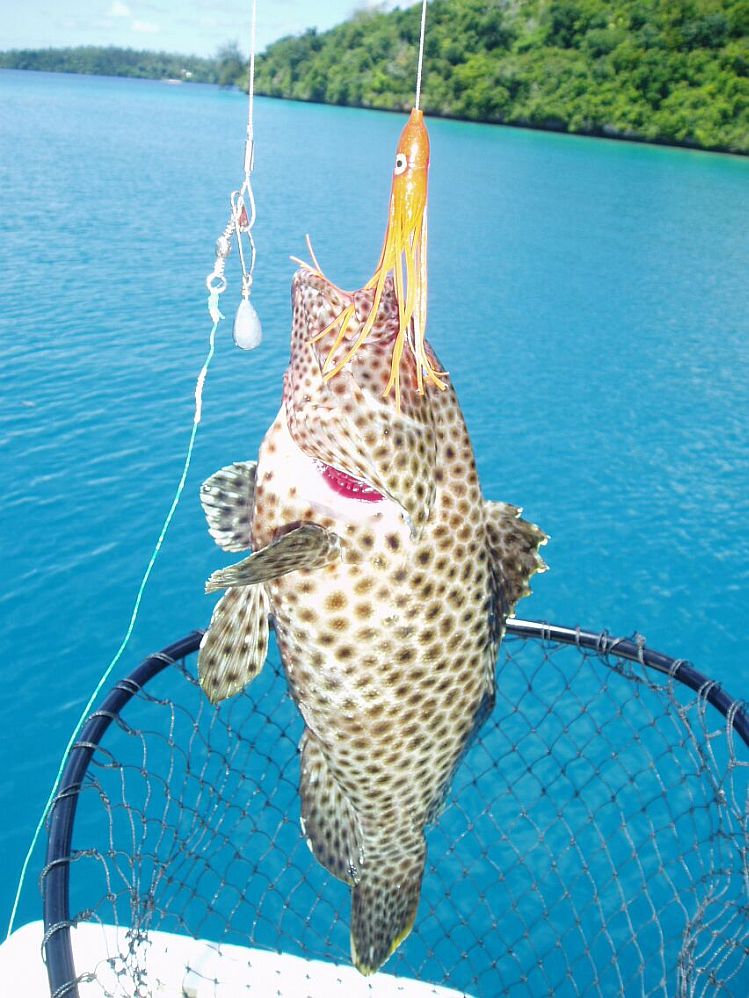
We turned southeast again as we rounded the tip of Hunga and an hour or so later, anchored inside the lagoon at Vaka 'Eitu. Annette had been trailing fishing lines throughout the trip (whales maybe?) but had caught nothing. Within a few minutes of our arrival in at our anchorage, a squeal announced that she had a fish. The fish was a good size but was brown with darker brown spots and too many fins. We thought we identified it as a scorpion fish from our book on reef fish. This seemed pretty ominous so it was chucked over the side and back to freedom.
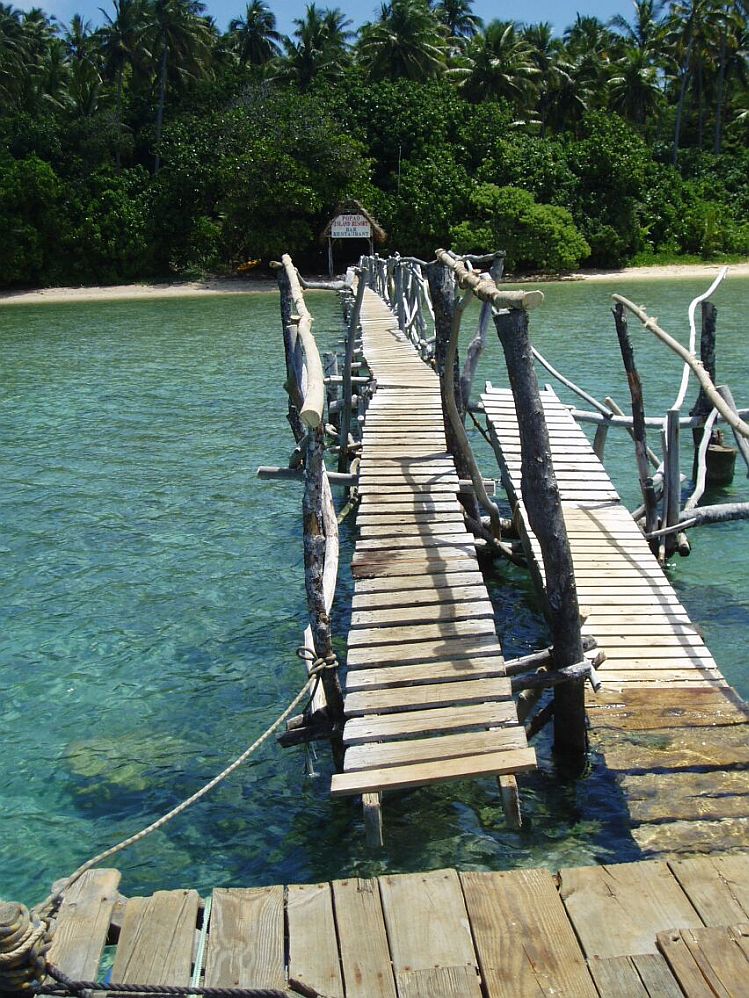
We motored ashore and climbed a path of 250 or so stepping stones, that wound their way up the steep hillside, on a jungle trail to Popao Island Resort. This is a small hotel / restaurant that was opened within the last month by a young newly married Canadian couple. We made dinner reservations for the evening and headed back to DoodleBug.
When we arrived, Annette found she had a much larger fish on her fishing line. We might have identified it as a type of Surgeon fish but after the scorpion
fish experience, we were too chicken to prepare it, so it was bunged into the freezer. That evening we carried an
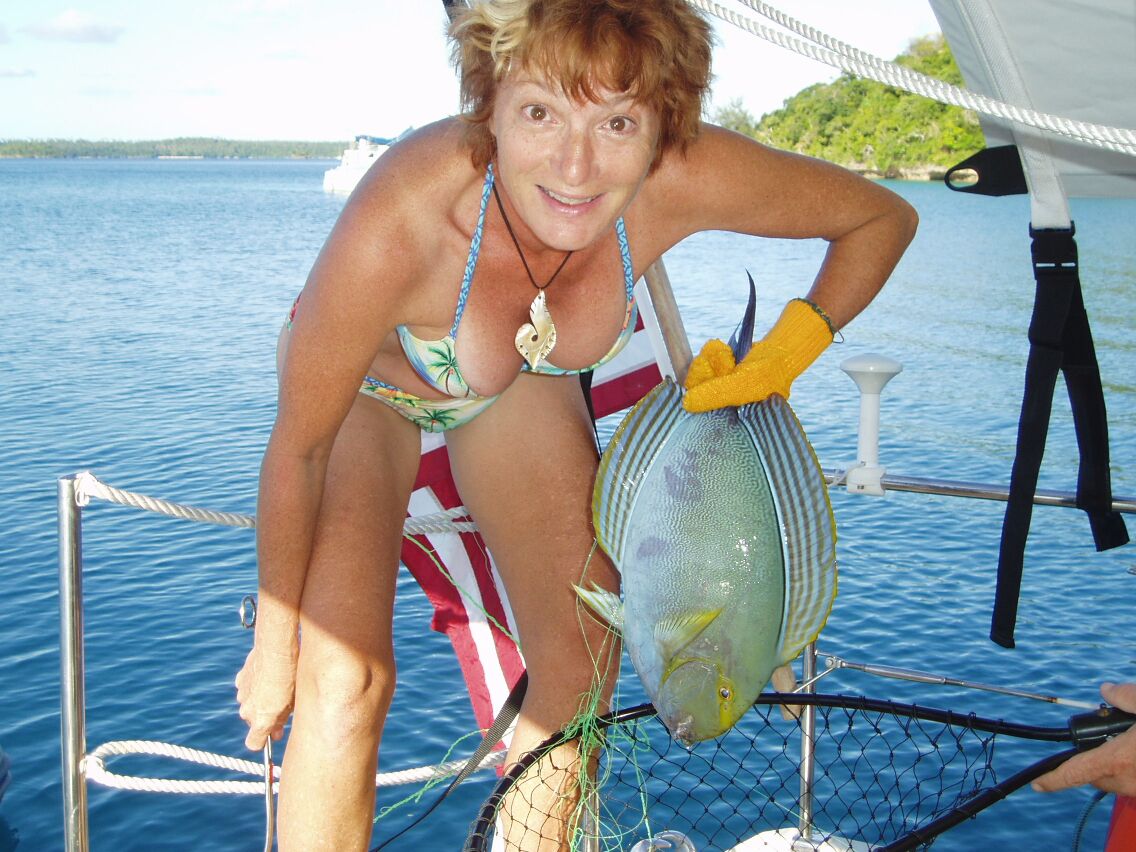
 insulated bag up the jungle trail to the restaurant. The bag contained our bug spray, three flashlights and the fish!
Dinner was excellent - the appetizer was fresh octopus on a bed of Chinese cabbage and topped off with local lemon grass. The restaurant fish guru
announced that our fish was very good to eat and proceeded to fillet it for us. This was certainly the entertainment for the evening.
insulated bag up the jungle trail to the restaurant. The bag contained our bug spray, three flashlights and the fish!
Dinner was excellent - the appetizer was fresh octopus on a bed of Chinese cabbage and topped off with local lemon grass. The restaurant fish guru
announced that our fish was very good to eat and proceeded to fillet it for us. This was certainly the entertainment for the evening.
The hike back to the boat in the dark and across the long and amazingly rickety dock was almost as much fun as the meal.
October 7, 2004
This morning was spent rebuilding the port sheet winch. It was misbehaving and needed stripping, washing in kerosene, regreasing
and replacing all of the various pawls and springs. This took three hours plus several beers, before it was all put back together and began


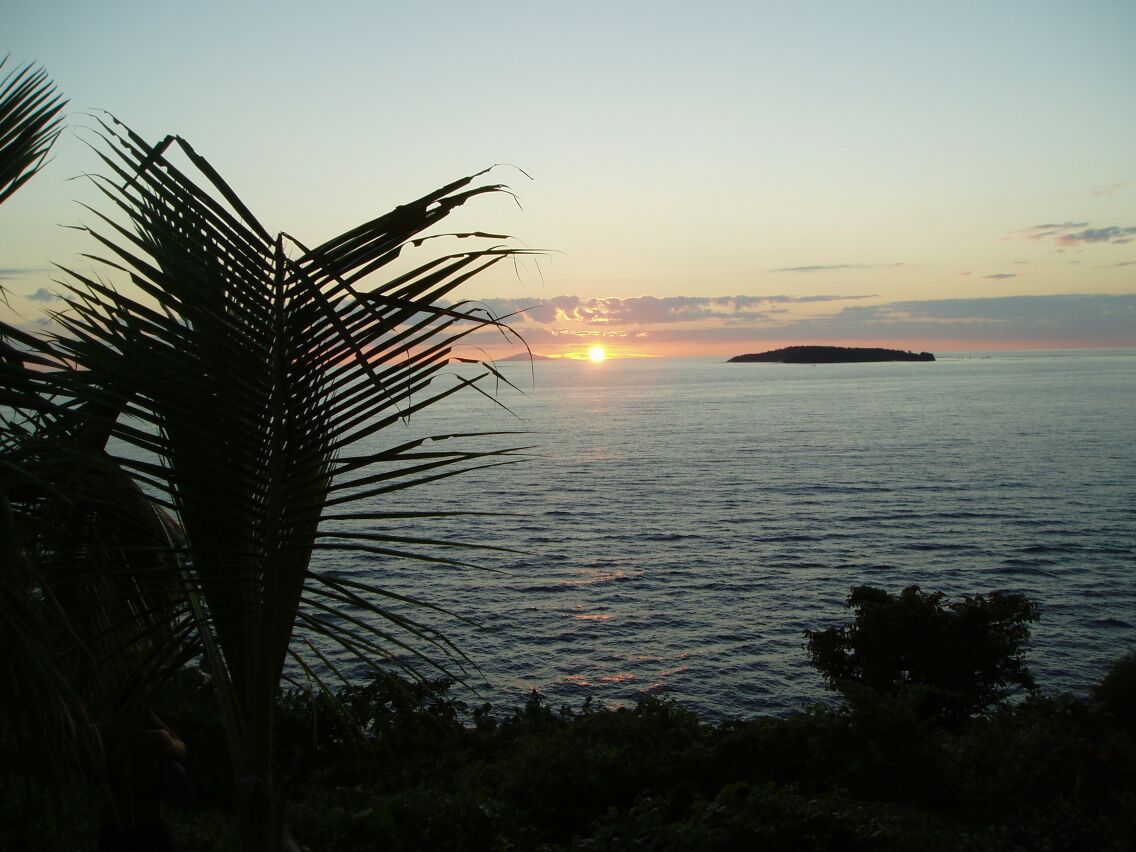 making happy little winch noises again. Meanwhile S/V Olla had shown up in the anchorage and we arranged to meet them for drinks and sunset viewing, followed by supper at Popao
Island Resort. The dinghy trip back across the darkened anchorage was highlighted by hundreds of pale blue glowing globes suspended in the sea. These
turned out to be jellyfish glowing with bioluminescence.
making happy little winch noises again. Meanwhile S/V Olla had shown up in the anchorage and we arranged to meet them for drinks and sunset viewing, followed by supper at Popao
Island Resort. The dinghy trip back across the darkened anchorage was highlighted by hundreds of pale blue glowing globes suspended in the sea. These
turned out to be jellyfish glowing with bioluminescence.
Later that evening Brian was sitting on the foredeck and I pointed out the fireworks display of plankton with their flashing luminescence while I accidentally kicked over his glass of Glenfiddich.
October 8, 2004
Position: 18 41.4 S 174 01.7 W
We raised anchor and made an early departure for Neiafu. As we were motoring out, Annette was yelling at me from the bow and pointing, the depth sounder read 10 feet, the autopilot failed and S/V Freewind began calling me on the radio. We stopped and reversed the boat before we hit the coral head, switched the autopilot to standby and called Freewind. Then we maneuvered out of the anchorage and hand-steered back to Neiafu harbor to begin the check out procedure. I thought this would be easy, just a visit to Customs since we are not actually leaving Tonga yet. Wrong! I had to visit Immigration, harbor master to pay 14 Pa'angas - no clue what for - I just needed the receipt. Finally back to Customs. "We want to leave tomorrow morning". "You must pay overtime". "But it's Friday today". "You must pay overtime". "If I leave today, do I pay overtime?" "No". "Then I'm leaving today". This produced a scowl and a threat of dire consequences if we were found in Neiafu harbor that evening. Little chance of this, as we were heading for the Tongan feast / party that Freewind had called about, to be held at the adjacent anchorage.
We finally got our exit document and headed for an anchorage at 18 41.4 S 174 01.7 W off the Mala Island Resort. There
were supposed to be hundreds of cruisers heading for the opening party at the Mala Island Resort, as well as rumors of politicians visiting from Nuku'alofa
and possible rock star celebrities. Mick and Bianca maybe?
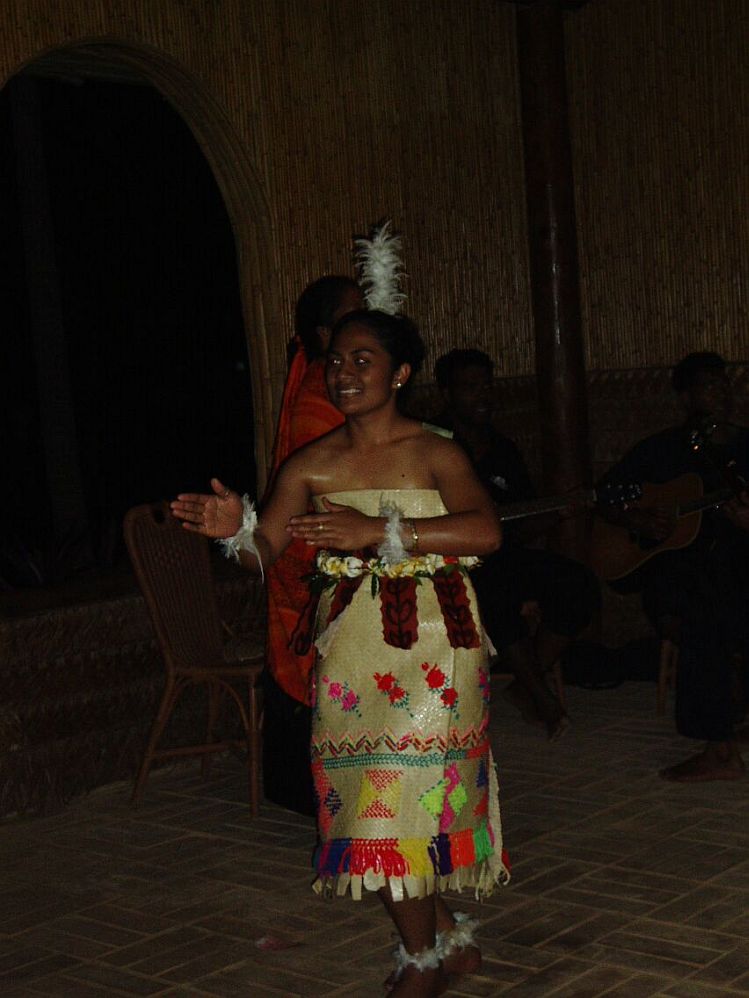 We were told to get our meal tickets by 1700 hours and the feast would begin at 1900 hours. We did
indeed arrive at 1700 hours and stood around drinking with about 40 total cruisers until we finally got to eat three hours later. No rock stars (as if we
would recognize any of the current crop anyway!). There was a display of Tongan dancing from the sponsoring village but when rated with all of the shows we have seen on the passage, this was strictly amateur night. They might have looked
better if they had shown a little more skin but the girls were swathed in the Tongan kitchen rug thing and reminded me of the "dance of the mushrooms" in Walt
Disney's Fantasia.
We were told to get our meal tickets by 1700 hours and the feast would begin at 1900 hours. We did
indeed arrive at 1700 hours and stood around drinking with about 40 total cruisers until we finally got to eat three hours later. No rock stars (as if we
would recognize any of the current crop anyway!). There was a display of Tongan dancing from the sponsoring village but when rated with all of the shows we have seen on the passage, this was strictly amateur night. They might have looked
better if they had shown a little more skin but the girls were swathed in the Tongan kitchen rug thing and reminded me of the "dance of the mushrooms" in Walt
Disney's Fantasia.
October 9, 2004
This morning I worked on resetting the autopilot parameters, which had somehow become "lost", while Annette pre-cooked meals for tomorrow's passage. We plan an early departure tomorrow. It is a 65 mile run to the next anchorage south - an anchorage I categorize as "acceptable" for our needs. We generally need to arrive at an unknown anchorage in good light, so we don't hit anything we shouldn't. If for some reason we can't find a place to anchor, or if sea and wind conditions don't allow our anchorage, we also need an alternative plan. With a boat speed of 6 knots for planning purposes, 65 miles becomes a long passage for just a "day sail". Later that afternoon we snorkeled around the base of some rocks that did indeed have extensive coral growth and lots of fish. Annette handed Brian a sea cucumber she had scooped up from the bottom. It was gray / green, warty looking, about 5 inches in diameter and about 18 inches long. When brought unwillingly into the air, they begin to squirt jets of fluid from an indefinable end (they look the same at both ends) which produced a most gratifying effect on her brother-in-law. Next she grabbed my hand firmly to tow me over to look at something or other. I noticed a 3 foot long sea snake with black and white bands around it. Annette was totally unaware of it's existence and was heading straight for it, while I struggled to free myself from her grip. Have you any idea how hard it is to scream "SNAKE!!!" through a snorkel?
October 10, 2004
Position: 19 40.3 S 174 17.4 W
0525 hours; Raised anchor and headed out of the anchorage using GPS, Radar and binoculars in the pre-dawn darkness. We headed
south, close hauled and sailing at 7.5 to 8 knots in moderate seas. The sun came out and it was a very pleasant sail with the wind barely
 exceeding 13 knots. We spotted a humpback whale well ahead of us and it passed down our starboard side at a distance of less than 100 yards. Still very exciting! Throughout the
passage we could see a volcanic cone in the distance. It looked like it could be perhaps 10 miles away but the chart identified it as the island "Kao" at over 20
miles distance. The pre-supper snacking of junk food was temporarily interrupted when we discovered that Brian had been sleeping on the bag of potato chips all afternoon
and had not improved their condition. Position off Ha'Ano Island at 19 40.3 S 174 17.4 W
exceeding 13 knots. We spotted a humpback whale well ahead of us and it passed down our starboard side at a distance of less than 100 yards. Still very exciting! Throughout the
passage we could see a volcanic cone in the distance. It looked like it could be perhaps 10 miles away but the chart identified it as the island "Kao" at over 20
miles distance. The pre-supper snacking of junk food was temporarily interrupted when we discovered that Brian had been sleeping on the bag of potato chips all afternoon
and had not improved their condition. Position off Ha'Ano Island at 19 40.3 S 174 17.4 W
October 11, 2004
This morning we visited the village just off our anchorage. Annette began her adventure by quizzing a local lad on the dock who was holding a roll of "tapa" cloth. "Is there a shop in the village where I can buy Tapa cloth?". "Probably". "Where would I find it?". "Don't know". "Don't you live here?". "No, my village is over there". Okaay........
We met a local man, whom we greeted and asked for directions for the store. He told us that the both of the stores were currently closed, because there had been a death at the village and everyone was going to the funeral.


We wandered around the village and found a group of villagers slaughtering a large pig with a machete - presumably for the funeral wake. See the movie "Apocalypse Now" for an idea of the process. The village was pretty much deserted but we found a modern and recent sign announcing a "Garden Center", funded by the government of Australia and listing the benefits of the ecologically sensitive reintroduction of certain plant species. The sign stood in the middle of a weed patch that showed no obvious sign of human industry. Exploration of the beach produced some interesting shells but experimentation proved that all of the hermit crabs found were tone deaf.
Later that evening we were invited to a dinner on S/V Freewind with fabulous steaks provided and cooked by Frank and Jan, plus hors d'oeuvres provided by Jack and Daphne from S/V Resolute. We brought "cruiser salad". This is salad made from whatever you have left. Annette was gratified to see several folks take seconds.
That night the wind increased and shifted to the south. The anchorage became rolly and we spent an uncomfortable night worrying that we might drag onto the reef. It was with some relief on our part, that the wind dropped in the early hours of the morning.
October 12, 2004
Position: 19 56.5 S 174 43.0 W
We raised anchor and set sail for Ha'afeva Island. The first 20 miles or so was a pleasant close reach and we passed under full sail through the middle of a group of four boats, that had anchored uncomfortably overnight at Ofolanga Island. They were now motoring directly into a headwind and the sight of their efforts reminded us that we would probably have to do the same for the last 10 miles of our approach. We spotted another humpback about 100 yards ahead which sounded and did not reappear. Our mid-morning snack produced a coupon from the potato chip bag (Brian didn't get this one) that stated we had won two free bottles of "Sprite". This good news was tempered by the expiration date of the coupon of March 31st, 2004. The expiration date was spotted just before I hauled DoodleBug back around to the east to redeem our prize!
In early afternoon, we anchored at 19 56.5 S 174 43.0 W off the village jetty and headed ashore for a walk. We passed a grove of fruit trees and finally got to view the giant fruit bats up close. They have a wing span like a buzzard (3 feet or so) and it was interesting to see them land awkwardly in the branches of a tree and then flop upside down to eat the fruit. We had some debate as to what type of fruit tree they were in - mango etc. My suggestion of a "Double 'A' Bat Tree" was dismissed.
We met the local schoolteacher who was hoeing a patch of ground to plant yams. All along the side of the road to the village were small plantations of bananas, taro, yams, sweet potatoes, cassava etc. We passed the cemetery and found the power station opposite. Again a fine sign stating that this was a joint project between the Governments of Tonga and Australia but funded entirely by the latter. I think that Tonga provided the toaster. There was no evidence that it was actually operating. That evening the weekly ferry arrived at the dock we were moored about 80 yards away from. I put on all of the deck lights to add to the anchor light and they missed us on docking.
October 13, 2004
Today we revisited the village on the "other" side of the island. We passed by the school to say "Hi" to the teacher we met
yesterday and also found the village store. Here we replenished our vital supply of matches, which were becoming seriously depleted by our having a smoker on
board. After lunch, Annette went shelling on the nearby beach, while Brian and I watched a movie on board and occasionally checked up on her with binoculars. She
met a local man, whom she assumed was high on kava and who was looking for a ride off the island with a destination of "anywhere".


 Later, Annette caught a small fish on her hand lines set from the deck but felt sorry for it and tossed it back. In the evening we hosted an impromptu
"International" dinner on board DoodleBug with the two other boats in the anchorage. We had eight guests - 3 Americans, 1 Brazilian, 1 English, 1 Irish
and 2 Swiss. 6 of these folks were on the Brazilian flagged 36 foot S/V Pasargada and they all ate as though they hadn't had a real meal in weeks. Very
gratifying for the chef.
Later, Annette caught a small fish on her hand lines set from the deck but felt sorry for it and tossed it back. In the evening we hosted an impromptu
"International" dinner on board DoodleBug with the two other boats in the anchorage. We had eight guests - 3 Americans, 1 Brazilian, 1 English, 1 Irish
and 2 Swiss. 6 of these folks were on the Brazilian flagged 36 foot S/V Pasargada and they all ate as though they hadn't had a real meal in weeks. Very
gratifying for the chef.
October 14, 2004
There is a large high pressure system south of us and the winds have picked up considerably in strength. We decided to sail directly for Tongatapu, instead of making the two additional island visits we had planned. The next anchorage south on our original plan, would not be attractive in the current wind conditions. Because we have 90 some miles to run, we plan on leaving at 1600 hours and sailing overnight, to arrive at dawn in Tongatapu. We spent the morning preparing the boat, transferring diesel etc and Annette caught a bigger fish. This one became breakfast and she was regretting her charity of yesterday. We all shelled the beach, so we could fend off any kava intoxicated rapists and returned to DoodleBug to find yet a bigger fish attached to her fishing lines. (No rapists, sorry...). This one went in the fridge and we then raised anchor and set sail in winds in the 25 to 30 knot range. 15 minutes from the anchorage, the outhaul on the mainsail broke. This is the line I had replaced in Pago Pago and I suspected that the splice had given way, as I had whipped the joint with the heaviest cord I had and which was much lighter than the original whippings. We just furled the mainsail and turned around to reanchor in our original spot. Try again tomorrow.
October 15, 2004
Position: 21 02.7 S 175 15.7 W
This morning we replaced the outhaul, which had indeed failed as suspected. We decided that we would sail for Kelefesia Island,
some 40 miles north of Tongatapu and overnight there, if approach conditions looked OK. We raised anchor at 0945 hours and set off on a cloudy day with 25
knots of wind. We were close reaching on reefed genoa and reefed mizzen at 7 to 8 knots, in 6 foot seas and were

 making good progress. I was not looking forwards to the last 12 miles into Kelefesia, since we would have to motor sail
directly into the wind and waves. Nevertheless we made our turn and began to plunge through the seas, with the engine throttled way up so we could make some
progress. We were taking a lot of water over the bows and occasionally would ship "green" water. After about 30 minutes of this torture and with another hour
and a half to go, I heard S/V Freewind on the VHF talking to S/V Resolute. Freewind was already anchored at Kelefesia and was telling Resolute that the
anchorage was too small for another vessel and that their proximity to the reef was so uncomfortable, they were considering leaving. On hearing this we heaved
to, to reconsider our possibilities.
making good progress. I was not looking forwards to the last 12 miles into Kelefesia, since we would have to motor sail
directly into the wind and waves. Nevertheless we made our turn and began to plunge through the seas, with the engine throttled way up so we could make some
progress. We were taking a lot of water over the bows and occasionally would ship "green" water. After about 30 minutes of this torture and with another hour
and a half to go, I heard S/V Freewind on the VHF talking to S/V Resolute. Freewind was already anchored at Kelefesia and was telling Resolute that the
anchorage was too small for another vessel and that their proximity to the reef was so uncomfortable, they were considering leaving. On hearing this we heaved
to, to reconsider our possibilities.
Kelefesia was no longer an option and our choice was to continue to heave to where we were, or to head south to Tongatapu. We knew it would be dark when we would arrive, so again, we would heave to in the lee of the west coast of Tongatapu until dawn. Back under sail again we headed south, sailing easily with reefed genoa and mizzen. The sun was shining and the motion much easier, as we were almost beam reaching. As we sailed, I examined the possible anchorages on the west side of Tongatapu. We received a call on the radio from Frank on Freewind asking what our sail plan was. I told Frank we were using genoa and mizzen and he radioed back that he could see us on the horizon as he had now exited Kelefesia with the same destination as us. I found an anchorage off Atata Island, that the sailing guide claimed was possible to arrive at night - with "due care". The electronnic chart showed leading lights to guide us through the entrance reef and the anchorage would be just over a mile from this. Doable! I passed this on to Frank and increased sail, as we now were going to attempt to anchor instead of bobbing up and down "heaved to" all night.
At 2100 hours we arrived off the reef pass entrance. There were lights everywhere but no leading lights whatsoever. We messed around checking bearings
etc. and finally heaved to. Frank was now approaching in Freewind and asked me to turn my masthead light on and off so that he could identify us amongst all of
the lights around. Some of these lights were strobes on FAD's (Fish Accumulation Devices). We don't really know what a FAD is but anything you put a
flashing light on in deep water is generally a bad thing to hit. Frank
 announced he could now see us and another voice joined the conversation from S/V Vagabond Blues. They had also identified us and were anchored at our desired destination.
They indicated their location by flashing a spotlight in our direction across the reef. They also gave us a navigation waypoint for the reef entrance with a
bearing for entry. I plotted this on the chart and found it very close to my own waypoint for reef entrance. The bearing provided was slightly different but
still very close. The seas were much calmer in the lee of the reef, so we decided to attempt the reef entrance. Freewind generously suggested we that we
"go first" and we began to motor in towards land, with Annette and Brian on the bow with flashlights. This kept them entertained and out of mischief but with
flashlights pointing in every direction, I was pretty much blind at the steering. As we approached the entrance, I was monitoring the depth, position on
the chart etc. and trying to watch everything at once. The chart showed that we were drifting off track, which I presumed was due to current and adjusted course
accordingly. This was definitely a high adrenalin affair. Brian announced that Frank was following us on Freewind. When we were inside the pass, I needed to
turn at 90 degrees to port and when I glanced over, there was another vessel about 30 feet away and running alongside us. "That can't be Frank". "Yes it
is". "Put a light on him". "That's not Frank". "Yes it's Frank". I slammed the
engine into reverse and the fishing boat that had followed us through the reef passage surged ahead. I don't believe he had any navigation aboard and on a
moonless night, without working navigation beacons, had decided to use us as a guide. We turned towards the anchorage and finally dropped our hook. There must
have been a lot of current through the anchorage which was causing much confusion as we were edging in slowly to avoid hitting the unseen nearby reef.
Frank arrived shortly afterwards swearing he will "Never! Never! Never! do anything like that again". We toasted each other with a beer and then repeated
the procedure with another. Supper. Bed. We anchored at 21 02.7 S 175 15.7 W
announced he could now see us and another voice joined the conversation from S/V Vagabond Blues. They had also identified us and were anchored at our desired destination.
They indicated their location by flashing a spotlight in our direction across the reef. They also gave us a navigation waypoint for the reef entrance with a
bearing for entry. I plotted this on the chart and found it very close to my own waypoint for reef entrance. The bearing provided was slightly different but
still very close. The seas were much calmer in the lee of the reef, so we decided to attempt the reef entrance. Freewind generously suggested we that we
"go first" and we began to motor in towards land, with Annette and Brian on the bow with flashlights. This kept them entertained and out of mischief but with
flashlights pointing in every direction, I was pretty much blind at the steering. As we approached the entrance, I was monitoring the depth, position on
the chart etc. and trying to watch everything at once. The chart showed that we were drifting off track, which I presumed was due to current and adjusted course
accordingly. This was definitely a high adrenalin affair. Brian announced that Frank was following us on Freewind. When we were inside the pass, I needed to
turn at 90 degrees to port and when I glanced over, there was another vessel about 30 feet away and running alongside us. "That can't be Frank". "Yes it
is". "Put a light on him". "That's not Frank". "Yes it's Frank". I slammed the
engine into reverse and the fishing boat that had followed us through the reef passage surged ahead. I don't believe he had any navigation aboard and on a
moonless night, without working navigation beacons, had decided to use us as a guide. We turned towards the anchorage and finally dropped our hook. There must
have been a lot of current through the anchorage which was causing much confusion as we were edging in slowly to avoid hitting the unseen nearby reef.
Frank arrived shortly afterwards swearing he will "Never! Never! Never! do anything like that again". We toasted each other with a beer and then repeated
the procedure with another. Supper. Bed. We anchored at 21 02.7 S 175 15.7 W
October 16, 2004
Position: 21 07.5 S 175 09.7 W
0930 hours we raised anchor and motor sailed around the island of Atata towards the capital of Tonga at Nuku'alofa. As we
moved out of the shelter of Atata, we found the wind was still blowing at over 25 knots and the sea was quite shallow - on the order of 40 feet. This produced
a nasty short chop sending sheets of water over the bows. We headed for Pangai Motu Island and anchored just off the beach
 across from "Mama's Bar and Grill" with a large sign outside declaring "Yacht Club". The water off the bar was calm
and we dinghied over to sample the "fish and chips" and beer. By afternoon Brian convinced us that we needed exercise, so we returned to the bar and
circumnavigated the island walking on the beach. This took about 30 minutes to return to our starting point at the same bar, including stops to examine shells
etc. On our walk we were accompanied by the three dogs from the bar. This appeared to be a regular event for them and they dutifully stayed quite close to
us until they had completed their escort duties. Position 21 07.5 S 175 09.7 W.
across from "Mama's Bar and Grill" with a large sign outside declaring "Yacht Club". The water off the bar was calm
and we dinghied over to sample the "fish and chips" and beer. By afternoon Brian convinced us that we needed exercise, so we returned to the bar and
circumnavigated the island walking on the beach. This took about 30 minutes to return to our starting point at the same bar, including stops to examine shells
etc. On our walk we were accompanied by the three dogs from the bar. This appeared to be a regular event for them and they dutifully stayed quite close to
us until they had completed their escort duties. Position 21 07.5 S 175 09.7 W.
October 17, 2004
Sunday in Nuku'alofa. Everything was closed. We took the water taxi from the Pangai Motu Resort to "town" - about a 10 minute
ride.

We found the International Dateline Hotel open for lunch. We were the only customers. We then found a gourmet bakery open and bought lots of bread. There was plenty of time to kill before the next shuttle back to Pangai Motu and we found another hotel bar open. Again we were the only customers. Tonga really shuts down on Sunday.
That evening we hosted a dinner on DoodleBug for the crews of "Freewind", "Resolute" and "Vagabond Blues". Dinners at this end of the trip are more common as everyone tries to clean out their freezer before hitting New Zealand. Nevertheless a great time was had by all, analyzing the Friday night reef passage etc. and of course Brian is now an experienced sailor and can participate fully in the so called technical sailing conversations.....
October 18, 2004
Heavy day. Customs for check in. Then over to the New Zealand High Commission to apply for visas. The clerical staff were all Tongans and worked at full "bureaucrat watching paint drying mode". The guide books warn you that if you show impatience, they are a non-confrontational society and they just get slower.
We sent Brian to meet us at the Internet cafe. This was fortunate as it took an hour and a half to file our visa applications. The Internet cafe was "meeting point central" for most of the sailors in the area, so he was well entertained by the cruisers he knew there. In the afternoon I went off to get a permit to purchase duty free diesel and then over to the BP depot to order the fuel brought to the dock on the morrow. I hitch hiked back to town and got a ride from a Tongan police officer.


Brian and Annette went to the Tongan cultural center for an afternoon of Tongan culture demonstrations. They were shown weaving, coconut milk preparation, Tongan dances with a troupe of about 20 dancers in full costume. They got to drink kava (a local mildly narcotic drink) and had a really great time. They were the only attendees.
October 19, 2004
The great diesel fill up day! About a half dozen boats were to jockey for position at the crowded dock in Nuku'alofa. We had
enough jerry jugs so we shipped our jugs to the dock in the Pangai Motu Resort shuttle and left DoodleBug at anchor. By the time everyone had fuelled up it was
afternoon. We missed the afternoon shuttle and drove our dinghy over the mile or so to the Nuku'alofa dock with Brian
 and his luggage. He flies home today! We are so sorry to see him go. We have had such a great visit. Freewind and Resolute want to see Brian before his departure to say goodbye and everyone
meets back at the Internet cafe "Friends". Annette and I went back to the New Zealand High Commission to get our passports. It took over an hour and Annette's
visa was granted and then withdrawn, as she had no free pages left in her passport! She will have to sort this out upon arrival in Opua.
and his luggage. He flies home today! We are so sorry to see him go. We have had such a great visit. Freewind and Resolute want to see Brian before his departure to say goodbye and everyone
meets back at the Internet cafe "Friends". Annette and I went back to the New Zealand High Commission to get our passports. It took over an hour and Annette's
visa was granted and then withdrawn, as she had no free pages left in her passport! She will have to sort this out upon arrival in Opua.
October 20, 2004
Back to the bureaucratic dance. Today we will "check out" of Tonga. This entails a visit to the Harbor Master's to pay fees
for the zero
 services received - no working navigation lights; no trash disposal facilities etc. Then a trip to Immigration for passport stamping. Back to
Customs for an exit document. We had missed the shuttle back to Pangai Motu so we hitched a ride with a local boat moving seaweed to a fertilizer processing
plant. If we get an "all clear" on the weather will leave tomorrow morning for Opua in the Bay islands area of New Zealand. There is a low forming out there and we
don't yet know how it will affect us.
services received - no working navigation lights; no trash disposal facilities etc. Then a trip to Immigration for passport stamping. Back to
Customs for an exit document. We had missed the shuttle back to Pangai Motu so we hitched a ride with a local boat moving seaweed to a fertilizer processing
plant. If we get an "all clear" on the weather will leave tomorrow morning for Opua in the Bay islands area of New Zealand. There is a low forming out there and we
don't yet know how it will affect us.
