The Galapagos Islands
February 22, 2004
We sailed into "Wreck Bay," Cristobal, Galapagos on Saturday morning. The sea was like glass with almost no wind. There was a haze on the horizon and no lights showing from the Island we were approaching, until we were 8 miles or so from the harbor. As we came into the harbor, we saw pairs of fins sticking out of the water. It was just dawning and not obvious at first what we were seeing. Then it came to us. We were seeing sea lions floating just below the surface on their "backs." Sleeping at sea?
The harbor entrance had a spectacular surf line. Although the sea seemed like glass there was an underlying swell, so this was forming a huge breaking wave when it hit the reefs on either side of the harbor entrance. It was both eerie and unnerving to see this huge amount of energy being unleashed from a seemingly dormant and placid sea.
Once we had dropped anchor, cleaned up, inflated the dinghy, cleaned up again from the effort of inflating, and launching the dinghy etc., we set off to visit the Port Captain's office and begin the entry procedure. Each boat or dinghy that we passed was festooned with sleeping sea lions. Some boats had 6 or more sea lions on the front of the boat, so that the back of the boat was lifted completely out of the water. We ran our dinghy up a beach next to the port captain's office and had to walk between more groups of sea lions. They are everywhere. In the children's swimming area. Along the sidewalks. On the benches.
The port captain was pleasant enough and asked for a souvenir tee-shirt from our boat. We told them we didn't have any. The next stop was the police station for immigration. The immigration guy was apparently not available but there were about a half dozen young men in what looked like army camouflage fatigues. They told us "momento" and got on the radio. About 15 minutes later, the sound of a motor scooter was heard and we were told, "he is here." The immigration control officer came in wearing a uniform top but soccer shorts and soccer shoes below. We had drug him out of his game. His key would not open his office door, so one of the young "policemen" opened it for him with a credit card in the door jamb.
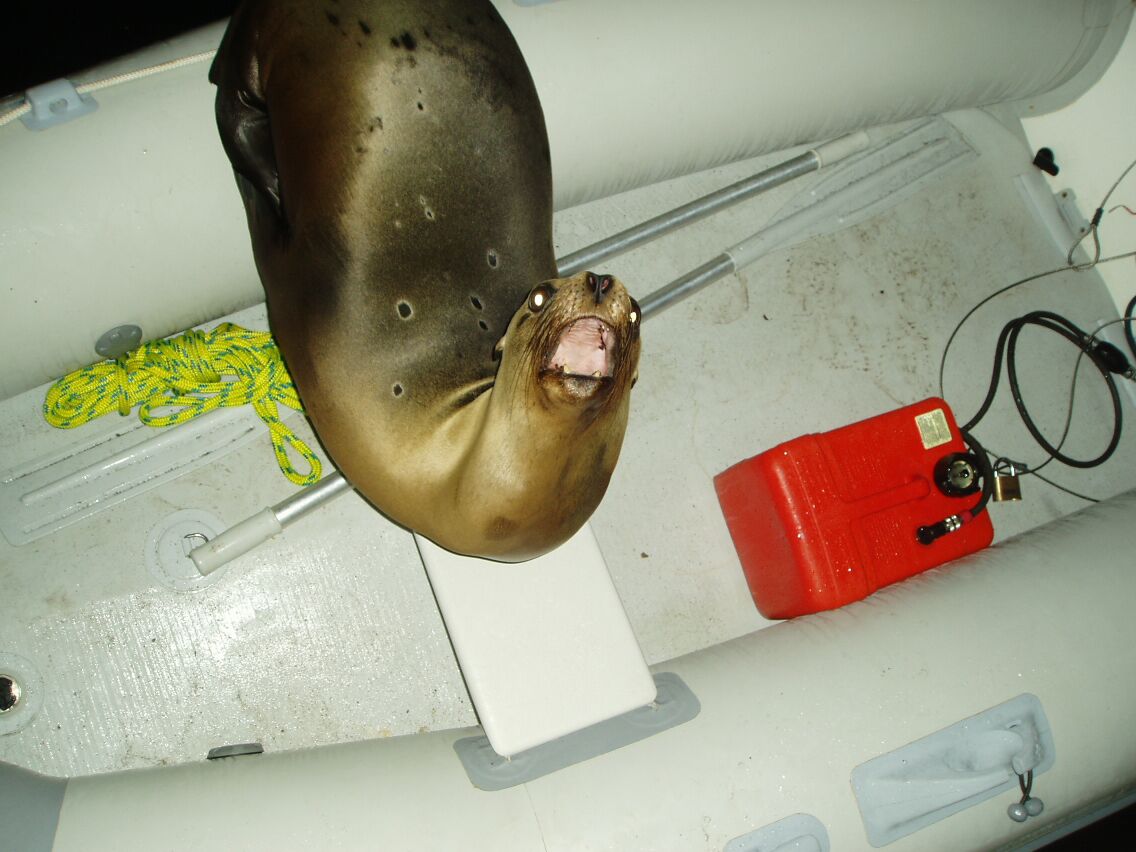
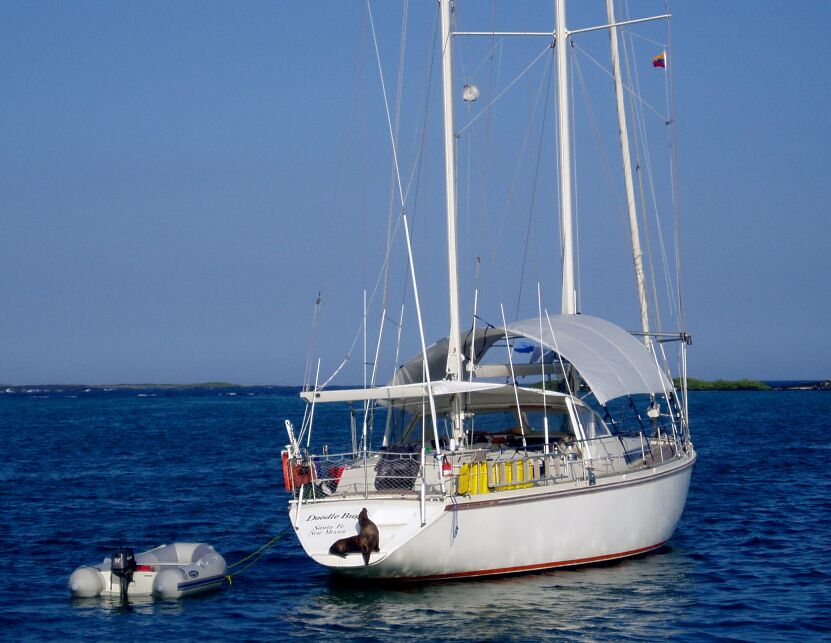
We ate out in town and came back to the boat rather later than we had intended, so we just tied the dinghy off the stern of the boat. At 2 a.m. Annette woke me to say that the dinghy was full of seals. Well, there were two of them and they looked at us with polite interest
when we shone a flashlight at them. It took the boat hook to get their attention and evict them. So at three o'clock in the morning, after obtaining a complete photographic record, we got rid of the squatters and brought our dinghy on board. We sat in the cockpit with tea and coffee and admired the lights across the sleeping harbor.
February 23, 2004
Today was a work day. The port captain and his cohort showed up shortly after 8.00 a.m. to "inspect the boat." This was a very casual affair. Neither of these officials spoke any English but we had the usual "chat" about whether we have children. Do they live with you? Do you have grandchildren? etc. These questions know no boundaries or borders.
The officials then departed and we spent most of the day doing boat chores - that is, getting the boat ready for sea again. Attila discovered the sea-lions big time. There was a pair that kept swimming around and under the boat. She spent at least 45 minutes
"chasing" them from side to side of the boat with her tail stuck straight up and quivering and then her head jammed under the rail staring down into the water. She seems to know they are some kind of water dog. She was finally exhausted and collapsed into sleep.
We had invited our closest neighbor over for a beer yesterday and after some inter-boat yelling, he rowed his dinghy over. This is Pierre, a French historian. He has been traveling since 1999 and looks very brown. Pierre has a business arranging historic tours of the battlefields of Northern France - mainly for British and American tourists.
Pierre was a delightful and knowledgeable visitor. Another sail boat arrived this morning. Annette had yelled a welcome to them and received a puzzled response. Pierre said he knows the couple on board. Annette asked him, "Are they nice?" He answered, "Well, they are Swiss."
Tomorrow we are going on a boat tour of various sites to see blue footed boobies, hammerhead sharks etc. The day after we do the "land" tour and check out the giant tortoises. We will letcha know.......
February 24, 2004
Today we took our first "commercial" tour of Galapagos. We were picked up from our boat by a wooden "panga" with a 75 h.p. outboard. The tour guide is from Galapagos and speaks virtually no English. There were three other passengers who are academics from Ecuador, who are supposedly the lead team of an environmental study. They were allegedly checking out the facilities for the remainder of their team but they seemed more like tourists to us. We motored down the coast of Isla Cristobal in the opposite direction to DoodleBug's Saturday approach. It is now apparent why we saw no lights. There is no habitation whatsoever, no roads and no sign of trails. The shoreline shows the obvious volcanic origin of the Galapagos islands with basalt flows separated by white coral sand beaches. Our panga put in close to the black cliffs at several locations and we observed the blue footed booby's. I think they look as though they have paddled through a trough of blue paint. The color just doesn't seem real on them.
We continued our tour and arrived at our first goal of El Leon Dormata - "the sleeping lion" rock. I presume this was a side vent plug of a volcano, since it rises vertically from the ocean floor. There are several splits in this immense rock, that permit the Pacific swell to roll through. It was very exciting to penetrate these rock canyons in a small boat with the walls rising precipitously just feet away and with the sea level soaring as the swell was compressed between the "canyon" walls. In the midst of this we are observing sea lions, manta rays, frigate birds in their red breasted mating plumage, booby's, etc. etc. It was like combining San Diego Zoo and Disneyland on the same visit.
On the return trip we snorkeled in a shallow stretch of water formed between Cristobal and a small island and then toured the smaller island on foot. We saw lots of marine iguanas, more booby's, more frigates in mating plumage, and then finished up on a small beach. Around us were a score of baby sea lions. Apparently momma sea lion goes off in the morning to fish and returns at nightfall. The babes are left to their own devices all day. They were either sleeping or playing with each other in the water. They were quite unafraid of our presence and would come up to you and sniff you or include you in whatever game they were paying by splashing you with water from a flipper. Delightful creatures. I kept looking for one that would fit the barbeque. Tomorrow we are in search of tortoises.
February 25, 2004
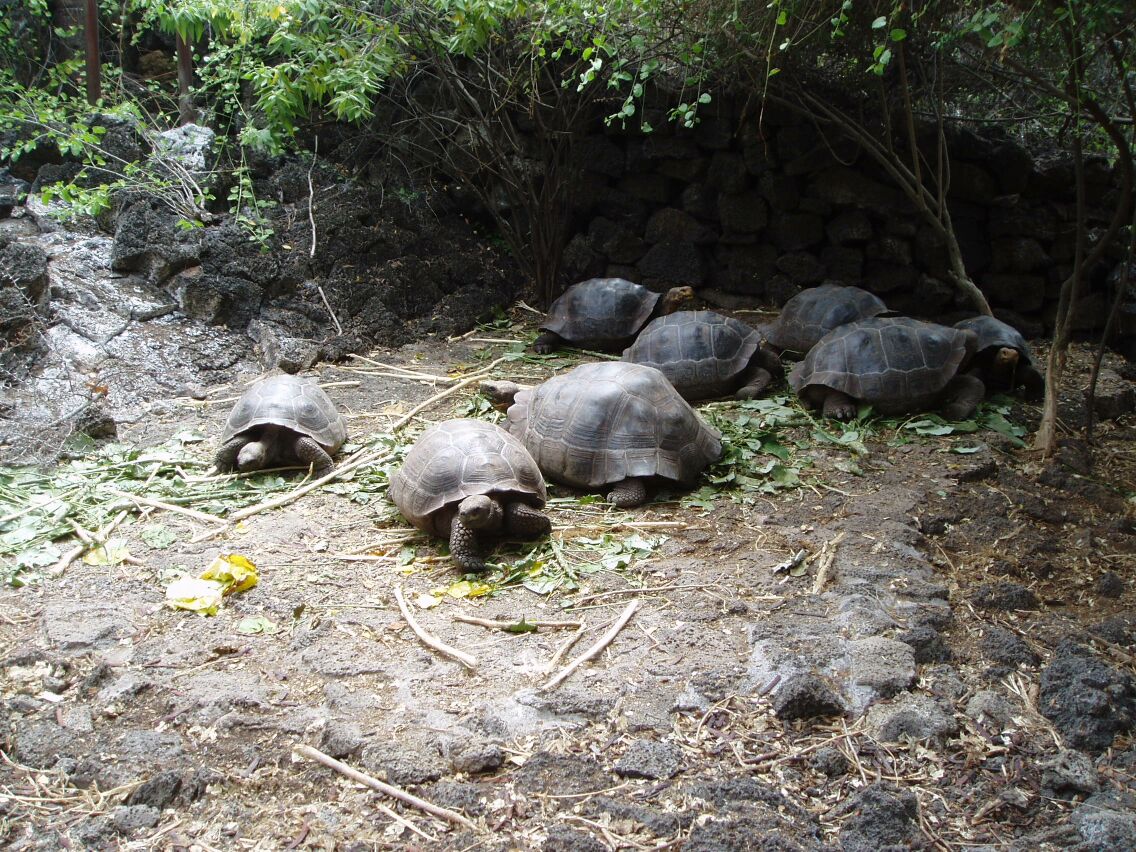
Today we did the "land" tour of San Cristobal. We were picked up in truck and driven to a Tortoise sanctuary. When we arrived, we were joined by our Ecuadorian friends from yesterday. The sanctuary looked very "new" and was funded by the Darwin Trust. They have gathered some 49 giant tortoises into a sanctuary area. They have provided soaking ponds where the tortoises can hide from the
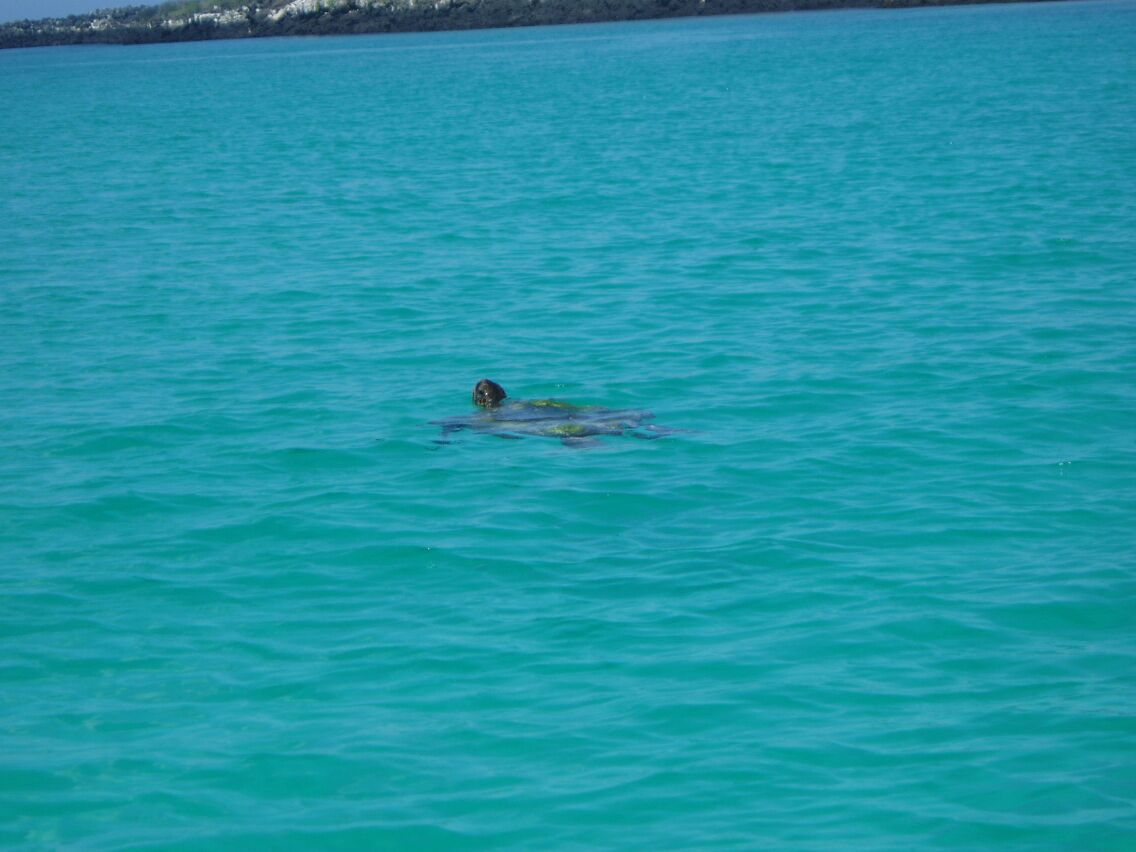
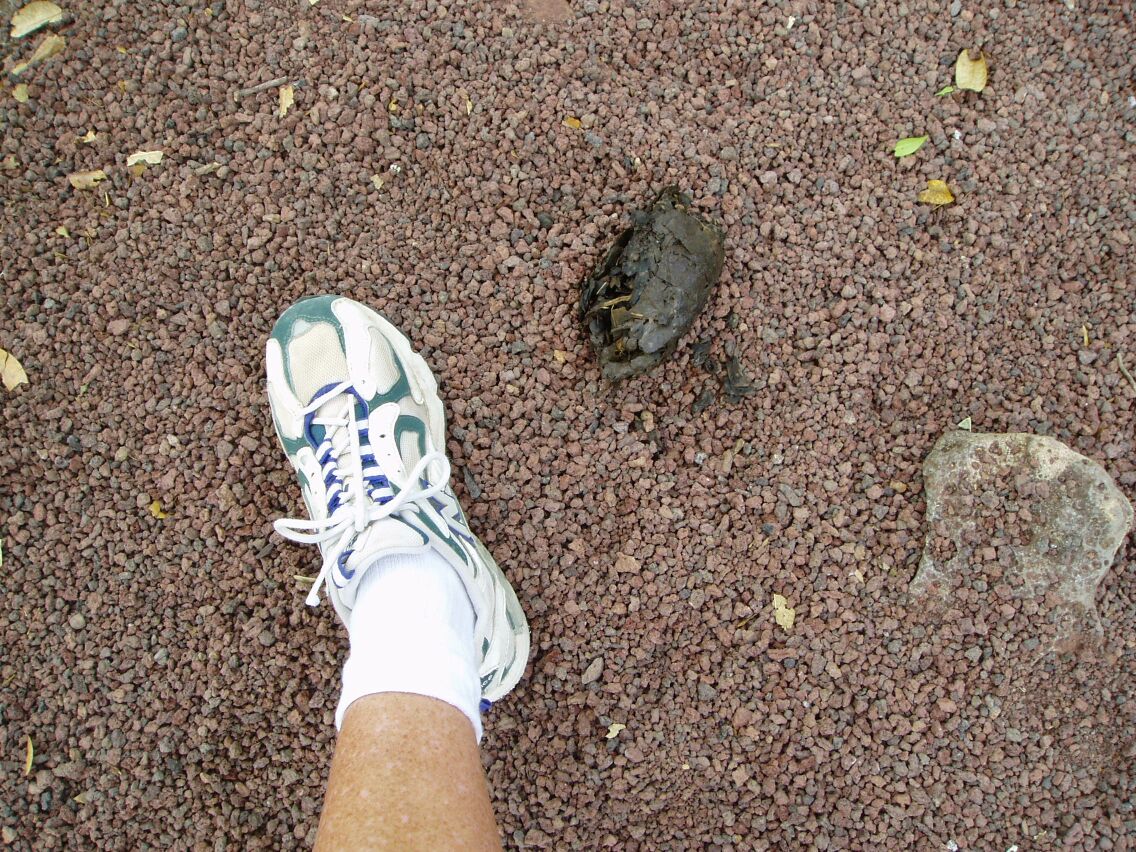
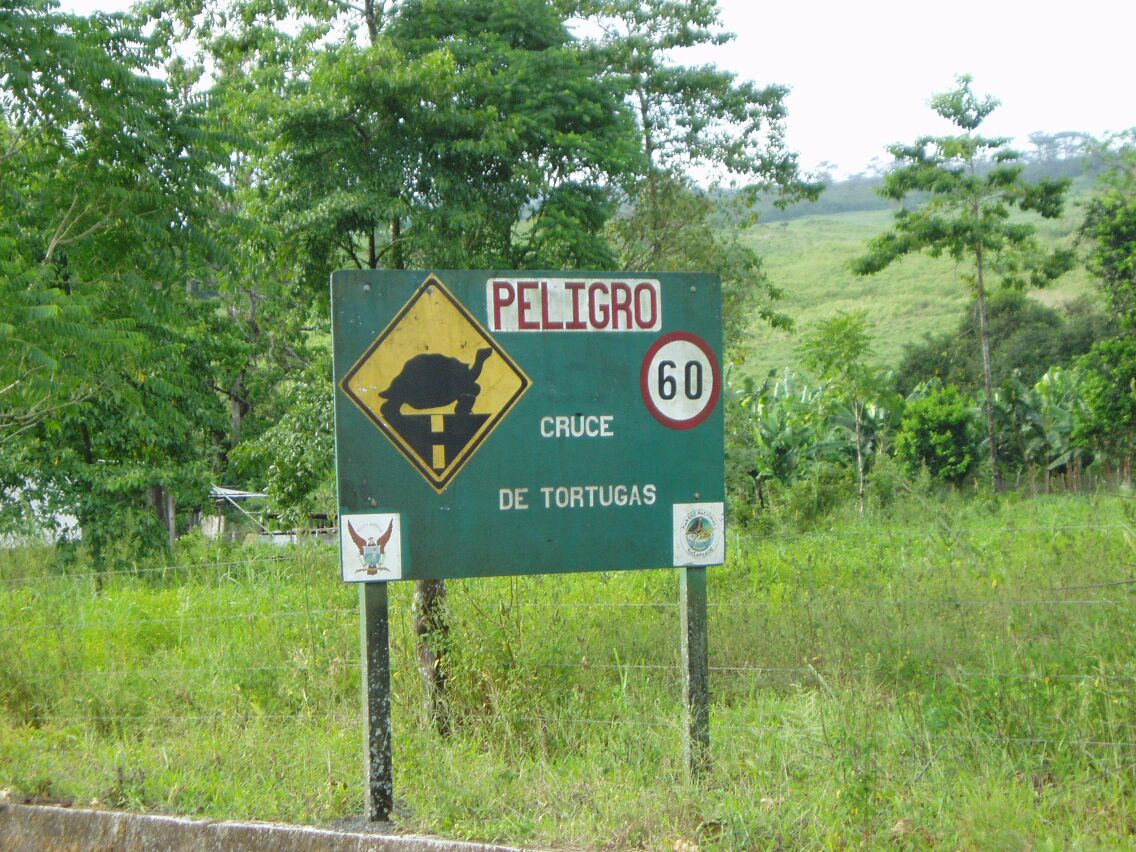
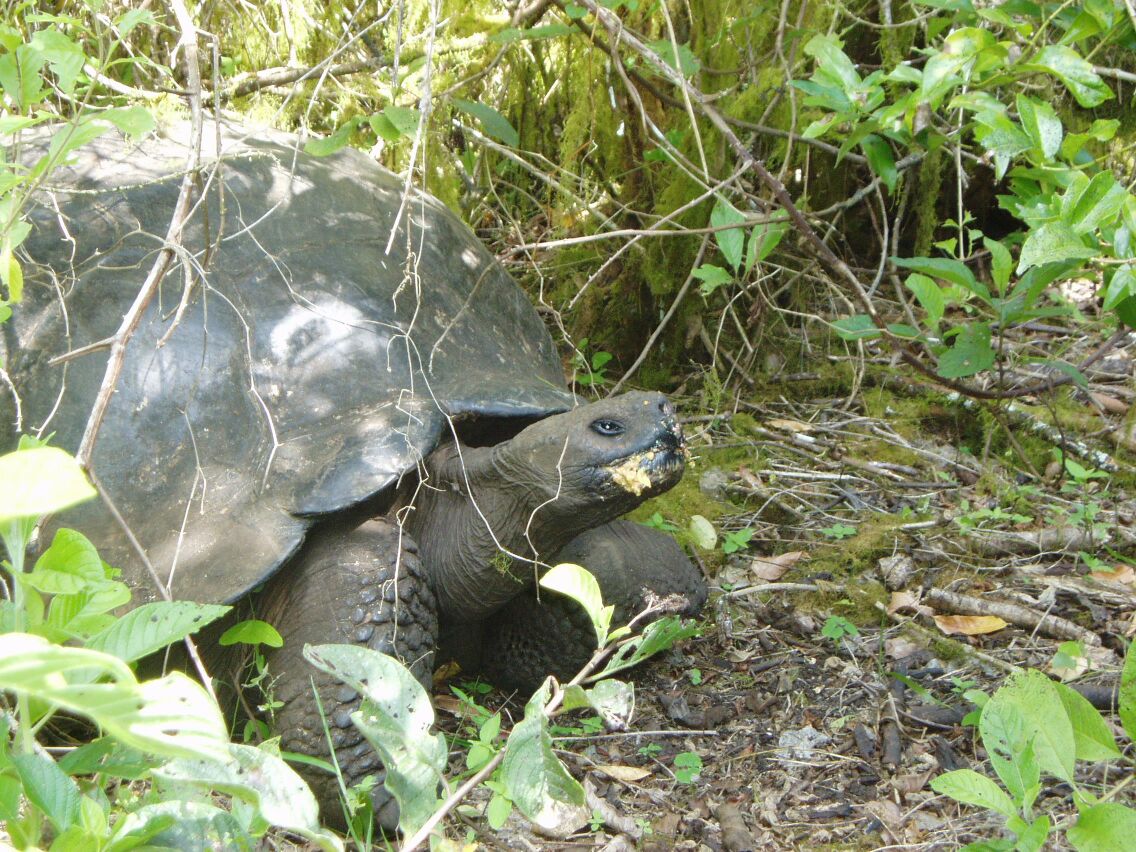
mosquitoes (what did they do before the ponds?) and they also provide some quantity of the "correct" forage. The intention is to repopulate the island by collecting eggs, hatching them under controlled conditions and then keeping the hatch in a protected environment for 5 years. At that time their carapace should be impermeable to predation by rats and dogs - both introduced by man. The tortoises were impressive and in their natural environment, looked like huge rocks with legs. One of the Galapagos Islands is uninhabited and has a population of some 1,000 tortoises. They hope to export some of these to the other islands to rebuild the population. Galapagos means "tortoise" in Spanish. Centuries ago, sailing ships called here to stock up on tortoises. The latter stayed alive in the holds of ships and were a source of fresh meat for the sailors.
The next stop on our tour was a walk up to the rim of a volcanic crater. The walk was only about 20 minutes but when you haven't had
any real exercise in 2 months....... The crater contained a fresh water lake. We walked all the way around the rim. The views both inside and out were spectacular, as on the outside you were looking down across San Cristobal and could see the Pacific on both side of the island. On the inside the sky was filled with wheeling frigate birds. They were courting and also plunging into the crater lake to drink.
The crater vegetation had many ferns and reminded me strongly of an English Lake District tarn. Annette also remarked on the resemblance. The difference is that it was about 10 degrees warmer than it would have been in England and it is unlikely that you would have observed frigates over the Lake District tarn.
We stopped off to visit a tree house (the locals call it "the Tarzan house") - 50 cents each to visit! - then on to a local beach. More huge marine iguanas, baby seals etc.
In the port town, the kids were throwing water, flour and paint in water balloons, at each other and also any unfortunate victim that came into range. We finally figured out that this was their Mardi Gras celebration and
the reason the town has been shut down for the past two days "holiday."
Our Ecuadorian friends had invited us to a barbeque in the evening, so we cleaned ourselves up and headed over to the feast with four bottles of wine. And it was a feast! One of the local men, "Pepe" used to be a chef and he barbequed a meal consisting of beef, fish, sausage, chicken, plantain bananas plus a delicious non-barbequed salad. We feasted until late and then had to stagger back to the dinghy in an alcoholic haze, in order to launch it thru the surf in the dark, find the "DoodleBug," get back aboard without damaging ourselves, and then hoist the dinghy and outboard on board to protect same from the sea-lions. Phew!
February 27, 2004
Wednesday we had to go to the "Capitania" at 0800 to pay our fees for entry to Galapagos. As you remember we arrived on a Saturday - a week-end day and Monday and Tuesday were holidays. This is the first "working" day. The port captain had all his half dozen people in a meeting. We were told to come back in half an hour. The meeting looked very serious and drug on for nearly another half hour. What have we missed? Has Ecuador declared war on anybody? We paid our fees and went grocery shopping. We were entertaining Bob and Franny from "Evelyn Roberts" that evening. Annette wanted chicken, so we searched the village for "pollo fresca." Annette finally found two that met her expectations. She described them as "sturdy" and they came complete with feet and eyeballs. We ate the thighs and breasts that evening. Our third crew member enjoyed the feet, eyeballs and the miscellaneous pieces/parts we don't generally serve to guests, or each other for that matter.
We had ordered diesel to be delivered to our boat and that arrived only three hours later than promised, in the afternoon. Thursday we had a huge list of chores to be completed before departure, so we did none of them. Annette napped and wrote 32 post-cards. I read a book all day. I have been re-reading "Atlas Shrugged" by Ayn Rand. The last time I read it, I was in college. I remember thinking way back then, that some of the conversations were a little unrealistic. Now I realize, I have heard and been the target of some of these utterly unrealistic conversations over the past few decades - i.e. in my past life!
Friday, we hit the Capitania for a "Zarpe" - departure document first thing this morning.
Back to the departure list! We plan on leaving first thing Saturday morning for Santa Cruz - about 45 miles.
February 29, 2004 South
Saturday morning we slipped out of Wreck Bay, San Cristobal and set sail for Academy Bay, Santa Cruz. The morning was a pleasant sail with 15 knot winds and tripping along at 6 or 7 knots boat speed. Around noon, the winds died and we went to engine, to motor sail the rest of the way. We passed just south of the cliffs of Isla Santa Fe. The cliffs are basalt and volcanic ash and offer no means of access. The island itself rises up with a thin covering of scrubby trees and is uninhabited. There must be some water for the struggling vegetation but I expect it is mainly rain and fog.
We arrived in Academy Bay around 1500 hours and put out an additional stern
anchor to hold us into the swell. This was the first time I have tried to
"row" the dinghy with the stern anchor aboard and I fervently hope all potential
witnesses were occupied with their afternoon siesta. We cleaned up and
went into town to check in with the port captain and look around. This is
the main "tourist" town of the Galapagos and looks it. Plenty of
restaurants, tour and dive operators and hotels. This town also hosts the
"Darwin Center." We will check it out tomorrow. If you read the
glossy tourist literature, you would think that
Darwin
discovered the Galapagos Islands and sat here to write his book the "Origin
of the Species." He did visit the Islands some 300 years after their
discovery but he did not even come to Santa Cruz. I bet he didn't get the
list of do's and don'ts that we get now. Example: Don't smoke anywhere on
the islands in case you start a fire.......
March
1, 2004This morning we visited the Charles Darwin Center which is on the outskirts of Puerta Ayora, Santa Cruz. They had an interpretation center plus several pens containing adult giant tortoises. They also operate the breeding program to regenerate the tortoise population. We watched a video in the interpretation center which described in glowing terms, how the various warring factions of government, fishermen, and environmentalists got together in 1999 to work out a plan to make everyone happy regarding setting aside areas for parkland - no fishing etc. The voice over talked about the group hugs at the end of the meeting and said how well the plan is working. This did not entirely jibe with the street demonstrations we witnessed in Cristobal when we arrived - but more on this later.
In the afternoon, we took a tour to a "ranch" within the national park to see "wild" tortoises on the hoof, plus do a little bird watching. We saw a half dozen or so large tortoises in a two hour hike of the ranch. It was indeed more interesting to see them in their natural habitat. The terrain was fairly wild with dense growth but a very high number of fruit trees - passion fruit, guavas, oranges, etc plus shallow ponds. The tortoises were grazing greedily on the fallen fruit and I wondered if we were walking through what was once extensive orchards but is now so heavily overgrown, is hardly recognizable as such. The tortoises migrate annually across the island and would certainly have figured out a good campsite over a hundred years or so.
We next toured a lava tube. There are several on the island but this one goes back more than 1200 feet. It was like being inside a
tunnel at the London underground. The curves were gradual and the ceiling was quite high. These tubes would contain molten lava which at the end of the eruption, would continue to flow out of the tube it had melted, leaving the hollow form behind. When we began the tour there was no lighting and we had three small flashlights between 5 people. The inside of the tube is black lava, so there is little reflected light and the 3 LED headlamp, I had brought with us from the boat, did not do a particularly good job at illuminating our passage. At the turn around point, the electric lighting magically came on, which eliminated the challenge but also changed the experience.
I asked our guide about the fisherman's dispute, since we had been warned not to go to Isla Isabella for about ten days and that is our next destination. He assured me that it is now perfectly safe. The fishermen are happy and they got everything they wanted. He said the last time they demonstrated, they blockaded all of the tourist anchorages. They kidnapped the giant turtles from the Darwin Center's display, they burned the Park Headquarters on Isabella, and shot a park ranger.
Oh.
March 3, 2004
Slow day today. We did boat maintenance stuff, replaced the flag halyard, checked rigging etc. while we watched boobies doing kamikaze dives into the harbor. They are amazing to watch. They begin their dive at quite high altitude, much higher than pelicans or cormorants. They fold their wings in and become a vertical arrow. They will dive right next to the boat - you think you are going to be hit and they have to be traveling much faster than mere gravity will allow. Tomorrow we are scuba diving in the bay and then the day after, we might go out to the Santa Fe Island we passed on the way in, for more diving. Possibly sail out of here on Friday for Isabella.
March 4, 2004
We went scuba diving in the bay today. First we hauled all of our gear to the main dock and sat on a park bench waiting for the dive boat. Annette said the activity at the dock was wilder than a three ring circus. First you have the boats. The dock space is small, maybe 30 feet by 60 feet. There are water taxis discharging and taking on passengers. The cruise ship tenders doing the same thing with passengers loaded up with airline luggage. Then there are boats trying to unload the twice weekly supply ship with sacks of onions, stalks of bananas, melons, a Toyota truck strapped to the top of the heap. The workmen shoo a 3 foot long marine iguana off a sack of potatoes, where he has decided to sun. Then the trash boats hauling bags of trash from the cruise ships to dumpster trucks on the dock; the dive boats trying to load air tanks, weights etc. In the middle of this shouting, yelling, outboard motors backing and shoving, you have a school of small fish. There are larger fish trying to eat them and so they are swirling around trying to escape. The booby's are plunging vertically at super-sonic speeds into the middle, almost inches from the boats. Two sea lions have joined the hunt and an occasional pelican crash lands into the stew. You could watch this stuff all day without getting bored.
The Humboldt ocean current comes up through the Galapagos and it is COLD. The surface water down 6 feet or so is nice and warm and then the cold hits you. We wore the 7mm thick wetsuits though and it was OK. We saw all sorts of fish, octopus, sting ray etc. The sea -lions will come and play with you under water! They swim amazingly fast but like puppies, part of their game is a pretend bite. Didn't happen to us but would be disconcerting.
We decided the water was a little too cold and the wet-suits a little too constrictive for us to repeat the dives tomorrow, so instead we will begin the checkout dance and head for Isabella. Should be there Friday.
March 5, 2004
The first task of the day was to get a "Zarpe." Basically it is a document giving you permission to leave and depending on where you are, it is a statement that you have paid all of your bills. This latter requirement does not apply here and we had heard from several cruisers that the Port Captain in Santa Cruz was a problem. Sure enough he pulled the same stunt on us that we had been warned about. Wanted our "Autoridad" that takes weeks to get from Ecuador. He maintained that we had come here illegally without this document. His position was that by arriving without a visa as we did, we could stay 20 days but just at the island we had arrived at. I adopted the broken record approach and repeated that the port captain in San Cristobal KNEW we had no visa, told us we could visit three islands, told us to visit Isabella - "muy bonita." Santa Cruz captain said it is illegal, I repeated my statement. This went on for a while until a gentleman arrived whose English was flawless. We did the same thing. I said just give me a Zarpe for Marquesas. I indicated to the translator that I expected to have engine problems on the first day out (just as I was passing Isabella). He said he would too. Once I said I wasn't going to Isabella, all problems disappeared. Suddenly Isabella was OK. It just cost us $6.50 for the domestic Zarpe. We heard other boats were asked for $100 for the Isabella Zarpe. Only took 90 minutes. Then we needed lunch and beer.
I hit the Internet cafe to check to see if the world was still out there - it
is. I downloaded some weather fax software and then we toured the
grocery store for beer. The beer costs 60 cents per bottle here with a
40 cent deposit on the bottle - total $1 / bottle. They were concerned
that we knew we would get our 40 cents back when we returned the bottles.
Since beer is allegedly $5 / bottle in French Polynesia, I don't think we will
worry too much about the deposits. Tomorrow morning we leave for
Isabella.
March 6, 2004
South
57.9 degrees 4.8 minutes, West 90 degrees 57.8 minutesWe
are currently anchored at Villamil, Isla Isabella. S 00 deg 57.9' W 090
deg 57.8'
We recovered the anchors in Santa Cruz and set out on an overcast and almost
windless day. A couple of hours after we left, Annette caught a 26 inch
Dorado (Mahi Mahi) on a trolling line. As far as she was concerned, if
the boat had sunk at that moment, she would
still have had a great day.
The Dorado steaks are in the fridge and we have dinner guests tonight to help
us dispose of them. Annette tried jiggling her second trolling line by
hand and about 10 minutes later, was rewarded by a second and larger Dorado,
ripping the entire rig off and leaving her holding a small length of
monofilament. When we first began buying "installment one" of the
fishing gear, she did not want anything large. Now she wants steel
cables and harpoon guns. Nothing is too big! The wind finally came
up and we sailed the last hour or so to Villamil.
As we approached the island, Annette saw the wing tips of a huge Manta (?) Ray
in the water. The tips were easily 8 foot across. I think this
would be a small one. A little later we spotted our first shark.
He was swimming along the surface and his two fins were about a dingy length
apart. We have scoured the shark identification pictures and decided
upon a possible hammerhead.
The harbor was tricky to get in to and we recognized the two yachts already there, from previous anchorages. The most EXCITING thing was that although the harbor contains sea lions (old hat) and all sorts of fish (seen 'em before), there are PENGUINS!!! They are about 18 inches or so and zoom through the water. They flip up to the surface and swim around and under the boat. Annette wants one. So does Attila.
March 7, 2004
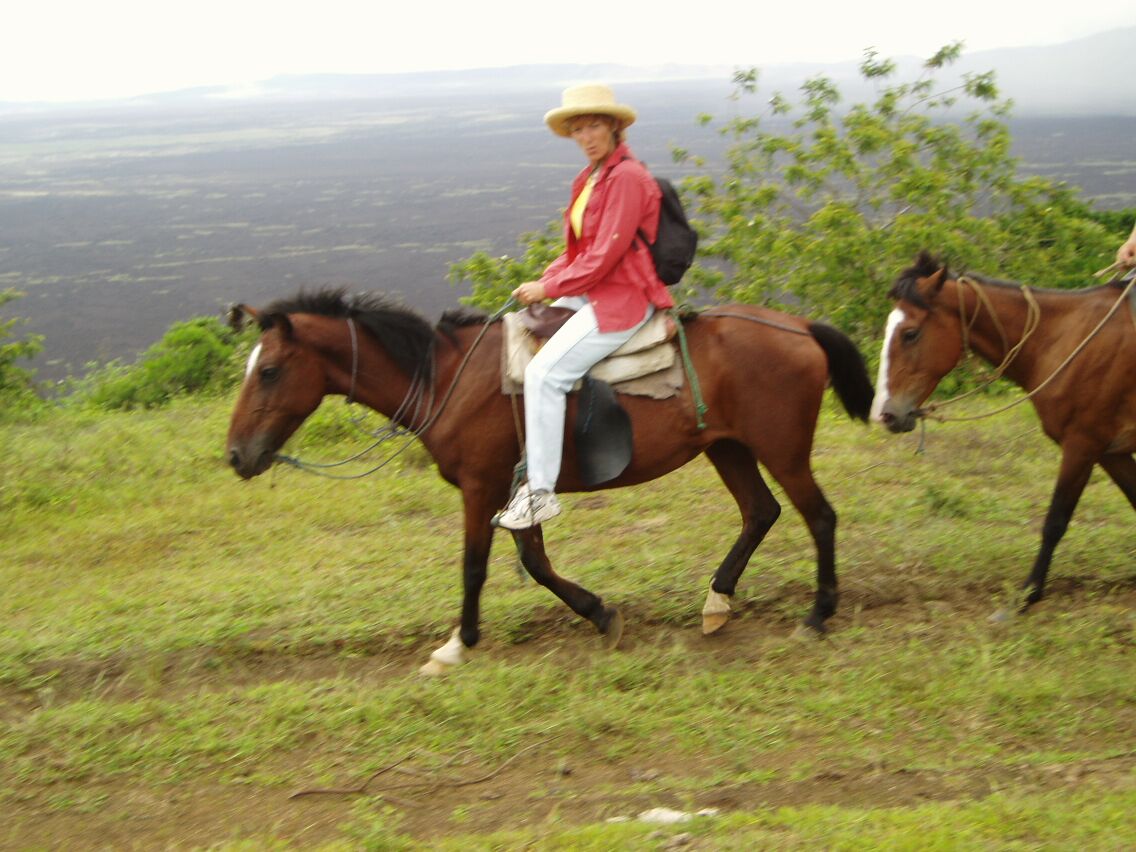
Today was a busy day. Our Swiss friends Pierre Phillipe and Kathleen from "OLLA" came over last night to help us eat our Dorado. This morning we picked them up in our dinghy for a trip to visit several volcanoes. This was a 10 hour trip of which two hours was by truck, four hours by horseback and two hours hiking over some incredibly beautiful and tortured terrain. We drove up to a ranch and
then trans-shipped to small unshod mountain ponies. Well I am assuming the latter, I saw "The Man from Snowy River." The horses seemed to know pretty much what was expected of them, which was fortunate. Annette named her's "Nibbles," due to it's tendency to graze continuously as it was walking up the trail. It was less comfortable following it, since it kept hitting it's horsey brakes and then farting. I named my horse "Purina" as a sort of gentle warning.
We traversed the rim of the immense caldera of Sierra Negra, (second largest in the world). The nearby volcano of Cerro Azul last erupted in 1998. The caldera was filled with what had obviously been an immense lava lake. We "parked" horses and continued our journey to the volcano "Chico" on foot. The terrain was covered in ash, pumice, basalt, and lava flows. Some of these dated from the previous eruption over a century ago and some of the flows were obviously quite recent. We crossed lava tubes, fumaroles issuing steam and up to the several craters of Chico. The colors were almost beyond belief with the yellows of sulfur and the reds of iron, through almost every color in the spectrum. From the summit of "Chico" we looked out over a black lava plain, with a few bright green islands of vegetation, that had avoided being toasted by the last eruption and beyond that, Elizabeth Bay and the Pacific.
We hiked downhill away from "Chico" and then back uphill on cinders towards the tethered horses. I asked Annette if she wouldn't prefer to hike back to the truck. She said she was going to kiss her horse when she found him again.
We remounted like Hollywood extras and headed back along the rim of Sierra
Negra. The view was breathtaking until the skies opened. We
haven't seen more than a couple of drops of rain since we left Houston.
We about drowned on horseback. I kept thinking of the scene from "The
Unforgiven" where Clint Eastwood just about expires. I know how he felt.
The trail turned from damp to a river. The horses were slipping,
stumbling, and sliding all over the place. I wasn't too concerned until
SOMEONE had to mention not finishing up like Superman. (Christopher
Reeves, for you uncool people, was paralyzed after a dreadful riding
accident). I was very happy to see horse central
again and switch to our freezing open air truck ride.
We had a soggy "lunch" at a resort that was on the way back to Villamil.
The barbecue was out of doors and the rain kept putting the coals out.
A really fun day and one that I would possibly like to repeat sans horses.
March 8, 2004
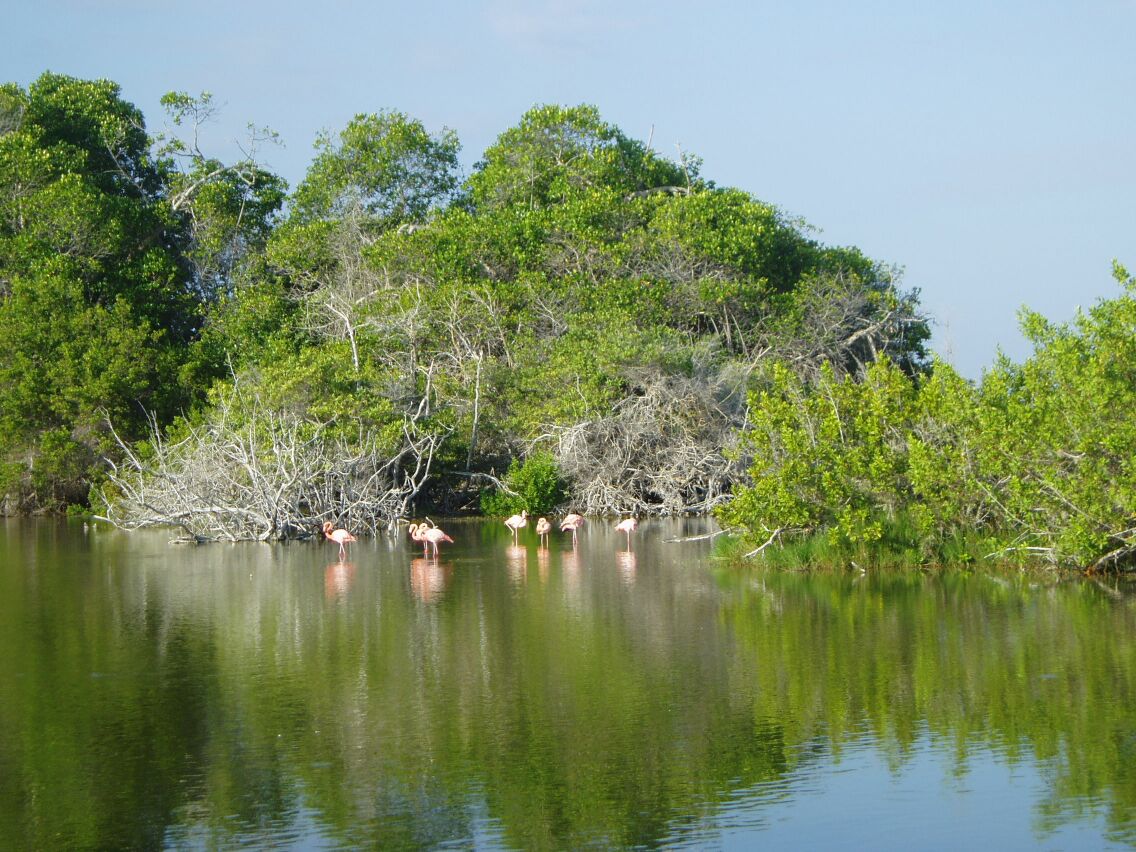
We did chores today. Changed generator oil, Racor diesel filter, water maker filters etc. All messy jobs! Then we went into Villamil touristing. Ecuador used to have a prison here and they made the prisoners build a wall to keep them out of mischief. The wall is "El Muro de las Lagrimas" and is supposed to be 10 meters high and 120 meters long. We had been told that it was a 10 minutes walk from Villamil. After ten minutes of walking along a beautiful little track along the edge of the beach, we came to a break in the mangroves opposite the beach and found a shallow lake filled with pink flamingos. We took the required photographs and continued our
hike. A little later, we came across the cemetery. Interesting - all overgrown with creepers. A strange mixture of styles. Some graves looked like Hollywood's "boot hill" - some looked more like the above ground vaults you see in Louisiana. They dated back to the 1930's. We continued our walk. Finally we came to a sign "El Muro de las Lagrimas" and an arrow indicating 5 kilometers. We were out of water, so we turned around and headed back to a bar in Villamil for a couple of beers. Next time - find a cab.
We entertained the crew of Farne on board DoodleBug and then we all left in their dinghy for the restaurant at the dinghy landing. About 10 o'clock we piled back into Farne's dinghy but the tide had gone way down. (Saw a big Eagle Ray under Farne's dinghy at the dock). We threaded our way back to our yachts by flashlight and had to keep lifting the engine to get over rocks and using the paddles. It took about 30 minutes to do what had taken about 5 minutes at high tide. We saw small flying fish lying on the surface of the water. They would "hop" when startled by the flashlight and Annette decided they were sea frogs.
March 9, 2004
S/V "Farne" left this morning for the Marquesas.
Today was a slow day. We did some more boat chores in the morning and
then hung around in the afternoon reading books (I am reading "Ahab's Wife")
since our local boat supplier had promised to deliver diesel to the boat by 3
o'clock in the afternoon. At around 4:15 he still hadn't shown, so we
headed for the dock and hired a truck to take us out to "El Muro de las
Lagrimas" (Wall of Tears). We had been told it was about 10 minutes walk
north of town. It took 20 or so minutes by truck. About a 3 hour
walk each way.
The wall was impressive. Deserted and eerie, it blocked the gap between two small pinnacles. The prison was established in 1945 and held some 50 prisoners at a time. The slabs where two large huts had been remain. There was a huge pit where the prisoners dug for rocks and then the brooding wall. Mortality rate was high and there was no wire to keep the prisoners in, since there was no where to go on the island and no fresh surface water available.
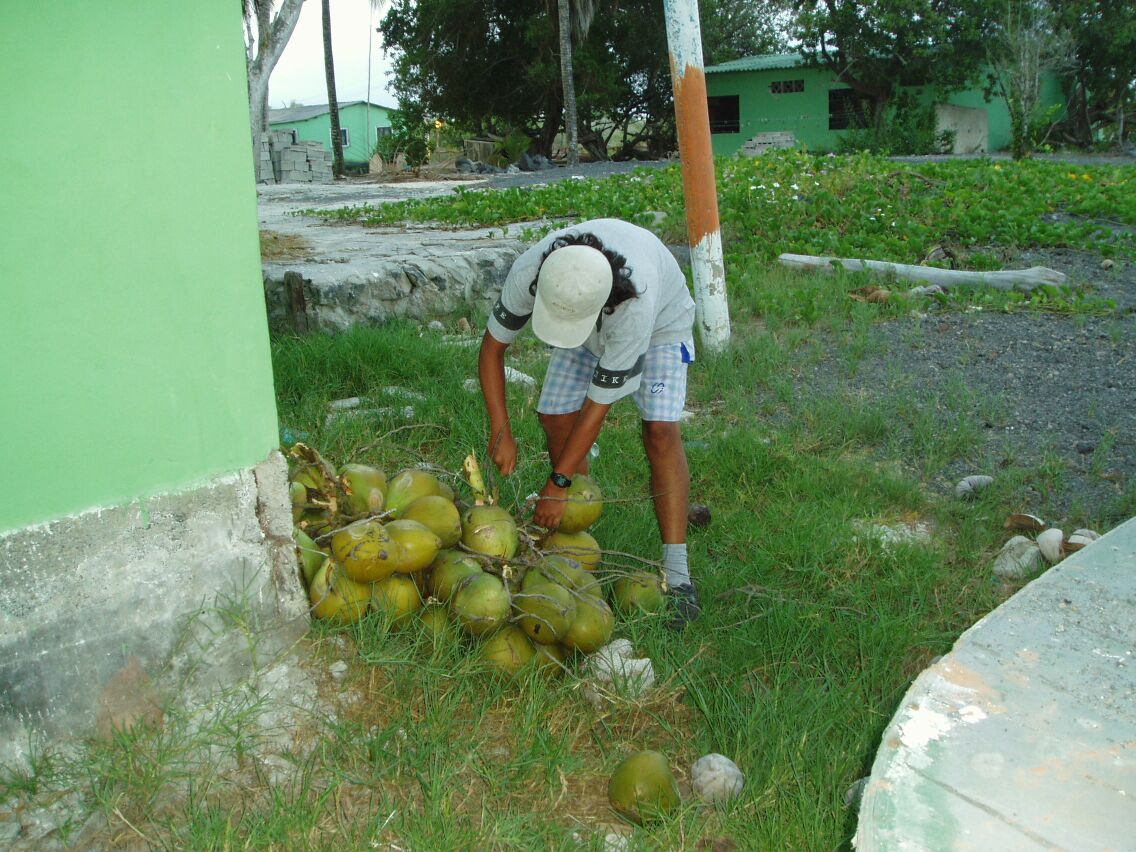
We then headed back to town to buy two coconuts for Annette (took 30 minutes -
coconut trees everywhere but no coconuts for sale!),
then back to the dock.
The diesel guy was loading his boat as we got there and took off as we watched
him. We headed after him in the dinghy, to protect him from Attila but
when we reached the boat, the diesel was aboard but he was gone.
Wednesday morning, we talked to "Farne" by SSB radio. They had no wind
at night and motored. When we spoke to them, they had 5 knots of wind.
By this time we had 10 knots where we were anchored, so maybe it was headed
towards them.
We hit the Capitania for an exit "Zarpe." No problems, 4 bucks. We
couldn't get an exit stamp for our passports because the local police station
doesn't have a stamp. They just kept repeating, "No problema."
Well, not for them, certainly.
This evening Pierre and Catherine from "OLLA" helped us celebrate Annette's
birthday with champagne and rum cake from the Cayman Islands. Pierre and
Catherine gave Annette a present of a CD of singer / poet Jaques Brel.
He (along with the painter Gaugin) are buried on the Marquesas.