


The Cook Islands
July 12, 2004
Position: 14 23.4 S 153 35.4 W
0900 hours. Our run for the past 24 hours was 165 miles with 420 miles left to go.
July 13, 2004
Position: 12 24.9 S 155 14.1 W
0900 hours. Our previous 24 hour run was 152 miles. No ships sighted, no whales, dolphins etc. just a big empty ocean. You definitely need to be self contained out here. Penrhyn used to be visited every month or so by a supply ship but today there is supposed to be weekly air service to Rarotonga. This evening at 1900 hours, the wind dropped away and we began to motor sail. After 3 hours of motoring we were sailing again with a poled Genoa, reefed main plus Mizzen with 10 knots of wind about 30 degrees off the stern. Not fast sailing but we are back on course and not burning diesel.
The most exciting occurrence all night was the rising of the moon which is waning from a "Cheshire Cat" grin down to a nail clipping.
July 14, 2004
Position: 10 52.0 S 156 31.0 W
0615 hours finds us at 10 52.0 S 156 31.0W. I expect the 24 hour run to be about 135 miles. We will then have about 130 miles to go to reach the West coast of Penrhyn. Penrhyn is an atoll rather like Ahe in the Tuamotus. It has a narrow and shallow reef pass on the West side with a lot of current if approached at the wrong time. The closest reference tide station I have is over 800 miles away and not a whole lot of use. More excitement tomorrow!
July 15, 2004
Position: 09 01.9 S 158 06.0 W
0730 hours. The faintest stirring of dawn allowed me to use the binoculars and found a wave that was not moving. We had arrived off the coast of Penrhyn and I could see the shape of the motus. Motus are low little islands that perch on top of the ringing barrier reef. A little more light and I could also make out trees. This gave a measure of relief, as we had approached to within 4 miles of the coast at night, based upon faith in GPS and the accuracy of the chart. If our arrival had been timed for earlier in the night, I would have hung around at least 10 miles to 20 miles offshore to await daylight.
I tried the radio for local information on the pass conditions and managed to raise the S/V "Lilian B". They had arrived yesterday and recommended a good sun angle to enable us to spot the coral heads as we navigate within the lagoon. They said they were boarded by 3 officials (customs, immigration, agriculture), who gave a cursory inspection of the vessel and asked if they had any DVD's on board. Apparently they wanted to borrow some for the local village "movie night" entertainment.
Our current position is 09 01.9 S 158 06.0 W. We are sailing slowly under reefed main up the coast to arrive off the reef pass at around 1000 hours.
(logged later that day...)
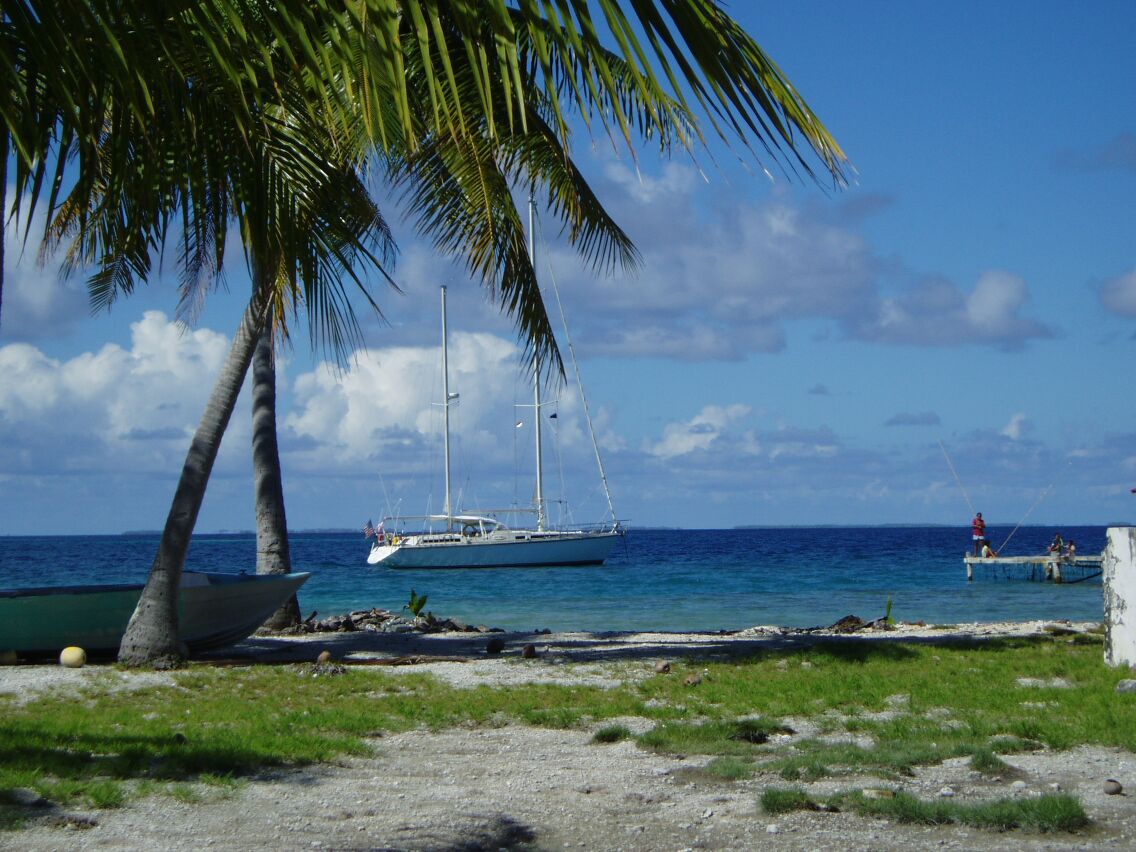
We had spoken to the "Lillian B" by radio and they had reported no current in the Penrhyn reef pass at 1200 hours yesterday. We had hung around just offshore, eating breakfast and checking e-mails until 1030 hours, when we thought the sun angle was sufficiently high to be able to spot the coral heads in the lagoon. The pass was fairly narrow and we found 4 knots of current against us. The depth went to 20 feet over the bar but nevertheless we passed safely into the lagoon to begin dodging coral heads and allow my pulse rate to slow down a little. We anchored off the main village of Omoka, which is a line of low buildings behind a white coral sand beach and decorated with coconut palms. There was little movement ashore. We began the process of extracting the dinghy and outboard from the stern locker. Before we had a chance to inflate the dinghy, a man showed up in an aluminum runabout and introduced himself as customs and immigration (Ru). We welcomed him on board and had just about completed our paperwork, when another skiff showed up with two more individuals. These represented themselves as "Agriculture" (Pah and Andrew). Everyone sat around and chatted and they asked if we had DVD's we could lend them. It was all very relaxed and friendly. Thirty minutes or so after they left, another skiff arrived. This contained "Health" (Ta Ta) plus Sam and Peter, the crew of the "Lillian B". The "Health" inspection consisted of spraying the inside of the boat for "Rhinoceros Beetle". We then asked the "Health" inspector if he was off duty so we could offer him a beer.
Finally everyone cleared off the boat and we lowered our "Q for quarantine' flag, finished lunch and took a deserved nap. We had been invited to the Lillian B for "sundowners" - but it was gray, rainy looking, blowing and not much sign of sun. Showing a little spine, we dinghied over to our neighbors for drinks. About thirty minutes later, it was quite dark and we were sitting in the cockpit of "Lillian B", when a large skiff, carrying no lights but about 8 or so large islanders, came alongside. The skiff crew included the "Customs" and "Agriculture" inspectors from the morning (Ru and Pah), returning from fishing. They passed a bucket of fish aboard, wished us "good evening" and headed off into the blackness. Ed, Sam and Peter drank beer in the cockpit while Annette cleaned fish. What emancipation proclamation? Sam managed to cook the cleaned fish and we had a wonderful supper aboard the Lillian B.
July 16, 2004
We finally rolled out of bed and headed ashore for a two mile walk to the airport. There we found "Warwick" - meteorologist, computer whiz, currency exchange guru and purveyor of beer. Warwick agreed to sell us three cases of beer and exchange some US currency for


New Zealand dollars - thereby enabling us to pay the port captain and eventually leave. He also offered to transport us and the beer back to our dinghy. While he was preparing himself for his official duties, we wandered across from the met station into a coconut grove, where the remains of 3 engines from a crashed WW II Liberator bomber have been decaying since the end of the war. We then got a tour of the runway. One of Warwick's official duties is to inspect the runway for errant coconuts, since the weekly flight from Rarotonga is due tomorrow. The runway was constructed by American forces in WW II and is 8500 feet long and still in reasonable condition. By the time we had returned to DoodleBug, the Lillian B was preparing to set sail for Hawaii. Their departure was delayed while they collected their DVD's from the local borrowers, so we fed them lunch on DoodleBug. We then took a tour of the local village and in the process, we collected the loaf of bread that Lillian B had ordered that morning and had to leave without. Thanks guys!

 We toured the local cemetery and found the rest of the crashed Liberator bomber nearby. The fourth engine and the fuselage were sitting in the dump. One man's history is another man's trash.
July 17, 2004
Although we had toured the village and I thought we were ready to visit the village on the other side of Penrhyn's lagoon, Annette had been busy trading with the villagers, swapping surplus items from the boat for local crafts. Jemima and William have a house with a landing dock next to it, where we beached our dinghy. Annette traded some towels and a thermos flask for some necklaces and 6 natural gold colored pearls. She had also agreed to trade an insulated bag and sundries for some custom made earrings and polished oyster shells from "Pa" the assistant agriculture inspector. We walked over to Pa's house but he had gone to the airport to pick up his son who was arriving on the weekly flight from Rarotonga. To pass some time until his return, we decided to walk along the beach on the ocean side of the lagoon. This is when we found out where all the pigs on the island are billeted along with all of their flies. The beach was beautiful but we were downwind from the livestock and after a game effort, we were forced to head back upwind into the village.
Pa had now returned and promised to complete the earrings Annette had "ordered" later that afternoon. This meant of course that the sun would be too low in the sky to see the many coral heads scattered about the lagoon and so we told Pa we would make the trip tomorrow. He was horrified. "You can't do that, it is Sunday". Annette asked, "Is it against the law?". He spluttered, "No.... but you just can't do that. You must come to church with us tomorrow. My wife will lend you a hat" We then received a lecture on what would constitute correct attire for church.


As we passed Jemima and William's place on the way to our dinghy, they waved us over. Several of the local men were cutting up large fish into steaks and wrapping them in transparent plastic wrap. They were throwing the fish remains into the small dock where our dinghy lay. It was then that we noticed the dock was teeming with sharks of every size. Even though the dock was only a foot or so deep, there were large lemon sharks mixing it up with a roiling mass of black tip requiem sharks. We had to wade out and launch our dinghy into this! The reader can safely assume it was exciting.
July 18, 2004
At 0920 hours we dinghied ashore, wearing shorts but with our more formal gear and shoes tucked safely into a bag. A quick change, the borrowed hat and we walked solemnly off to church with Pa and his family. The villagers were converging on the church in almost a procession form. The ladies were wearing bright colored dresses and hats of course. It looked like a drifting flower garden. We were directed to precise locations in the church to sit and I noticed that many of the men were sitting separately from their families. The singing in the church was both eerie and startling in it's beauty. The entire congregation was singing in elaborate harmonies in Maori. I believe the separation of the families was for acoustic purposes and not for any custom. The church is almost 100 years old and beautifully and simply finished inside, no crosses, pictures or statues of any kind. The London Missionary Society left their mark here with an almost puritanical society and near 100% church attendance on Sunday. The villagers don't cook on Sunday, the food is prepared the day before and Pa and his wife are deacons in the church and attend each of the four Sunday services. The church has a single door, although there were large open windows for ventilation. The latter were welcome as it was quite warm and humid and several of the men were wearing shirts with ties and suit jackets. The pulpit was above the main door of the church, with a long and steep set of stairs - almost a ladder - on either side and the church door was closed each time the congregation was in prayer and reopened when they were singing. The service began promptly with a prayer at 1000 hours with the doors closed. If you were late, there was absolutely no way of sneaking in unnoticed - you would have to wait for the doors to be opened and then walk in facing the entire congregation.


As I said above, the singing was fantastic and far exceeded the marvelous singing we had witnessed in the Marquise Islands and in Tahiti. The entire service was in Maori and I was beginning to drift, when I realized that the preacher was speaking English and addressing Annette and me. He welcomed us to their church and then blessed us and our voyage. He said "We know you will be leaving us soon but you will know there is a small island in paradise named Penrhyn, where the people there love you and will pray for the safety of your voyage and where you will always be welcome". The preacher gave a brief explanation in English of his subject today and then launched into an animated, "fire and brimstone" sermon in Maori. Some words in English popped out such as "exorcism" and I felt slightly guilty about loaning the two deacons DVD's of the uncut version of "The Exorcist" and also "The Devil's Advocate".
After the service we were invited for coffee and snacks at Pa's and we in turn invited them to visit our boat. They came after dark and it was a slightly wet ride with five of us in the dinghy and with a short chop in the water. I had printed photographs Annette had taken of their family, both after the church service and the day before. Pa's wife was near tears when we gave them to her.
July 19, 2004
Position 09 57.3 S 157 55.9 W
We prepared the boat for departure today, to visit the "other side" of the lagoon. There are two villages on Penrhyn and the village, eight miles or so away on the East side, is more remote from the airstrip, bank, post office etc. but reputed to be a much more sheltered anchorage for yachts. We needed to delay our departure until after 1000 hours to get a decent sun angle, in order to spot the many coral heads within the lagoon. (The lagoon is around 100 feet deep but every few hundred yards there is a vertical column of coral that comes within inches of the surface. You spot them by the color of the water). At 1000 hours we could not raise the anchor. The chain was jammed in deep coral at 70 feet. After trying various maneuvers with the boat pulling at different angles, I put on scuba gear and dived into water, where the visibility is not so great and where I knew there was a large shark population. I found the anchor chain problem immediately. The anchor chain led from the boat, resolutely through the middle of a coral head and out the other side. In the past I have seen chain hooked around coral, under coral, over coral etc. but never through the middle. The only way it could have got in there was below the soft sand bottom and then up under the coral. I could not budge the chain and resurfaced for tools. For my second dive, I tried to use a hammer and cold chisel to cut away the coral. It was extremely hard and shrugged off my efforts. I tried prying with a large screwdriver, again to no avail. At this depth my "no decompression" work time was only 25 minutes and I was getting nowhere.
On the surface again, I tried more violent maneuvers with the boat to see if 18 tons in motion would have a positive effect. It didn't. We relaunched the dinghy
and headed back to the village to see if we could find a commercial diver (there are still a couple of active pearl farms) with some heavy tools. We
tracked down "Ru" the Port Captain at the church. He was helping the other villagers working at replacing the plywood siding on the back of the church. I
explained the problem and asked if he knew a diver. He thought for some time and then said he would like to come out to the boat, borrow my scuba gear and look
for himself. I expressed concern about his experience using scuba gear and he said that he had worked as a commercial diver for the Ministry of Agriculture
before taking the job as Port Captain. When he arrived on board, there was already three villagers from the "other village" on board trading with Annette.
This was turning into a three ring circus! Ru dived and surfaced an anxious 10 minutes or so later. He yelled at me from the water to take up the
anchor. This we did and after another jam plus another dive, we were finally free. Ru said the problem was exactly as I had described but he had attacked it
from the anchor side of the coral head, instead of the boat side, as I had done. Annette returned Ru to
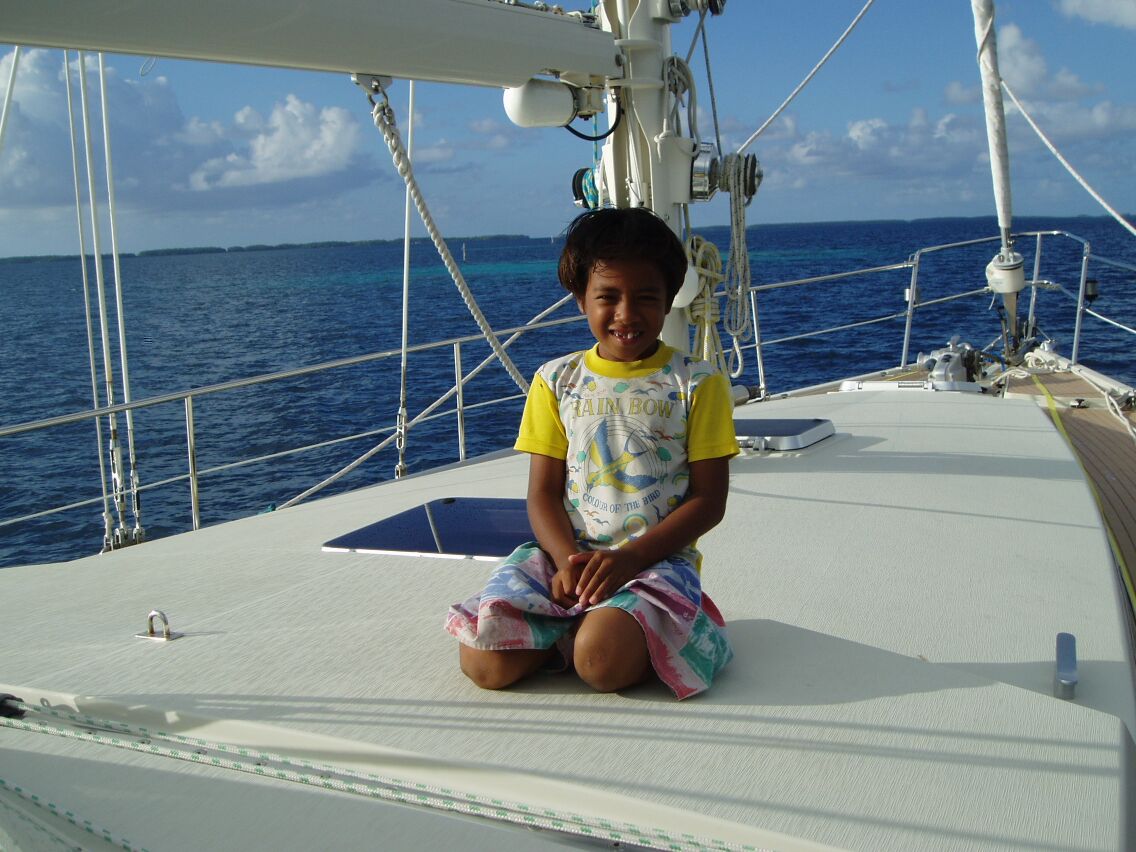 the beach, I kept "DoodleBug from running aground since we were no longer attached to the sea-bed and then Annette's traders piloted us
back to their village, expertly dodging the coral heads while we towed their dinghy. We are currently anchored at 08 57.3' S 157 55.9 W - hopefully in sand. This
church stuff really pays off. We discovered that the Port Captain "Ru" is Pa's brother.
the beach, I kept "DoodleBug from running aground since we were no longer attached to the sea-bed and then Annette's traders piloted us
back to their village, expertly dodging the coral heads while we towed their dinghy. We are currently anchored at 08 57.3' S 157 55.9 W - hopefully in sand. This
church stuff really pays off. We discovered that the Port Captain "Ru" is Pa's brother.
July 20, 2004
Yesterday was exhausting so we had an early night. The result of this was we found ourselves up at 0400 hours drinking decaf. coffee in the cockpit. There were no lights showing in the village and no moon - I was later told that they don't have enough diesel to run the village power for 24 hours a day, so they shut the generators down at 2300 hours. We lay on the mizzen deck under the starlight. As we started below to try and get some more sleep, I was enchanted to see the stars were also beneath the boat. At first glance I thought this was a reflection but I noticed the tiny lights were flashing on and off like fireflies. It was bioluminescence in the plankton in the lagoon.
At 0800 hours we were barely out of bed, when a skiff arrived with three rough looking characters. I asked how they were and they replied, "Terrible". They had been fishing all night and had caught nothing. We invited them aboard for coffee and chatted with Roy, Mike and Ben. After a few minutes it appeared that Roy is the local Pastor. Good job we didn't pour boiling oil on them or anything!


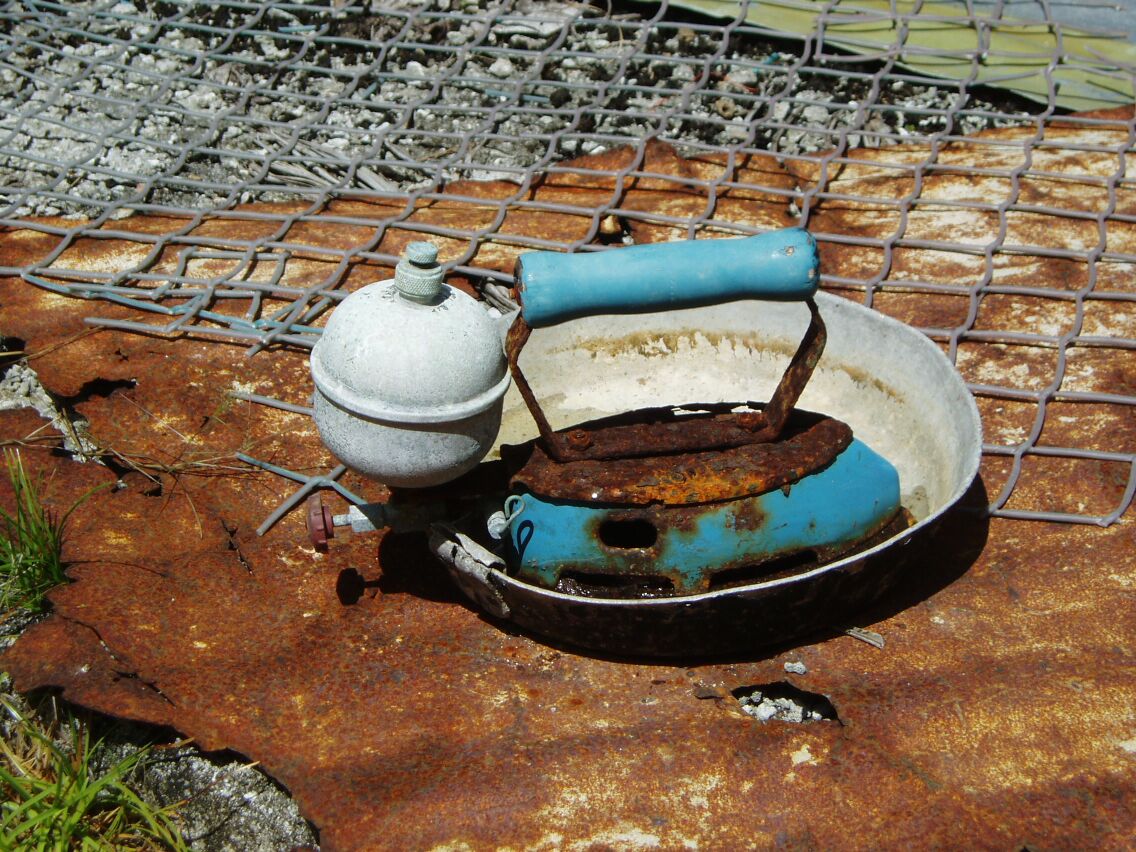
We visited the village at about 1000 hours. The sea color was a fabulous shade of light bluish green. We motored our dinghy into a small dock that contained a half dozen or so large lemon sharks. These were so close to the dock, you could have reached over and touched them. Roy had asked us to make an entry in the village yacht visitor's book. About 20 yachts per year visit Penrhyn. We picked up the book to make a later entry and then walked the length of the Motu in both directions from the village. In one direction, there were many abandoned homes. Roy had told me the population of the Motu in the 1960's was about 2,000 but is now reduced by emigration to 80 souls. Some of the abandoned homes were constructed of "modern" materials but we also found ruins of the traditional homes built from woven Pandanus leaves. Annette carefully approached the doorway of one barn looking structure and mutually startled a large pig. It flew out one end of the building while Annette did the same at the other end.




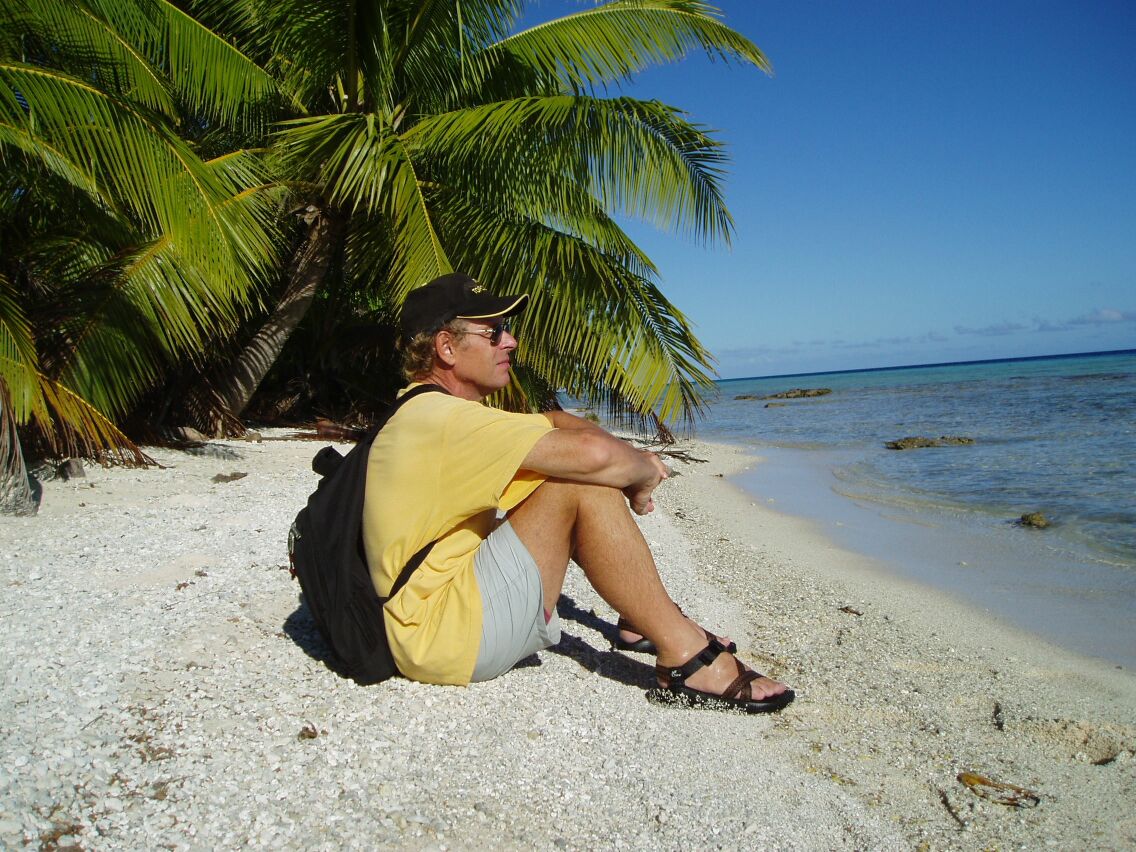
We walked back through the village and explored the motu in the other direction. This was uninhabited but there was a white coral sand beach with an extensive shallow coral shelf extending from the beach. Annette paddled out into the shallows while I took pictures of the pair of black-tip sharks that came over to investigate. Annette watched them carefully but stayed in the water because, as she put it, "they were little and I thought I could stomp the shit out of them if they tried anything."
Roy had invited us to lunch at the Sunday School building which the villagers were in the process of renovating. Lunch was a communal pot-luck affair and Annette's favorite was a type of fried pancake made from the interior of a coconut that had been allowed to form shoots. When opened, the coconut contains a white spongy mass that is dried, grated, mixed with flour and then deep fried. Delicious!
Roy then gave us a tour of the church. From the outside it is very plain and stark white. The inside woodwork was rich and magnificent. The wood to build the church had been sent from England but I cannot identify it. Roy showed us the large brass bell used to call the faithful to service. The shackle, chain and support holding the bell up, were almost completely corroded through and Roy said he was afraid they will lose a deacon someday when the bell drops on his head. I donated a large stainless steel shackle from my boat spares to save the life of an unknown bell-ringer.


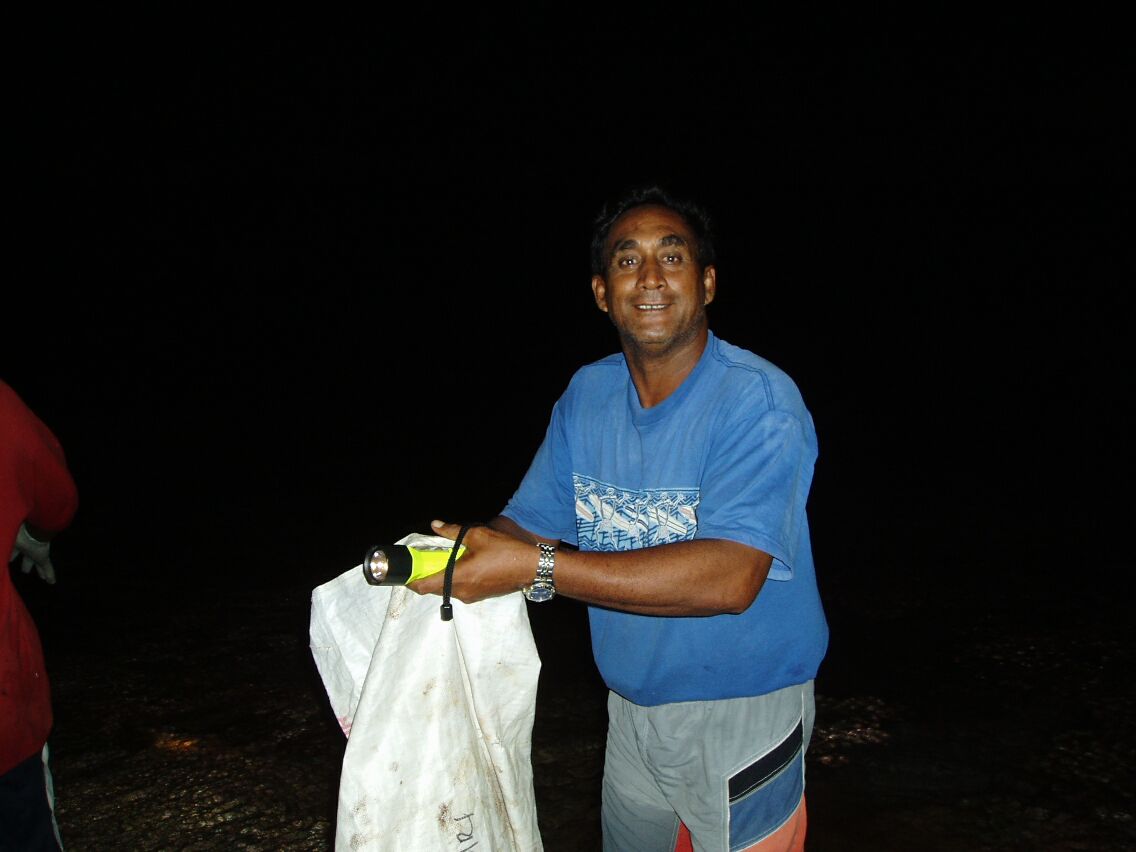
Before heading back to the boat, we visited one of Roy's deacons who had burned his foot in an accident. The man had been using a grinding wheel to cut a fuel drum that he had partially filled with water. The burn was gruesome. The man had refused to be evacuated to the infirmary at the main village of Omoka. The nurse there had sent ointment and when we checked our medical kit, the only burn treatment we have on board is the same ointment. There was a little elderly lady at the same house and she called me over. She said her knee hurt and she couldn't even walk to the bathroom. (A playful grandson had thrown a coconut and hit her in the knee) I explained that I was not a doctor but the statement seemed to have no effect on her. I found some ibuprofen on the boat and sent this back with Roy. We arrived at the boat and Annette had two young maidens as visitors while I sat in the cockpit entertaining Roy. The girls below wanted to trade strings of shells made into necklaces, for popcorn and "Wild Turkey" bourbon. Annette made a batch of popcorn, which she shared with the intellectuals in the cockpit, whilst she negotiated with the girls. We don't carry bourbon, so she offered them some Johnny Walker, Red Label. They tried it and it soon became apparent that neither of them had ever tried spirits before. They asked to try tequila which produced similar facial grimaces. Eventually they concluded the trade for popcorn and small jewelry boxes as the girls lacked the chutzpah to attempt to smuggle their whisky past their pastor in the cockpit. Around 2000 hours a boat showed up with Saitu driving and Tumukahu our lobster hunting expert aboard. Tumukahu, Roy, Annette and I were dropped off on the edge of the reef at low tide, with just a thin sliver of moon. The waves were still breaking over the reef but most of the time we were calf deep in water and only occasionally wading waist deep. We were walking along the top of a live reef in blackness, with all sorts of things moving, growing, crunching underfoot, swimming away etc. There was just too much to look at. We had flashlights and searched for the lobsters by the reflection in their eyes. Tumukahu caught the first lobster and I caught the second. It was obvious by the way Roy kept saying, "How did you do that? How did you do that?", that his primary role on these trips is to carry the catch bag. I was excited to have caught my first lobster ever and it was my only catch of the night. Tumukahu caught another 4 bringing our total to 6. Even though we did not catch anything else ourselves, just to walk / wade the two miles or so along the top of a coral reef by starlight, with the warm Pacific waters washing over our legs, while we hunted for anything and everything was an experience not to be missed. We had our flashlights and I wisely didn't mention to Annette the shark that was swimming behind her as she played with the shells, crabs, hermit crabs, sea urchins, sea cucumbers etc. etc.
When we arrived back at the villager, it was nearing midnight but Tumukahu insisted we had to cook the lobsters. This was performed on board DoodleBug and it took a full two glasses of Chardonnay for Annette to be able to watch the maestro cooking and cleaning the catch. Dinner was delicious and at 0200 hours we finally parted with our guests and went to bed.



July 21, 2004
More visitors showed up at 0800 hours at DoodleBug for trading. This was beginning to get really tiring. We finished making our entry in the yacht visitors log book, deposited same on shore, said our farewells and headed back the 7 miles to Omoka across the lagoon. Pastor Roy had asked for a ride and we were towing his boat behind DoodleBug. (He had been invited to judge the children's singing competition in Omoka that evening).


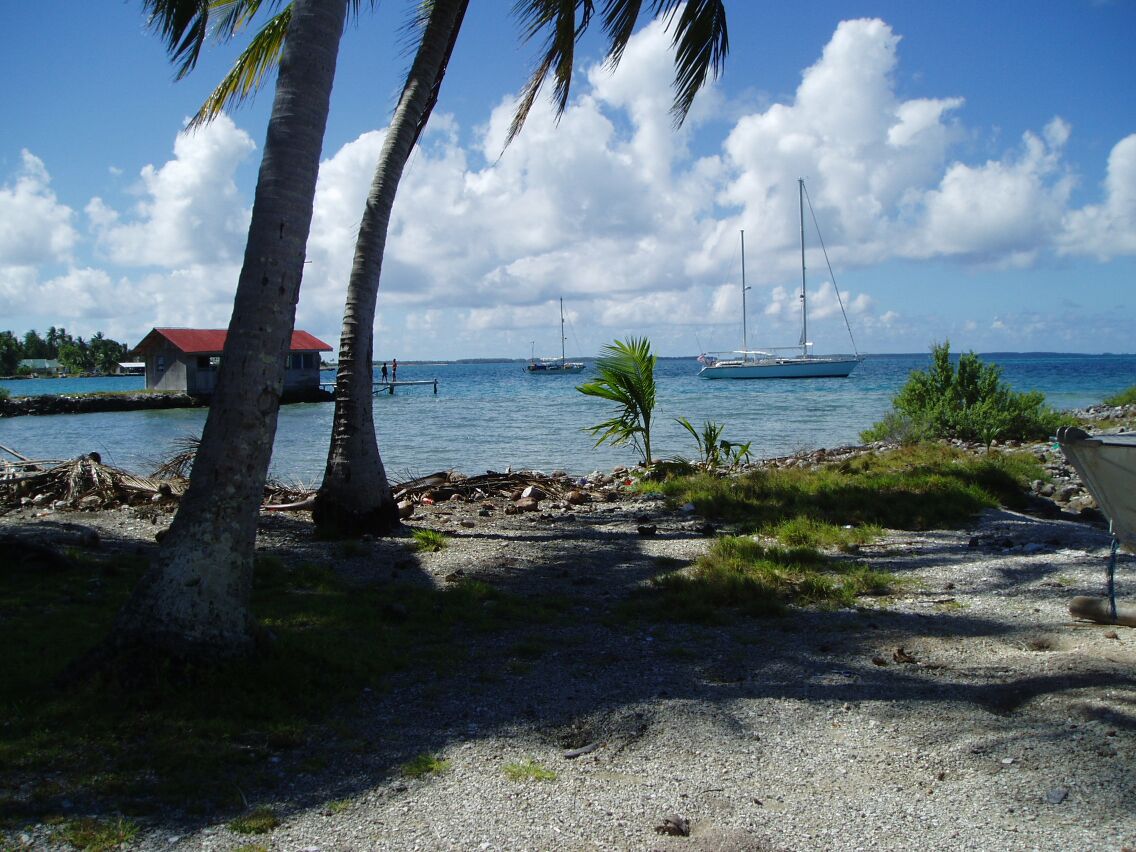
As we approached Omoka, I noticed some shallow spots where I didn't expect any and slammed the throttle into full reverse. DoodleBug stopped about 20 feet short of a large coral head. I had been talking to Roy and he had been giving general directions of the route between the coral heads. It became very obvious to me at that moment, that Roy's skills lay in the pulpit and not with either lobster catching or navigating. We proceeded very carefully thereafter, with both Annette and Roy keeping watch from the bow. As we arrived at the anchorage off the Omoka village, an American vessel the S/V "Jatimo" from Santa Cruz, California, was also approaching the anchorage. The crew, Jan and Ramona visited us on DoodleBug for "sundowners" that evening.
July 22, 2004
 This morning we collected our departure documents from the Port captain, Ru, Annette made a couple of last minute trades and we
raised anchor without problems at 1130 hours. By 1215 hours we transited the pass back into the Pacific, with only a couple of knots of current against
us. We then broad reached under Genoa, Main, Mizzen Spinnaker and Mizzen sails for Suwarrow (Suvarov) some 400 miles away to the Southwest.
This morning we collected our departure documents from the Port captain, Ru, Annette made a couple of last minute trades and we
raised anchor without problems at 1130 hours. By 1215 hours we transited the pass back into the Pacific, with only a couple of knots of current against
us. We then broad reached under Genoa, Main, Mizzen Spinnaker and Mizzen sails for Suwarrow (Suvarov) some 400 miles away to the Southwest.
July 23, 2004
Position 10 10.2 S 159 28.6 W
0745 hours. We are at sea heading for Suwarrow atoll. We have about 280 miles or two days to go. Annette has a cold (hugging too many diseased people), otherwise everything fine. Details on great lobster hunt to follow.
July 24, 2004
Position: 12 02.2 S 161 40.6 W
0740 hours. We have spent our second night at sea and are now 110 miles from Suwarrow. This means we can't arrive in daylight today. We will probably hang around all night until dawn tomorrow. We are concerned about the weather. You need calm, "stable trade wind" conditions to enter Suwarrow as it is a difficult and dangerous atoll. Many boats have been lost there. Last night was uncomfortable with frequent squalls, wind changes and choppy short seas of 6 feet or more. The morning dawns with towering purple cumulus to the East. We are reefed down but still moving at over 8.5 knots. More cups of coffee needed and careful attention to the weather reports if we can get them.
July 25, 2004
Position: 13 02.8 S 163 03.6 W
0730 hours. We have spent all night heaved to about 15 miles from Suwarrow (Suvarov) waiting for daylight. The boat had a very uncomfortable rocking motion and Annette says she now knows how a seagull feels like, sitting on a buoy. We will check the entry pass conditions and if OK will try to enter the lagoon at 1000 hours when the sun angle is good enough to spot the coral heads.
July 26, 2004
Position 13 14.8 S 163 06.5 W
0700 hours. Yesterday morning we were heaved to waiting until after 1000 hours for good light for the lagoon passage. At around 0900 hours the wind and seas began to build and a very large rainstorm lay upwind of us. I checked the tide tables for Suwarrow and saw that low water - and presumably low current in the pass - was in about 20 minutes time, so we fired up the engine and ran for the pass. As these things usually work out, the conditions in the pass were better than expected and the electronic chart we were using, appeared to be quite accurate. Our entry into the lagoon therefore became reasonably straightforward. The cruising guide had warned not to attempt to enter the pass except in the "calmest of conditions" and also reported that the island lay about one mile east of it's charted position. Fortunately for us, none of this was true.


The lagoon was calm and contained another seven yachts at anchor. One of these was a Dutch vessel and as they were leaving, we slid into their spot and anchored. That evening we were invited ashore for a pot-luck supper where the hosts (the government caretaker "Papa John - sorry, no pizza) provided a table busting quantity of coconut-crab, tuna, coconut cakes and coconut beer (see a trend here?). We had an enjoyable time chatting with the other cruisers before heading back to DoodleBug and gratefully diving into a bed that had stopped moving.


(logged later that day)
This morning we headed ashore with our yacht registration paperwork to "check in" with "Papa John", the Cook Island national park administrator, who lives here with one assistant "Baker" and Papa John's grandson "Toto". Papa John was not to be found. Toto said he was sick with the flu. We uncharitably concluded that this was "Johnny Walker Red Label flu", as Annette had given him a gift of a bottle of the same, the previous evening. We wandered at loose around the atoll, waded the lagoon and generally messed around, while Toto hid in the bushes, occasionally throwing coconuts behind Annette so she would jump. This she usually did in a truly gratifying manner. Toto told us he is 16 but "finished" with school. He has refused to go there and he described how he yells at his Aunt and goes drinking whenever he feels like it. It did not seem to occur to him that there might be a connection between his self described behavior and the fact that he is now marooned for six months on a isolated atoll with his grandfather.
Suwarrow has an unusual history. During WW II New Zealand stationed coast watchers here. In 1942 a hurricane washed 4 meter waves across the island and the residents survived by tying themselves to the top of a large coconut tree. From 1952 until his death in 1977, a New Zealander Tom Neale lived here in isolation. He wrote a book "An Island to Oneself" about his experiences. As I indicated above, the island has now been designated a national park of the Cook Islands.
This evening, what began as a casual "sundowner", turned into an impromptu dinner aboard DoodleBug with Alan from "S/V Imagine" and Tammy, Dan and Cordy from "S/V Anjoli". (Pork tenderloin and bowtie pasta with sundried tomatoes, bacon and parmesan cheese, plus excessive amounts of Chardonnay).



July 27, 2004
A lazy day spent setting up navigation for the next leg of the journey, trying to get a weather forecast etc. Papa John came back to life and hosted another pot-luck party ashore, where he again provided immense quantities of coconut crabs, tuna, coconut cakes etc. We provided (well...Annette did) Tex-Mex style bean dip with Doritos and Jalapenos. This was a big hit with the three other American boats but the Belgians, Germans, and Italians were at first a little puzzled but nevertheless helped polish it off. Papa John seemed none the worse for wear and he and Baker entertained the group with songs and dances accompanied by Papa John's guitar. The wind started to increase in intensity during the late evening and at around 1100 hours, the anchor alarm went off, to indicate we might be dragging. The anchor alarm uses the GPS (Geostationary Satellite Positioning System). When the GPS shows that we have moved more than it's current setting of 0.03 nautical miles (about 200 feet), it sounds a very loud alarm. The boat is anchored with 200 feet of chain deployed and so it will swing and change position a little, as the wind changes direction. We have coral within a couple of hundred feet on three sides of us, so we spent an anxious hour or so, monitoring our movement before heading back to bed for a restless night.
July 28, 2004
The wind increased today and three more boats arrived at the anchorage. I decided that I would be able to sleep a little better if I had a second anchor deployed. Annette and I accomplished this from the dinghy, as we were surreptitiously watched by most of the "Suwarrow Fleet". - Sometimes you watch the show...sometimes you are the show. The strong wind was accompanied by squalls and rain all day so I inventoried the spare parts, Annette began to inventory the food and in between we watched movies. Kurt and Nancy from "S/V Gumbo Ya-Ya" joined us for supper.
July 29, 2004
The wind still blowing strong but a little less rain. We finally drug ourselves out of our cocoon and motored the dinghy over to visit a


 nearby motu. There were thousands of birds nesting there and they were not all pleased to see us. We poked around looking for shells
and "stuff" before heading over to "town" to officially check in and out of Suwarrow. We filled out the usual forms about how many dead rats we had found
on board - really! and stamped our own passports. If the weather forecast holds, we plan on leaving tomorrow for American Samoa. This is a run of around
420 miles. My route showed us passing between two objects which the chart describes as "Volcanic activity reported 2002". Sounds like even more excitement!
nearby motu. There were thousands of birds nesting there and they were not all pleased to see us. We poked around looking for shells
and "stuff" before heading over to "town" to officially check in and out of Suwarrow. We filled out the usual forms about how many dead rats we had found
on board - really! and stamped our own passports. If the weather forecast holds, we plan on leaving tomorrow for American Samoa. This is a run of around
420 miles. My route showed us passing between two objects which the chart describes as "Volcanic activity reported 2002". Sounds like even more excitement!
